
MINISFORUM 895D7
Published on

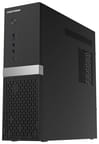
The MINISFORUM 895D7 is a small upright desktop for 1440p gaming and creative work, with a slot for a low-profile graphics card. It runs AMD’s 16-core Ryzen 9 8945HX laptop chip at up to 100W, and MINISFORUM sells it with a low-profile Radeon RX 9060 XT 16GB, a low-profile GeForce RTX 5060 8GB, or no card at all. In ETA PRIME’s tests the RX 9060 XT version held 1440p in current games without throttling. The slot takes low-profile cards only, and the port list has no USB4 or Thunderbolt.
Each graphics option comes as a barebone or with 32GB of DDR5 and a 1TB SSD, which makes six configurations. The same 8.47-liter case with an Intel Core i9-13900HX board is sold as the MINISFORUM 139D7.
Pros and cons
| Pros | Cons |
|---|---|
| 16 cores and 32 threads held at 100W in ETA PRIME’s sustained CPU test | The Ryzen 9 8945HX is a Zen 4 chip, a generation behind AMD’s Zen 5 HX parts |
| Choice of a low-profile RX 9060 XT 16GB or RTX 5060 8GB, or no card | The x16 slot only fits low-profile cards |
| PCIe 5.0 x16 slot with an internal 8-pin power lead | No USB4, Thunderbolt, or OCuLink |
| Internal 400W supply, so there is no external power brick | One 2.5GbE port and no second network jack |
| Two SO-DIMM slots up to 96GB and two PCIe 4.0 M.2 slots | Front USB-C runs at 5Gbps one way up and USB 2.0 the other |
| Wi-Fi 7 and Bluetooth 5.4 | Much larger than a palm-sized mini PC at 12.3 x 11.5 x 3.7 inches |
Related Videos
MINISFORUM 895D7 Comparison Chart
6 configurations
| Configuration | RAM | Storage | GPU | Performance | List price | Amazon price | Compare |
|---|---|---|---|---|---|---|---|
| 32GB/1TB/RX 9060 XT | 32 GB | 1 TB SSD | Dedicated AMD Radeon RX 9060 XT | 7.7 | $1,639.00 | Loading... | Details
|
| Barebone/RX 9060 XT | None | None | Dedicated AMD Radeon RX 9060 XT | 7.3 | $1,119.00 | Loading... | Details
|
| 32GB/1TB/RTX 5060 | 32 GB | 1 TB SSD | Dedicated NVIDIA GeForce RTX 5060 | 7.7 | $1,559.00 | Loading... | Details
|
| Barebone/RTX 5060 | None | None | Dedicated NVIDIA GeForce RTX 5060 | 7.3 | $999.00 | Loading... | Details
|
| 32GB/1TB/Radeon 610M | 32 GB | 1 TB SSD | AMD Radeon 610M | 7.7 | $1,079.00 | Loading... | Details
|
| Barebone/Radeon 610M | None | None | AMD Radeon 610M | 7.3 | $495.00 | Loading... | Details
|
Specs shared by every configuration
| Processor | Sixteen-core 2.50 Ghz (max 5.40 Ghz) AMD Ryzen 9 8945HX |
|---|---|
| Dimensions width x length x thickness | 12.28 x 11.5 x 3.66 inches (311.91 x 292.1 x 92.96 mm) |
| WiFi | Wi-Fi 7 (802.11be) |
| Bluetooth | Bluetooth 5.4 |
| Ethernet | 1 Ethernet port at 2.5 Gbps |
| VGA | No VGA Ports |
| USB Ports | 2 USB 2.0, 3 USB 3, 2 USB-C Rear USB-C 10Gbps with DP; front USB-C 5Gbps |
| Thunderbolt Ports | No |
| OCuLink | No |
| Internal SATA Ports | No SATA ports |
| Card Reader | No Card Reader |
| Headphone Jack | front |
| Fanless | No |
| VESA Mount | No |
| In the Box | Main unit, power cord, Wi-Fi antennas, graphics card air-sealing foam, screws, manual |
| Expandability | Two DDR5 SO-DIMM slots (96GB max), two M.2 2280 slots, PCIe 5.0 x16 slot for low-profile cards up to 145W. Internal 400W supply. |
Related Mini PCs
-
 MINISFORUM 139D7An 8.5-liter upright desktop with a 24-core Core i9-13900HX, a PCIe 5.0 x16 slot, and an internal…
-
 ASUS ROG GR70The ASUS ROG GR70 packs an AMD Ryzen 9 9955HX3D with 3D V-Cache and an NVIDIA GeForce RTX 5070…
-
 ASUS ROG NUC 16The ASUS ROG NUC 16 packs a refreshed Intel Core Ultra 9 290HX Plus and an NVIDIA RTX 5080 or RTX…
-
 MINISFORUM MS-02 UltraThe MINISFORUM MS-02 Ultra is a 4.8-liter box sold with an Intel Core Ultra 9 285HX or 275HX (or a…
-
 ACEMAGIC G3AA 3.5-liter workstation with a socketed desktop Core i9-13900F and a low-profile NVIDIA RTX 2000…
-
 BOSGAME VTA-439The BOSGAME VTA-439 pairs AMD's Ryzen AI 9 HX 470 (Gorgon Point) with Radeon 890M graphics in a…
16 Zen 4 cores at 100W

The Ryzen 9 8945HX has 16 Zen 4 cores, 32 threads, a 2.5GHz base clock, and a 5.4GHz boost, and it scores about 51,600 on PassMark’s CPU Mark. That puts it ahead of the Core i9-13900HX in the 139D7, which sits near 41,400. It shares its core count and clock range with AMD’s Ryzen 9 7945HX from 2023, and AMD’s Zen 5 Ryzen 9 9955HX scores a little higher at about 55,800. The chip has no neural processing unit, and its Radeon 610M graphics are only for display output and light work.
MINISFORUM runs the processor at 100W in its balanced mode. Memory sits in two DDR5 SO-DIMM slots at up to 5200 MT/s with a 96GB ceiling, and storage goes in two M.2 2280 PCIe 4.0 slots that take up to 4TB each. The configured models ship with 32GB, a 1TB SSD, and Windows 11; the barebones ship with no memory, storage, or operating system.
The CPU cooler uses a phase change thermal pad and a 3500 RPM blower fan. MINISFORUM rates the noise at 26.4dB at idle and 44.1dB at full load in the balanced mode, measured at 50cm in its own anechoic room.
Two low-profile graphics cards on a PCIe 5.0 slot
The Radeon RX 9060 XT in the AMD graphics configurations is an RDNA 4 card with 16GB of GDDR6, rated by MINISFORUM at 140W. The GeForce RTX 5060 in the NVIDIA configurations has 8GB of GDDR7 and a 145W rating. On PassMark’s G3D Mark the desktop versions of the two cards land close together, about 20,100 for the RX 9060 XT and 20,700 for the RTX 5060. The RX 9060 XT’s extra memory matters in games that fill more than 8GB at high settings and for local AI models that run on the GPU.
Both cards sit in a PCIe 5.0 x16 slot fed by an 8-pin connector from the internal 400W supply. MINISFORUM rates the slot for dual-slot, low-profile cards up to 145W, so full-height cards do not fit. A foam strip in the box seals the gap around the card so it draws air from the side panel. The Radeon 610M configurations leave the slot empty: a buyer can start with the onboard graphics and add a low-profile card later, and the slot also takes network or storage cards.
Case, ports, and wireless

The case measures about 12.3 x 11.5 x 3.7 inches and stands upright. MINISFORUM lists 8.4 pounds with the RTX 5060 and 8.5 pounds with the RX 9060 XT. The front panel holds the power button, a 5Gbps USB-A port, a USB-C port, and headphone and microphone jacks. That front USB-C port runs at 5Gbps with the plug one way up and at USB 2.0 speed when it is flipped. The rear holds two more 5Gbps USB-A ports, two USB 2.0 ports, a 10Gbps USB-C port with DisplayPort output, a 2.5GbE port on a Realtek RTL8125 controller, line in, line out, and a microphone jack.
The board has its own HDMI 2.1 and DisplayPort 1.4 outputs plus the rear USB-C, which drive three displays in the Radeon 610M configurations. The RX 9060 XT adds HDMI 2.1, DisplayPort 2.1, and DisplayPort 1.4 on the card. The RTX 5060 adds HDMI 2.1, two DisplayPort 2.1 outputs, and a DisplayPort 1.4.
Wireless is a MediaTek MT7925 module with Wi-Fi 7 and Bluetooth 5.4, with antennas in the box. There is no USB4, Thunderbolt, or OCuLink port, so fast external drives and external GPU docks are out, and the single Ethernet port rules out router or firewall duty without an add-in card.
Reviewer Insights
ETA PRIME
ETA PRIME tested the RX 9060 XT version in Windows 11. His unit had a single 16GB stick and a 512GB SSD, a configuration MINISFORUM does not sell in the US, where the configured models ship with 32GB. In a two-minute CPU-Z stress test the processor held 100W, and FurMark showed the card at its 140W limit. He measured 2,537 single-core and 15,389 multi-core in Geekbench and 14,501 in 3DMark Time Spy. At native resolution with no upscaling, Cyberpunk 2077 at the ultra preset averaged 92 FPS at 1080p, 68 at 1440p, and 34 at 4K, and Horizon Zero Dawn Remastered at very high averaged 113, 84, and 40. Forza Horizon 6 at 1440p extreme used more than 12GB of graphics memory, and he said “this is really what kind of holds back something like the RTX 5060.”
Across his gaming session the GPU averaged 63°C with a 72°C peak, and the CPU averaged 78°C with an 83°C peak at an average of 85.1W, with no thermal throttling. “I actually was expecting this thing to be a lot louder than it is,” he said, crediting the foam ducts that pull fresh air from the side panel. On looks: “It definitely looks plain Jane, kind of a little sleeper PC.”
In a second video he installed SteamOS on the same unit. He turned off Secure Boot and the Radeon 610M in the BIOS, because some games picked the integrated graphics over the card. SteamOS has no performance controls for this machine: “we don’t have any TDP control or GPU clock control. It’s because everything’s just going to be controlled from the BIOS.” Against Valve’s Steam Machine at the highest presets with no upscaling, Cyberpunk 2077 averaged 106, 65, and 28 FPS at 1080p, 1440p, and 4K to the Steam Machine’s 74, 45, and 19, and he put the average gain across three games at almost 55%. Spider-Man 2 and Hogwarts Legacy needed FSR to hold 60 FPS in SteamOS, which he said they did not need in Windows.
Miyconst
Miyconst reviewed a European unit with the Radeon 610M and no graphics card. It came with a single 16GB DDR5 stick and a no-name 512GB SSD. He spent about a week with it and tested the board out of the case as well. With an RTX 5070 Ti in the x16 slot he confirmed PCIe 5.0: “It works at full speed and all 16 lanes.” Splitting the slot for M.2 drives was less successful. With an x8/x4/x4 adapter only one of the two SSDs worked, even with the slot forced down to PCIe 3.0, and he suggested a splitter with active power delivery or a signal repeater instead. Both onboard M.2 slots ran PCIe 3.0 and 4.0 drives without issues. The rear USB-C port measured almost 1,000 MB/s and the front one about 500 MB/s. There are no SATA ports on the board, although the power supply has two SATA power leads.
In a Cinebench R23 stress test the CPU peaked at about 76°C with peak power of about 140W, and the whole system idled at 40 to 45W. He found the stock 92mm CPU fan audible when it speeds up or slows down on a desk near your ears, and added that under a desk “I don’t think you will notice it whatsoever.” The power supply also heats up, and its fan can be “a bit annoying,” so for rendering or video editing he recommended adding an 80mm intake fan. Sleep, Wake-on-LAN (wired only), restore on power loss, TPM, and Secure Boot all worked. Adding a second 16GB stick and running both at DDR5-5600 raised his Geekbench multi-core score from about 14,900 to more than 20,000, while Cinebench R23 multi-core stayed near 31,000 either way. Ryzen Master and ThrottleStop would not run, so CPU tuning is limited to the BIOS.
His unit arrived with a broken clip on the plastic front cover, and one of the expansion slot screws had been tightened hard enough to strip its thread. He said this shows “Minis Forum paying less attention to details compared to some fancy brands like I don’t know maybe like Dell or HP.” On the other side, every part except the soldered CPU is standard: a mini-ITX board, standard power supply connectors, and SO-DIMM memory, so the board can move to another mini-ITX case later. His verdict: “If this system fits your needs, I can recommend it.”
Conclusion
The 895D7 is worth buying for someone who wants a 1440p gaming and rendering machine on a desk with no room for a tower, and our pick is the RX 9060 XT barebone. Its 16GB card had headroom where ETA PRIME saw Forza Horizon 6 pass 12GB, and the barebones cost several hundred dollars less than the configured models, which suits anyone with spare DDR5 SO-DIMMs, an NVMe drive, and a Windows license. The RTX 5060 versions cost less and make sense when a program needs CUDA, and the Radeon 610M barebone is the cheapest way into the case for a buyer who already owns a low-profile card.
Skip it if you need USB4, Thunderbolt, OCuLink, or a second network port, or if your graphics card is full height. For 5GbE in a 3.8-liter tower, the MINISFORUM AtomMan G1 Pro has the same Ryzen 9 8945HX and an RTX 5060. The MINISFORUM 139D7 is this case with a 24-core Intel Core i9-13900HX, and the MINISFORUM 795S7 is a 7-liter case with a Ryzen 9 7945HX and no wireless card. Compare other boxes that take a graphics card in our Mini PC Comparison Chart.
Frequently Asked Questions
What is the difference between the MINISFORUM 895D7 and the 139D7?
The 895D7 has a 16-core AMD Ryzen 9 8945HX and the 139D7 a 24-core Intel Core i9-13900HX. Both use the same 8.47-liter case, PCIe 5.0 x16 slot, and 400W supply. Despite fewer cores, the AMD chip scores about a quarter higher on PassMark’s CPU Mark. The 895D7 is also sold with an RTX 5060, which the 139D7 is not.
Should I pick the RX 9060 XT or the RTX 5060 version of the 895D7?
The RX 9060 XT is our pick, for its 16GB of graphics memory against the RTX 5060’s 8GB; the two cards score close together on PassMark’s G3D Mark. The RTX 5060 versions list for $80 to $120 less, add a second DisplayPort 2.1 output, and run CUDA software.
Can I install a full-size graphics card in the MINISFORUM 895D7?
No. The PCIe 5.0 x16 slot fits dual-slot, low-profile cards that draw up to 145W. The internal supply provides an 8-pin power connector.
How much memory does the MINISFORUM 895D7 take?
Up to 96GB of DDR5 in two SO-DIMM slots, at speeds up to 5200 MT/s. US models ship with 32GB or as barebones with no memory.
Does the MINISFORUM 895D7 run SteamOS?
Yes. ETA PRIME installed SteamOS on the RX 9060 XT version from Valve’s recovery image, with Secure Boot and the integrated Radeon 610M turned off in the BIOS. Power limits and GPU clocks are set in the BIOS, not in SteamOS.
Does the MINISFORUM 895D7 need an external power adapter?
No. A 400W supply sits inside the case and takes a standard AC power cord, which ships in the box. It accepts 100 to 240 volts.