
HP EliteDesk 8 Mini G1i
Published on

The HP EliteDesk 8 Mini G1i is HP’s Arrow Lake-S entry in the 1-liter business desktop class, and it moves the platform well past the Elite Mini 800 G9. Where the 800 G9 topped out at Wi-Fi 6, Gigabit Ethernet, DisplayPort 1.4, and two M.2 slots, the G1i ships with Wi-Fi 7, Bluetooth 5.4, two DisplayPort 2.1 outputs, a rear Thunderbolt 4 port that also accepts 100W power in, and three M.2 2280 PCIe Gen4 slots inside a chassis that still weighs under three pounds. The processors are the 35W “T” versions of Intel’s Core Ultra 200S desktop line (Core Ultra 5 235T and Core Ultra 7 265T on this page), each paired with a 13 TOPS NPU and the business-grade Q870 chipset. HP’s own datasheet and support specifications are the sources for that loadout, and NotebookCheck’s announcement coverage from March 2025 lists the same rear I/O, the same three storage slots, and the Q870 chipset.
This is a fleet product sold through business channels, so what you pay depends heavily on which reseller you buy from, and identical configurations can sit hundreds of dollars apart between an Amazon third-party seller and a corporate storefront. It also still ships Gigabit Ethernet on the vPro configurations rather than the 2.5GbE that consumer mini PCs in this price band have treated as standard for two years. The Flex IO slots exist to fix that, but a 2.5GbE module is a configuration choice made at order time, not something in the box.
Pros and Cons
| Pros | Cons |
|---|---|
| Core Ultra 7 265T brings 20 cores (8P + 12E) and roughly 36,950 PassMark into a 1-liter chassis | Only Gigabit Ethernet on the vPro SKUs; 2.5GbE requires a Flex IO module chosen at order time |
| Three M.2 2280 PCIe Gen4 storage slots, two standard plus a third through HP’s SSD expansion kit | 35W base power means sustained multi-core clocks sit far below the 5.3GHz single-core peak |
| Thunderbolt 4 on the rear, including 100W power delivery into the machine | Every configuration here is integrated Intel Graphics; the optional RTX 5050 is order-time only and rules out the third SSD slot |
| Wi-Fi 7 and Bluetooth 5.4, plus 2x DisplayPort 2.1 and HDMI 2.1 for four displays | No independent hands-on benchmark review of this model has been published yet |
| Two configurable Flex IO ports (VGA, serial, 2.5GbE, fiber NIC, extra USB, extra video, or the optional GPU) | Business-channel pricing swings wildly by reseller for identical part numbers |
| DDR5-5600 in two user-accessible SODIMM slots, up to 64GB | 20 cores but 20 threads: Arrow Lake drops Hyper-Threading entirely |
HP EliteDesk 8 Mini G1i Comparison Chart
 HP EliteDesk 8 Mini G1i | HP EliteDesk 8 Mini G1i | HP EliteDesk 8 Mini G1i | HP EliteDesk 8 Mini G1i | HP EliteDesk 8 Mini G1i | HP EliteDesk 8 Mini G1i | HP EliteDesk 8 Mini G1i | |
| Price | List Price: $1,568.99 Amazon Prices: Best Buy: Loading price... | List Price: $1,619.99 Amazon Prices: | List Price: $2,202.99 Amazon Prices: | List Price: $1,783.99 Amazon Prices: | List Price: $1,835.99 Amazon Prices: Loading prices... | List Price: $2,531.99 Amazon Prices: Loading prices... Best Buy: Loading price... | List Price: Amazon Prices: Loading prices... |
| Version | 16GB/256GB/Ultra 5 235T | 16GB/512GB/Ultra 5 235T | 32GB/512GB/Ultra 5 235T | 16GB/256GB/Ultra 7 265T | 16GB/512GB/Ultra 7 265T | 32GB/512GB/Ultra 7 265T | 64GB/1TB/Ultra 7 265T |
| Performance Rating | 8.4 | 8.4 | 9.0 | 8.8 | 8.8 | 9.4 | 9.6 |
| Operating System | Windows 11 Pro | Windows 11 Pro | Windows 11 Pro | Windows 11 Pro | Windows 11 Pro | Windows 11 Pro | Windows 11 Pro |
| Processor | Fourteen-core 2.20 Ghz (max 5.00 Ghz) Intel Core Ultra 5 235T | Fourteen-core 2.20 Ghz (max 5.00 Ghz) Intel Core Ultra 5 235T | Fourteen-core 2.20 Ghz (max 5.00 Ghz) Intel Core Ultra 5 235T | Twenty-core 1.50 Ghz (max 5.30 Ghz) Intel Core Ultra 7 265T | Twenty-core 1.50 Ghz (max 5.30 Ghz) Intel Core Ultra 7 265T | Twenty-core 1.50 Ghz (max 5.30 Ghz) Intel Core Ultra 7 265T | Twenty-core 1.50 Ghz (max 5.30 Ghz) Intel Core Ultra 7 265T |
| GPU | Integrated Intel UHD Graphics 3Xe | Integrated Intel UHD Graphics 3Xe | Integrated Intel UHD Graphics 3Xe | Integrated Intel UHD Graphics 4Xe | Integrated Intel UHD Graphics 4Xe | Integrated Intel UHD Graphics 4Xe | Integrated Intel UHD Graphics 4Xe |
| RAM | 16 GB DDR5 SO-DIMM, 2-channel (DDR5-5600 SODIMM, dual-channel) | 16 GB DDR5 SO-DIMM, 2-channel (DDR5-5600 SODIMM, dual-channel) | 32 GB DDR5 SO-DIMM, 2-channel (DDR5-5600 SODIMM, dual-channel) | 16 GB DDR5 SO-DIMM, 2-channel (DDR5-5600 SODIMM, dual-channel) | 16 GB DDR5 SO-DIMM, 2-channel (DDR5-5600 SODIMM, dual-channel) | 32 GB DDR5 SO-DIMM, 2-channel (DDR5-5600 SODIMM, dual-channel) | 64 GB DDR5 SO-DIMM, 2-channel (DDR5-5600 SODIMM, dual-channel) |
| Internal Storage | 256 GB PCIe Gen4 NVMe SSD | 512 GB PCIe Gen4 NVMe SSD | 512 GB PCIe Gen4 NVMe SSD | 256 GB PCIe Gen4 NVMe SSD | 512 GB PCIe Gen4 NVMe SSD | 512 GB PCIe Gen4 NVMe SSD | 1 TB PCIe Gen4 NVMe SSD |
| Dimensions width x length x thickness | 7.13 x 6.97 x 1.35 inches (181.1 x 177.04 x 34.29 mm) | 7.13 x 6.97 x 1.35 inches (181.1 x 177.04 x 34.29 mm) | 7.13 x 6.97 x 1.35 inches (181.1 x 177.04 x 34.29 mm) | 7.13 x 6.97 x 1.35 inches (181.1 x 177.04 x 34.29 mm) | 7.13 x 6.97 x 1.35 inches (181.1 x 177.04 x 34.29 mm) | 7.13 x 6.97 x 1.35 inches (181.1 x 177.04 x 34.29 mm) | 7.13 x 6.97 x 1.35 inches (181.1 x 177.04 x 34.29 mm) |
| Weight | 2.97 lbs (1.35 kg) | 2.97 lbs (1.35 kg) | 2.97 lbs (1.35 kg) | 2.97 lbs (1.35 kg) | 2.97 lbs (1.35 kg) | 2.97 lbs (1.35 kg) | 2.97 lbs (1.35 kg) |
| WiFi | Wi-Fi 7 (802.11be) | Wi-Fi 7 (802.11be) | Wi-Fi 7 (802.11be) | Wi-Fi 7 (802.11be) | Wi-Fi 7 (802.11be) | Wi-Fi 7 (802.11be) | Wi-Fi 7 (802.11be) |
| Bluetooth | Bluetooth 5.4 | Bluetooth 5.4 | Bluetooth 5.4 | Bluetooth 5.4 | Bluetooth 5.4 | Bluetooth 5.4 | Bluetooth 5.4 |
| Ethernet | 1 Ethernet port at 1 Gbps | 1 Ethernet port at 1 Gbps | 1 Ethernet port at 1 Gbps | 1 Ethernet port at 1 Gbps | 1 Ethernet port at 1 Gbps | 1 Ethernet port at 1 Gbps | 1 Ethernet port at 1 Gbps |
| HDMI | 1 Full-Size HDMI Port | 1 Full-Size HDMI Port | 1 Full-Size HDMI Port | 1 Full-Size HDMI Port | 1 Full-Size HDMI Port | 1 Full-Size HDMI Port | 1 Full-Size HDMI Port |
| DisplayPort | 2 DisplayPorts (Rear: 2x DisplayPort 2.1 (DP++)) | 2 DisplayPorts (Rear: 2x DisplayPort 2.1 (DP++)) | 2 DisplayPorts (Rear: 2x DisplayPort 2.1 (DP++)) | 2 DisplayPorts (Rear: 2x DisplayPort 2.1 (DP++)) | 2 DisplayPorts (Rear: 2x DisplayPort 2.1 (DP++)) | 2 DisplayPorts (Rear: 2x DisplayPort 2.1 (DP++)) | 2 DisplayPorts (Rear: 2x DisplayPort 2.1 (DP++)) |
| VGA | No VGA Ports | No VGA Ports | No VGA Ports | No VGA Ports | No VGA Ports | No VGA Ports | No VGA Ports |
| USB Ports | 4 USB 3, 1 USB-C Front: 1x USB-C 20Gbps, 2x USB-A 10Gbps. Rear: 1x Thunderbolt 4 (100W PD), 2x USB-A 10Gbps. | 4 USB 3, 1 USB-C Front: 1x USB-C 20Gbps, 2x USB-A 10Gbps. Rear: 1x Thunderbolt 4 (100W PD), 2x USB-A 10Gbps. | 4 USB 3, 1 USB-C Front: 1x USB-C 20Gbps, 2x USB-A 10Gbps. Rear: 1x Thunderbolt 4 (100W PD), 2x USB-A 10Gbps. | 4 USB 3, 1 USB-C Front: 1x USB-C 20Gbps, 2x USB-A 10Gbps. Rear: 1x Thunderbolt 4 (100W PD), 2x USB-A 10Gbps. | 4 USB 3, 1 USB-C Front: 1x USB-C 20Gbps, 2x USB-A 10Gbps. Rear: 1x Thunderbolt 4 (100W PD), 2x USB-A 10Gbps. | 4 USB 3, 1 USB-C Front: 1x USB-C 20Gbps, 2x USB-A 10Gbps. Rear: 1x Thunderbolt 4 (100W PD), 2x USB-A 10Gbps. | 4 USB 3, 1 USB-C Front: 1x USB-C 20Gbps, 2x USB-A 10Gbps. Rear: 1x Thunderbolt 4 (100W PD), 2x USB-A 10Gbps. |
| Thunderbolt Ports | 1 | 1 | 1 | 1 | 1 | 1 | 1 |
| OCuLink | No | No | No | No | No | No | No |
| Internal SATA Ports | No SATA ports | No SATA ports | No SATA ports | No SATA ports | No SATA ports | No SATA ports | No SATA ports |
| Card Reader | No Card Reader | No Card Reader | No Card Reader | No Card Reader | No Card Reader | No Card Reader | No Card Reader |
| Headphone Jack | combo | combo | combo | combo | combo | combo | combo |
| Fanless | No | No | No | No | No | No | No |
| VESA Mount | Yes | Yes | Yes | Yes | Yes | Yes | Yes |
| In the Box | EliteDesk 8 Mini G1i, 90W power adapter, HP USB 320K v2 keyboard, HP 125 wired mouse | EliteDesk 8 Mini G1i, 90W power adapter, HP USB 320K v2 keyboard, HP 125 wired mouse | EliteDesk 8 Mini G1i, 90W power adapter, HP USB 320K v2 keyboard, HP 125 wired mouse | EliteDesk 8 Mini G1i, 90W power adapter, HP USB 320K v2 keyboard, HP 125 wired mouse | EliteDesk 8 Mini G1i, 90W power adapter, HP USB 320K v2 keyboard, HP 125 wired mouse | EliteDesk 8 Mini G1i, 90W power adapter, HP USB 320K v2 keyboard, HP 125 wired mouse | EliteDesk 8 Mini G1i, 90W power adapter, HP USB 320K v2 keyboard, HP 125 wired mouse |
| Expandability | Up to 64GB DDR5-5600 (2x SODIMM). 3x M.2 2280 PCIe Gen4. 2x configurable Flex IO ports. | Up to 64GB DDR5-5600 (2x SODIMM). 3x M.2 2280 PCIe Gen4. 2x configurable Flex IO ports. | Up to 64GB DDR5-5600 (2x SODIMM). 3x M.2 2280 PCIe Gen4. 2x configurable Flex IO ports. | Up to 64GB DDR5-5600 (2x SODIMM). 3x M.2 2280 PCIe Gen4. 2x configurable Flex IO ports. | Up to 64GB DDR5-5600 (2x SODIMM). 3x M.2 2280 PCIe Gen4. 2x configurable Flex IO ports. | Up to 64GB DDR5-5600 (2x SODIMM). 3x M.2 2280 PCIe Gen4. 2x configurable Flex IO ports. | Up to 64GB DDR5-5600 (2x SODIMM). 3x M.2 2280 PCIe Gen4. 2x configurable Flex IO ports. |
Related Mini PCs
-
 HP Elite Mini 800 G9HP's 1-liter Elite Mini 800 G9 packs a 24-core Intel Core i9-14900T, DDR5 memory, dual M.2 storage,…
 -
 HP Elite Mini 805 G8HP's 1-liter Elite Mini 805 G8 pairs a 6-core AMD Ryzen 5 PRO 5650G with DDR4 memory, dual M.2…
 -
 ACEMAGIC F5AA one-liter AMD Ryzen AI 9 HX 470 mini PC with Radeon 890M graphics, dual USB4, an OCuLink eGPU…
 -
 GMKtec EVO-X1The GMKtec EVO-X1 is a Ryzen AI 9 HX-370 mini PC with Radeon 890M graphics, 32GB of soldered…
 -
 MINISFORUM AI X1 Pro-470The MINISFORUM AI X1 Pro-470 drops AMD's Ryzen AI 9 HX 470 (Gorgon Point) into the flagship X1 Pro…
 -
 MINISFORUM AI X1 ProThe MINISFORUM AI X1 Pro combines AMD's flagship Ryzen AI 9 HX 370 processor with three M.2 slots,…
Three M.2 Gen4 Slots and Two Configurable Flex IO Ports

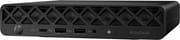
The chassis measures 7.13 by 6.97 by 1.35 inches and weighs 2.97 pounds, which is the standard 1-liter footprint that Lenovo’s ThinkCentre M-series and Dell’s Pro Micro line also occupy. HP’s styling here is more assertive than the plain slab of the 800 G9: the entire front face is a large diamond-lattice ventilation grille with the HP logo at the left edge, and the top panel is a fine perforated mesh rather than the older ridged plastic. Front I/O is a USB-C port at 20Gbps with charging, two USB-A ports at 10Gbps, a combo headset jack, and a recessed power button. The rear carries HDMI 2.1, two DisplayPort 2.1 outputs, two more USB-A 10Gbps ports, the Thunderbolt 4 USB-C port, the RJ-45 jack, and the barrel power input, with two blanked Flex IO cutouts between them. VESA mounting is supported, which is how most of these get deployed. One caveat on the wireless card is that the SKUs listed on this page carry Wi-Fi 7 and Bluetooth 5.4, but HP’s datasheet notes that Wi-Fi 7 is an option and that base configurations of the platform can ship Wi-Fi 6E with Bluetooth 5.3 instead, so confirm the card on any order code not covered here.
Both the Core Ultra 5 235T and the Core Ultra 7 265T are 35W desktop parts rather than the U-series and H-series mobile silicon that most consumer mini PCs run. The 265T carries 8 Performance cores and 12 Efficient cores for 20 cores and 20 threads, a 1.5GHz P-core base, and a 5.3GHz maximum turbo, with 30MB of L3 cache and a 112W maximum turbo power ceiling per Intel’s specifications. The 235T drops to 6 Performance cores and 8 Efficient cores, 14 cores and 14 threads, with a higher 2.2GHz P-core base and a 5.0GHz turbo. PassMark’s multi-thread CPU test currently places the 265T around 36,950 and the 235T around 31,370. Arrow Lake dropped Hyper-Threading, so 20 cores buys 20 threads, not 40. Workloads that scale on thread count rather than physical cores will not gain as much as the core count suggests.
HP documents three M.2 2280 PCIe Gen4 storage slots, plus a separate M.2 2230 slot for the wireless card, and two DDR5-5600 SODIMM slots that officially accept 64GB. Two of the storage slots are standard; the third comes from HP’s SSD expansion kit, has to be specified with the base unit, and shares its internal connector with the optional graphics card described below. HP’s own SSD choices stop at 2TB per slot, and NotebookCheck puts the ceiling at 6TB across all three. Even so, three NVMe slots is one more than the Elite Mini 800 G9, the Beelink SER8, or most 1-liter machines at any price. The two Flex IO ports on the rear take HP modules that turn those cutouts into VGA, serial, additional USB, additional video outputs, a 2.5GbE NIC, a fiber NIC, or the graphics card covered below, so a deployment that needs a legacy serial port for point-of-sale hardware or faster networking can order it built in rather than hanging a dongle off the front.
Every configuration on this page runs the Intel Graphics built into its Arrow Lake-S chip, and HP’s abbreviated datasheet for the Mini lists no discrete option at all. HP’s two fuller documents for the same machine do. The support specifications page lists an optional NVIDIA GeForce RTX 5050 with 8GB of GDDR7 under Graphics and puts a discrete graphics module among the Flex IO port 2 choices, and HP’s QuickSpecs for the Elite Series 8 G1i family marks the RTX 5050 as available on the Mini specifically, not just the tower and small form factor. The QuickSpecs also carries the catch that a Mini configured with the third M.2 storage slot cannot be configured with discrete graphics, because HP wires both to one shared internal connector. The card is an order-time option and rules out the third SSD. There is no OCuLink port on the chassis in any configuration.
On integrated graphics HP rates the Mini at four simultaneous displays with the 35W processors on this page, which is plenty for a multi-monitor desk, but the silicon behind those outputs is meant for spreadsheets, video calls, and browser work rather than gaming or GPU rendering. If graphics are the point of the machine, HP’s own Z2 Mini G1a is the model in their lineup built for it.
Reviewer Insights
No measured benchmark review of this Intel model has appeared yet. The published reviews cover the AMD-based EliteDesk 8 Mini G1a instead, at StorageReview and Windows Central, and that is a different processor on a different platform, so its thermal and storage figures do not carry over to this machine. The rest of the G1i material online is announcement coverage and HP’s own parts-replacement videos.
NotebookCheck’s March 2025 announcement coverage corroborates HP’s published I/O layout, the Q870 chipset, the three M.2 Gen4 slots, and the two Flex IO ports, and it reports power adapter options from 90W to 180W depending on configuration. The 13 TOPS NPU figure HP markets on this machine comes from Intel’s own specifications for both chips and is a vendor-published number, not a measured one. Sustained-load thermals and real storage throughput on this model remain unmeasured by anyone.
A Fleet Box With Room for Three SSDs
The G1i is aimed squarely at IT buyers who deploy in volume: vPro management, HP Wolf Security in firmware, VESA mounting, and enough configurability through Flex IO that one platform can cover a front desk, a developer bench, and a point-of-sale terminal that still needs a serial port. The configurability is the draw, and the third M.2 Gen4 slot, specified with the base unit, gives a buyer boot, data, and backup volumes inside a machine this small.
Consumer mini PCs such as the GMKtec EVO-T2 and the Beelink SER8 ship 2.5GbE or faster networking and USB4 as standard equipment rather than as a build-time module, and buying one does not mean hunting across business resellers for a sane price on a specific part number. What they will not give you is Intel desktop silicon with vPro, firmware-level fleet management, or a serial-port option at all. The G1i earns its price on vPro management and the expansion slots, and a consumer box wins on cores per dollar.
For those comparing options, see our Mini PC Comparison Chart to find the best match for your needs.
Frequently Asked Questions
What processors does the HP EliteDesk 8 Mini G1i use?
The configurations covered on this page use the Intel Core Ultra 5 235T (6 Performance cores plus 8 Efficient cores, 14 cores and 14 threads, 2.2GHz base, 5.0GHz turbo) or the Intel Core Ultra 7 265T (8 Performance cores plus 12 Efficient cores, 20 cores and 20 threads, 1.5GHz P-core base, 5.3GHz turbo, 30MB L3). Both are 35W Arrow Lake-S desktop parts with a 13 TOPS NPU. HP’s datasheet lists a wider processor menu for the platform, including Core Ultra 9 285T and the 65W non-T versions, sold as separate order codes.
How much RAM and storage can the EliteDesk 8 Mini G1i take?
HP documents two SODIMM slots accepting DDR5-5600 up to 64GB total, and three M.2 2280 PCIe Gen4 storage slots. Two are standard; the third comes from HP’s SSD expansion kit, has to be ordered with the base unit, and cannot be combined with the optional discrete graphics module because they share one internal connector. HP’s own SSD choices stop at 2TB per slot. A separate M.2 2230 slot holds the wireless card and is not usable for storage. There is no 2.5-inch SATA bay in this chassis.
What ports does the HP EliteDesk 8 Mini G1i have?
Front: one USB-C at 20Gbps with charging, two USB-A at 10Gbps, and a combo headset jack. Rear: one HDMI 2.1, two DisplayPort 2.1, two USB-A at 10Gbps, one Thunderbolt 4 USB-C port with 100W power delivery into the machine, one RJ-45 Ethernet jack, and the DC power input. Two Flex IO cutouts sit on the rear panel and can be configured at order time with VGA, serial, additional USB or video ports, a 2.5GbE NIC, or a fiber NIC.
How many displays can the EliteDesk 8 Mini G1i drive?
Four with the 35W processors covered here, using the standard rear I/O: two DisplayPort 2.1 outputs, HDMI 2.1, and the Thunderbolt 4 port with DisplayPort Alt Mode. HP documents up to six simultaneous displays when the machine is ordered with both a video Flex IO module and the HP Video Port Extender.
Does the EliteDesk 8 Mini G1i have 2.5 Gigabit Ethernet?
Not on the vPro configurations covered here. HP pairs vPro SKUs with the Intel I219-LM Gigabit controller and non-vPro SKUs with the Intel I226-V 2.5GbE controller. A 2.5GbE module can be ordered into one of the two Flex IO slots if the deployment needs it, but it is a build-time option rather than something you can add later without the module.
What are the Flex IO ports on the EliteDesk 8 Mini G1i?
Flex IO is HP’s name for two configurable rear-panel cutouts that ship blanked unless a module is ordered, and the two positions take different modules. Port 1 can be VGA, serial, DisplayPort 2.1, HDMI 2.1, Thunderbolt 4, dual USB-A, dual USB-C, a 2.5GbE NIC, or an HP fiber NIC at 1Gbps. Port 2 can be dual USB-A, serial, the HP Video Port Extender, or the optional NVIDIA RTX 5050 discrete graphics card. Both are order-time choices rather than later upgrades. This is how one chassis covers legacy point-of-sale hardware, faster networking, heavy multi-monitor setups, and a modest amount of GPU work without a separate model.
How does the EliteDesk 8 Mini G1i compare to the Elite Mini 800 G9?
Same 1-liter class and the same VESA-mount deployment story, but the G1i moves the platform forward on nearly every connectivity spec: Wi-Fi 7 instead of Wi-Fi 6, Bluetooth 5.4 instead of 5.2, DisplayPort 2.1 instead of 1.4, a Thunderbolt 4 port the 800 G9 does not have at all, and three M.2 Gen4 slots instead of two. The Elite Mini 800 G9 counters with the 24-core i9-14900T, which still posts a higher multi-thread PassMark score than the Core Ultra 7 265T. Both are stuck on Gigabit Ethernet in their standard vPro configurations.