
MeLE Cyber X1
Updated on

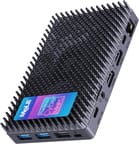
The MeLE Cyber X1 replaces the smooth metal lid this vendor has shipped for a decade with hundreds of plastic pin-fin spikes that look more like a synthetic hedgehog than a heatsink. The box underneath runs an Intel N150. MeLE claims the textured top gives the chassis 6.4 times the surface area of a flat lid, which lets the N150 hold a 10W power limit (up from the 8W on the older Quieter line) without throttling during long, silent workloads. It is meant to sit on a shelf, run Windows 11 Pro or a quiet Linux distro for weeks at a time, drive up to three 4K displays, and never make a sound. If you want something that can power through Premiere or modern AAA games, this is not it, and MeLE will tell you so itself.
| Pros | Cons |
|---|---|
| Silent fanless operation with no moving parts | WiFi 5 and Bluetooth 5.1 are dated for a 2026 product |
| Distinctive pin-fin heatsink boosts thermal headroom | Top and bottom surfaces can reach 55 to 70 degrees Celsius under load |
| Triple 4K@60Hz display support via dual HDMI plus USB-C DP Alt | Intel N150 is entry-level; not a workstation or gaming chip |
| Replaceable M.2 2280 NVMe SSD up to 4TB | Single-channel RAM and 1GbE ethernet limit network and memory bandwidth |
| Pocketable 5.2 x 3.2 inch footprint, weighs roughly 10 ounces | Buyer V.K. reports the USB-C power input plays poorly with docks |
| 12V barrel input and USB-C PD make it easy to power from batteries | Storage is a single M.2 slot with no SATA bay or secondary NVMe |
Related Videos
MeLE Cyber X1 Comparison Chart
4 configurations
| Configuration | RAM | Storage | Performance | List price | Amazon price | Compare |
|---|---|---|---|---|---|---|
| 16GB/512GB/Intel N150 | 16 GB | 512 GB SSD | 3.1 | $549.99 | Loading... | Details
|
| 8GB/128GB/Intel N150 | 8 GB | 128 GB SSD | 2.7 | --- | Details
| |
| 32GB/512GB/Intel N150 | 32 GB | 512 GB SSD | 3.5 | $629.99 | Loading... | Details
|
| 8GB/256GB/Intel N150 | 8 GB | 256 GB SSD | 2.7 | $499.99 | Loading... | Details
|
Specs shared by every configuration
| Operating System | Windows 11 Pro |
|---|---|
| Processor | Quad-core 3.60 Ghz Intel Processor N150 |
| GPU | Integrated Intel UHD Graphics |
| Dimensions width x length x thickness | 5.2 x 3.2 x 0.95 inches (132.08 x 81.28 x 24.13 mm) |
| Weight | 0.65 lbs (0.3 kg) |
| WiFi | Wi-Fi 5 (802.11ac) |
| Bluetooth | Bluetooth 5.1 |
| Ethernet | 1 Ethernet port at 1 Gbps |
| HDMI | 2 Full-Size HDMI Ports |
| DisplayPort | DisplayPort 1.4 over USB-C (4K@60Hz) |
| VGA | No VGA Ports |
| USB Ports | 1 USB 2.0, 2 USB 3, 1 USB-C 1x USB-A 3.2 Gen 2 (10Gbps), 1x USB-A 3.2 Gen 1, 1x USB-A 2.0, 1x USB-C 3.2 Gen 2 (10Gbps, DP Alt, PD 3.0) |
| Thunderbolt Ports | No |
| OCuLink | No |
| Internal SATA Ports | No SATA ports |
| Card Reader | microSD Card Reader |
| Headphone Jack | combo |
| Fanless | Yes |
| VESA Mount | Yes |
| In the Box | Mini PC, 12V/2A power adapter, VESA mount, screws, user manual |
| Expandability | 1x M.2 2280 NVMe slot (up to 4TB), 1x microSD slot (up to 2TB), 1x SODIMM RAM slot |
Related Mini PCs
-
 MeLE Quieter 4CThe MeLE Quieter 4C is a fanless, silent Intel N100 (or N150) mini PC with 16GB of memory, eMMC…
 -
 MeLE Quieter3QThe MeLE Quieter3Q is an ultra-slim, fanless mini PC built around the Intel Celeron N5105, with…
 -
 MeLE PCG02The MeLE PCG02 is a fanless Intel N100 PC stick with 8GB of memory, 256GB of eMMC storage, dual…
 -
 Bmax MaxMini B1 ProThe Bmax MaxMini B1 Pro is an ultra-budget fanless mini PC on Intel's older Celeron N4000, with 8GB…
 -
 MINIX Z100-0dBThe MINIX NEO Z100-0dB is a fanless Intel N100 mini PC in an all-metal chassis, sold with 8GB or…
 -
 ACEMAGIC Vista V1The ACEMAGIC Vista V1 is an ultra-budget mini PC sold in several Intel configs (N95, N97, and…
Pin-fin cooling over a single M.2 slot and one SODIMM
In hand, the Cyber X1 measures 5.2 x 3.2 inches with a chassis just under one inch thick, and it weighs around 10 ounces, putting it on the small end of the fanless mini PC market. The bottom and sides are dark gray plastic with a VESA mount pattern on the underside, while the top is the plastic pin-fin field that gives the product its hedgehog nickname. Ports are split across two long edges: one side carries a USB-C all-in-one connector (10Gbps data, DisplayPort 1.4, and PD 3.0 power input), a 3.5mm combo headphone jack, two HDMI 2.0 outputs, a second USB-C used as a 12V power input, and a single Gigabit ethernet jack. The opposite side holds three USB-A ports (one each at 10Gbps, 5Gbps, and 480Mbps), a microSD slot tucked at the corner, and a Kensington lock notch. There is no DisplayPort connector and no Thunderbolt; everything modern lands on the one full-function USB-C.
The Intel N150 is a 6W TDP Twin Lake chip with four Gracemont cores at up to 3.6GHz. PassMark places it around 5,343 on the multi-thread chart, which puts it level with the older N100 (5,305) and well behind any mid-range Core or Ryzen mobile part. That covers 4K media playback, large spreadsheets, 30+ browser tabs, and light office work. CNX-Software measured surface temperatures of 55 to 70 degrees Celsius under load, which MeLE notes is within IEC62368-1 safety limits but is hot enough that you would not want this device buried under a stack of papers. Inside, a single SODIMM slot holds the DDR4-3200 RAM (the Amazon spec sheet shows a labeled stick, even though the original September 2025 press release described soldered LPDDR5), and a single M.2 2280 slot takes a PCIe 3.0 x4 NVMe SSD up to 4TB. The 512GB SSD MeLE ships in the higher-tier configs benchmarks around 3,940 MB/s sequential reads.
Wireless is WiFi 5 (802.11ac) and Bluetooth 5.1, and the ethernet jack is a single 1GbE port. The wired selection covers a 10Gbps Type-A, a 5Gbps Type-A, a 480Mbps Type-A, and a true full-function USB-C, so you can hang a dock, an external SSD, and a peripheral hub off the device without a tangle of adapters. Triple-monitor support arrives through both HDMI 2.0 outputs plus the USB-C, for three independent 4K@60Hz screens. Storage expansion is limited to the one M.2 slot and the microSD reader (up to 2TB cards), so plan for external storage if you need more than one fast drive.
Reviewer Insights
Deep Space Astro’s hands-on review frames the Cyber X1 as a quiet upgrade path for telescope owners who run NINA, Stellarium, and similar capture software in the field. He points to the 12V barrel input that lets the mini PC share a power-distribution box with a mount and cameras, and the Auto Power On BIOS setting that boots the unit unattended after a power blip. He praises Mele’s track record (“they’ve always worked out of the box as expected”) but cautions that the performance jump from the older Quieter 4C is incremental rather than dramatic. His verdict is that this is a sensible upgrade if you are coming from a Quieter 2 or 3C, and a sideways move if you already own a Quieter 4C. Of the videos cited here, this is the only one that tests a Cyber X1 unit; the other MeLE videos cover sibling N150 fanless products and give context on the platform.
Jim’s Garage looked at the closely related MeLE Quieter 4C and ran it through Cinebench, a Jellyfin transcoding test, and a teardown. The Quieter 4C is the metal-chassis predecessor without the pin-fin lid, so its thermal numbers (CPU hitting 82 degrees, SSD hitting 72 degrees under sustained load) establish the baseline that the Cyber X1’s new heatsink is trying to improve on. His point that “I cannot recommend getting this over the Beelink even if the price was the same simply because you get a lot more value for money” applies even more sharply to the Cyber X1 once you factor in the slightly higher launch price. OSReviews’ tour of the Quieter 4C N150 notes that “performance is actually a little bit better than maybe what you were expecting” but RAM remains soldered and the chassis attracts dust.
TechRadar’s hedgehog write-up leans into the visual gimmick, calling out the “hundreds of metal spikes” and the explicit 24/7 design target. (The spikes are actually high-thermal-conductivity engineering plastic, not metal, per MeLE’s own materials, and CNX-Software’s deeper teardown corrects the record.) The article warns that the N150 is “modest” and that the RAM is “permanently soldered onto the motherboard,” which matched the launch press release but does not match the SODIMM stick visible in the current Amazon spec photos for the 16GB and 32GB SKUs. CNX-Software and Liliputing provide the most useful technical context, including the 6.4x surface-area claim, the bumped 10W power limit, and the note that the microSD slot is oddly positioned where the heatsink meets the chassis. FanlessTech’s review roundup compiles early owner feedback, which converges on the same themes: silent, cool enough under streaming workloads, hot to the touch under sustained load, and a clear win for people who need a 24/7 silent PC and a clear miss for anyone who wants gaming or transcoding throughput.
CNX-Software flags the surface temperatures as a flaw; FanlessTech’s owner panel shrugs at them. The RAM specification splits the reporting the same way. Early press materials and most launch articles say soldered LPDDR5, while the shipping Amazon SKUs photograph a DDR4 SODIMM, so a unit bought in 2026 arrives socketed.
OSReviews was taken with the Cyber X1’s distinctive spiky heatsink top, an aluminum-alloy fanless design built for completely silent operation that suits a home office or media center. At 288g it is compact and light. The review framed it as a well-built silent box for quiet-first setups.
Customer Reviews
Across 23 ratings on Amazon, the MeLE Cyber X1 averages 4.7 stars, and that distribution skews high: 91 percent of raters left five stars, with a small minority (about 5 percent at three stars and 4 percent at one star) pulling the average down. The recurring theme is the fanless design running cool. A verified buyer named Jesse wrote that “it stays very noticeably cooler than my previous mini PCs,” and a verified buyer named Toronto reported it “Runs 15C cooler than my fanless i5-8265u.” David Campbell, a verified buyer, picked it for an astrophotography rig because it is “small, light, 12V-powered, and passively cooled,” and Annie, also verified, ran ham-radio logging software across three displays and noted the machine drove a 1440p monitor at full resolution where her business laptop’s HDMI could not.
The one substantive criticism in the set comes from V.K., who was not a verified purchaser and rated it five stars but flagged the ports: “The IO really leaves a lot to be desired though,” describing the USB-C power-input port playing poorly with docks and producing a wonky HDMI video signal. With only a handful of detailed reviews and most of them five-star, this is a small sample; weigh the IO note if you plan to run it through a dock.
Read more owner reviews on Amazon.
A silent 24/7 box that stops at light productivity
If you need a small, totally silent, low-power PC to run a single screen for productivity, a triple-monitor digital-signage rig, a homelab control plane, a security-camera recorder, or a telescope controller, the Cyber X1 covers all of that in a 0.2-liter chassis. The pin-fin heatsink and the bumped 10W power envelope make it comfortable to keep loaded for long stretches, and the user-replaceable NVMe and SODIMM RAM mean you are not locked into the configuration on the box.
The WiFi 5 radio, the single 1GbE port, and the Intel N150’s modest multi-thread performance are the ceilings here. A network built on WiFi 6E or 2.5GbE will not get either from this box, and workloads past light productivity call for a Ryzen or Core Ultra mini PC with a fan.
Our Mini PC Comparison Chart lines the Cyber X1 up against other fanless and ultra-compact systems.
Frequently Asked Questions
What processor does the Cyber X1 use?
The Cyber X1 is powered by the Intel Processor N150, a four-core, four-thread Twin Lake chip with a 3.6GHz boost clock, 6MB of cache, and a 6W base TDP that MeLE runs at a 10W PL1 power limit for sustained workloads. It scores roughly 5,343 on PassMark’s multi-thread benchmark.
Is the RAM in the Cyber X1 upgradeable?
The shipping Amazon SKUs use a single DDR4-3200 SODIMM slot, which is socketed and can be replaced. Launch press materials in September 2025 described the RAM as soldered LPDDR5, but the production hardware on Amazon shows a labeled DDR4 SODIMM in the official spec photos. Plan around the SODIMM design if you are buying today.
How loud is the Cyber X1?
The Cyber X1 is completely silent. It has no fans, no pumps, and no other moving parts; cooling is handled entirely by the pin-fin plastic heatsink that covers the top of the chassis.
How many monitors can the Cyber X1 drive?
It supports up to three independent 4K@60Hz displays: two via the HDMI 2.0 ports on the rear and a third via DisplayPort 1.4 Alt Mode on the full-function USB-C port.
Can the Cyber X1 run Linux?
Yes. Owner reports in the FanlessTech and Amazon review pools confirm clean installs of Ubuntu and Debian (KDE) with working WiFi and Bluetooth out of the box. The Intel N150 and Intel UHD Graphics are well supported by modern Linux kernels.
How hot does the Cyber X1 get?
Under sustained load, CNX-Software measured surface temperatures of 55 to 70 degrees Celsius on the top and bottom of the chassis. MeLE notes these readings are within the IEC62368-1:2018 safety standard, but the chassis is hot enough that you should give it open desk space rather than enclose it.
What is the storage situation on the Cyber X1?
There is a single M.2 2280 slot that accepts NVMe PCIe 3.0 x4 SSDs (or SATA M.2 drives) up to 4TB, plus a microSD card reader rated for cards up to 2TB. The 512GB SSD that ships in the higher-tier configs benchmarks around 3,940 MB/s sequential reads. There is no 2.5-inch drive bay and no secondary M.2 slot.
What is in the box with the Cyber X1?
The Cyber X1 ships with the mini PC unit, a 12V/2A barrel-jack power adapter, a VESA mount bracket with screws, and a user manual. The USB-C port also accepts PD power input, so the bundled adapter is the simplest way to power the device but not the only one.