
MeLE Quieter3Q
Updated on

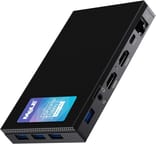
The MeLE Quieter3Q is an ultra-thin mini PC for the rooms where a fan would be the dealbreaker: silent home offices, a Roon endpoint near a hi-fi system, a kitchen media corner, or a telescope-mounted control PC. The chassis is 18mm thick (about 0.7 inches), with a plastic top grooved like a heatsink (plastic so the Wi-Fi antennas get reception) over a metal base plate. Inside is an Intel Celeron N5105 (Jasper Lake, four cores, 4MB cache, boost to 2.9 GHz), dual full-size HDMI 2.0 outputs capable of 4K 60Hz, Wi-Fi 6 and Bluetooth 5.2 on the 2022 review units (for current N5100 and N5105 builds, MeLE’s store title and bullets list Wi-Fi 5 and Bluetooth 5.1, while its spec table still shows Wi-Fi 6 and Bluetooth 5.2), and one user-accessible M.2 2280 NVMe slot for storage expansion.
Pros and Cons
| Pros | Cons |
|---|---|
| Silent fanless operation at 4W idle and about 12W under load | Single-channel, soldered RAM bottlenecks the iGPU |
| Chassis thin enough at 18mm to hide behind a monitor | USB-C port is power input only (no data, no video) |
| Wi-Fi 6 and Bluetooth 5.2 with an Intel radio on the 2022 review units | Onboard eMMC is slower than NVMe; install Windows on the M.2 |
| Dual 4K 60Hz HDMI outputs and HDR10 support | Chassis runs hot to the touch under sustained load |
| User-accessible M.2 2280 NVMe slot up to 4TB | USB-C input on 2022 review units was not standard PD (bundled 12V adapter) |
| Unlocked BIOS for power-limit and undervolt tweaking | Limited internal upgradeability beyond the M.2 slot |
Related Videos
MeLE Quieter3Q Comparison Chart
 MeLE Quieter3Q | MeLE Quieter3Q | MeLE Quieter3Q | |
| Price | List Price: $539.99 Amazon Prices: | List Price: Amazon Prices: | List Price: $359.99 Amazon Prices: Loading prices... |
| Version | 16GB/512GB/Intel N5105 | 4GB/128GB/Intel N5100 (Quieter 3Q Home) | 8GB/128GB/Intel N5100 |
| Performance Rating | 3.0 | 1.5 | 2.5 |
| Operating System | Windows 11 Pro | Windows 11 Home | Windows 11 Pro |
| Processor | Quad-core 2.00 Ghz (max 2.90 Ghz) Intel Celeron N5105 | Quad-core 1.10 Ghz (max 2.80 Ghz) Intel Celeron N5100 Processor | Quad-core 1.10 Ghz (max 2.80 Ghz) Intel Celeron N5100 Processor |
| GPU | Integrated Intel UHD Graphics | Integrated Intel UHD Graphics | Integrated Intel UHD Graphics |
| RAM | 16 GB LPDDR4, single-channel (Single-channel, soldered) | 4 GB LPDDR4, single-channel (Single-channel, soldered) | 8 GB LPDDR4, single-channel (Single-channel, soldered) |
| Internal Storage | 512 GB eMMC + NVMe | 128 GB eMMC | 128 GB eMMC |
| Dimensions width x length x thickness | 5.16 x 3.19 x 0.72 inches (131.06 x 81.03 x 18.29 mm) | 5.16 x 3.19 x 0.72 inches (131.06 x 81.03 x 18.29 mm) | 5.16 x 3.19 x 0.72 inches (131.06 x 81.03 x 18.29 mm) |
| Weight | 0.44 lbs (0.2 kg) | 0.44 lbs (0.2 kg) | 0.44 lbs (0.2 kg) |
| WiFi | Wi-Fi 5 (802.11ac) | Wi-Fi 5 (802.11ac) | Wi-Fi 5 (802.11ac) |
| Bluetooth | Bluetooth 5.1 | Bluetooth 5.1 | Bluetooth 5.1 |
| Ethernet | 1 Ethernet port at 1 Gbps | 1 Ethernet port at 1 Gbps | 1 Ethernet port at 1 Gbps |
| HDMI | 2 Full-Size HDMI Ports | 2 Full-Size HDMI Ports | 2 Full-Size HDMI Ports |
| DisplayPort | No DisplayPort | No DisplayPort | No DisplayPort |
| VGA | No VGA Ports | No VGA Ports | No VGA Ports |
| USB Ports | 4 USB 3, 1 USB-C 2x USB-A 10Gbps and 2x USB-A 5Gbps. USB-C is power input only (no data, no video); 2022 units were not standard PD (12V adapter); MeLE now rates it for PD 3.0. | 4 USB 3, 1 USB-C 2x USB-A 10Gbps and 2x USB-A 5Gbps. USB-C is power input only (no data, no video); 2022 units were not standard PD (12V adapter); MeLE now rates it for PD 3.0. | 4 USB 3, 1 USB-C 2x USB-A 10Gbps and 2x USB-A 5Gbps. USB-C is power input only (no data, no video); 2022 units were not standard PD (12V adapter); MeLE now rates it for PD 3.0. |
| Thunderbolt Ports | No | No | No |
| OCuLink | No | No | No |
| Internal SATA Ports | No SATA ports | No SATA ports | No SATA ports |
| Card Reader | microSD Card Reader | microSD Card Reader | microSD Card Reader |
| Headphone Jack | combo | combo | combo |
| Fanless | Yes | Yes | Yes |
| VESA Mount | Yes | Yes | Yes |
| In the Box | Mini PC, VESA mount, 12V/2A USB-C power adapter, thermal pad for SSD, quick start guide | Mini PC, VESA mount, 12V/2A USB-C power adapter, thermal pad for SSD, quick start guide | Mini PC, VESA mount, 12V/2A USB-C power adapter, thermal pad for SSD, quick start guide |
| Expandability | M.2 2280 NVMe slot (PCIe 3.0 x2) and microSD; RAM and onboard eMMC are soldered. | M.2 2280 NVMe slot (PCIe 3.0 x2) and microSD; RAM and onboard eMMC are soldered. | M.2 2280 NVMe slot (PCIe 3.0 x2) and microSD; RAM and onboard eMMC are soldered. |
Related Mini PCs
-
 MeLE Quieter 4CThe MeLE Quieter 4C is a fanless, silent Intel N100 (or N150) mini PC with 16GB of memory, eMMC…
 -
 MeLE Cyber X1The MeLE Cyber X1 is a fanless mini PC built around the Intel N150 and a distinctive pin-fin…
 -
 MINIX Z100-0dBThe MINIX NEO Z100-0dB is a fanless Intel N100 mini PC in an all-metal chassis, sold with 8GB or…
 -
 MeLE PCG02The MeLE PCG02 is a fanless Intel N100 PC stick with 8GB of memory, 256GB of eMMC storage, dual…
 -
 MINIX Z300-0dBThe MINIX Z300-0dB is a fanless Intel Core i3-N300 mini PC with 16GB of upgradeable RAM, dual 4K…
 -
 Yxk Mini S15 UltraThe Yxk Mini S15 Ultra is a thin, fanless Intel N100 mini PC with up to 16GB of DDR4, an M.2 SATA…
An 18mm fanless shell with a single M.2 slot
The Quieter3Q measures 5.16 x 3.19 x 0.72 inches and tips the scale at 0.44 pounds, which is small enough to disappear behind a monitor on the included VESA bracket or live unnoticed on a shelf next to a streamer. There is no fan anywhere in the design; the case carries the heat away by convection. The front has only the power button. The right side has three USB-A ports, and the rear has a fourth USB-A, the 3.5mm combo audio jack, the microSD slot, both HDMI 2.0 outputs, the USB-C power input, and gigabit ethernet. CNX Software’s bench testing found that the first two right-side USB-A ports run at 10Gbps (USB 3.2 Gen 2) despite a Gen 1 label, while the third and the rear port run at 5Gbps.
The Intel N5105 is a four-core, four-thread Jasper Lake part with a 2.0 GHz base and 2.9 GHz boost, paired with Intel UHD Graphics at 24 execution units. PassMark puts it around 4,000 points, which makes it adequate for a silent home office, 4K media playback, and casual GPU-light gaming. CNX Software lists the single-channel memory as a con, and ETA Prime saw it hold back the iGPU, with lower frame rates than on the same N5105 with dual-channel RAM, with Art of Rally unable to hold a steady 60 fps against a 68 fps average on the dual-channel machine. ETA Prime pushed the CPU to 101C by running benchmarks back to back, but everyday office and media workloads run far cooler.
On the 2022 review units, Wi-Fi 6 ran on an Intel radio and Bluetooth 5.2 covered peripherals. For current N5100 and N5105 builds, MeLE’s store title and bullets list Wi-Fi 5 and Bluetooth 5.1, while its spec table still shows Wi-Fi 6 and Bluetooth 5.2. A single gigabit ethernet jack handles the wired side. The USB-C port is a power input only, with no data or DisplayPort Alt Mode, so there is no docking station or external display over USB-C. On the 2022 units, the port took power from MeLE’s bundled 12V/2A adapter, and Lon Seidman warned it was not a standard power delivery port, so many standard USB-C chargers would not run it. MeLE now says the port accepts USB PD 3.0 input at 12V to 23V from a 24W or larger supply, so newer units may charge from a standard PD adapter. The M.2 2280 slot is PCIe 3.0 x2 and accepts NVMe SSDs up to 4TB, with a thermal pad already in the box.
MeLE also sells the Quieter3C, a separate model built on the same Jasper Lake chips (N5100 or N5105) and single-channel memory. The 3C swaps the power-only USB-C port for a full-function one with data, DisplayPort video, and PD power input, has one fewer USB-A port, and uses Wi-Fi 5 and Bluetooth 5.1.
Reviewer Insights
Lon Seidman’s test emphasized completely silent operation and what he called great Linux support, and he framed the Quieter3Q as a mini PC roughly the size of a retro game cartridge that hides a full Intel computer inside. He ran Ubuntu cleanly, walked through the unlocked BIOS, and confirmed Wi-Fi 6 performance was strong. On the USB-C port he warned, “They are very specific about the fact that this is not a standard power delivery port and therefore this is not something that’s going to work with USB docking stations.”
ETA Prime tested the device for retro emulation and light gaming, calling the N5105 “one of my favorite low-end Intel CPUs for 2022.” He measured 4W at idle and around 12W during gaming, which puts the machine in always-on territory without guilt. He hit the same single-channel-RAM ceiling: “Unfortunately like a lot of these mini PCs hitting the market recently it’s running in single channel which is going to hurt that GPU performance.” Despite that, he found GameCube games playable, some at 720p, a few PS2 games playable at native resolution, and PSP running full speed at 2x resolution.
OSReviews cited PassMark scores rising from about 2,900 for the previous Quieter2Q’s J4125 to 4,156 for the N5105. Robtech measured a 44% higher PassMark CPU score and over 130% more in 3DMark DX11 against the Quieter2Q. Robtech concluded, “It’s a unique mini PC that’s tiny and silent but can do everyday tasks just fine.” Team Pandory focused on Batocera and emulation and saw the CPU reach 83C during benchmarks, idling at 50 to 60C.
Archimago approached it from a hi-fi angle, validating it as a multichannel audio source and Roon endpoint with HDR10 output to an HDCP 2.2 receiver. His UserBenchmark results placed it in roughly the 66th percentile for N5105 implementations on CPU and the 76th for iGPU, which he read as a sign of good thermal-and-component synergy for a fanless design. He recommended giving the bottom of the chassis breathing room: “This machine can get pretty warm underneath so let it breathe a little down below!” Stick-on feet help if the unit will live on a tabletop.
Customer Reviews
Terry P, a verified buyer who images the night sky, wrote that “The Quieter3Q is perfect for controlling my telescope” and that after a problem “Mele took care of it right away.” Doug Robinson, a verified buyer in Canada on a third MeLE computer, wrote that “for everyday use they are more than adequate.”
Heat is the most common complaint. JBZ, a verified buyer, returned the unit, writing that “within 15minutes, that my hand burned when I picked it up” and that the warning about it getting “warm” understated the reality. One verified buyer, Solmis, manages the heat instead and noted that “Under high load the chassis may get little warm to touch, but I haven’t seen any throttling.” Gio Rodz liked the hardware but flagged the seller, writing “I contacted the company for an issue I had with this device, and they were not helpful in assisting me at all.”
Read more owner reviews on Amazon.
A silent x86 machine for always-on duty
A media rack, a monitor mount, or a spot next to a telescope is where this box belongs, and the trade is peak performance for absolute quiet. It sits in the same bracket as the mini PCs that replace the delayed Pi 6, and the mini PC vs laptop trade-offs and low-power Linux mini PCs pieces cover the fixed-desk and Linux angles. A 4W idle draw (ETA Prime’s measurement) keeps it cheap to leave running around the clock.
Skip it if you want headroom for upgrades, dual-channel performance, or USB-C dock connectivity. The soldered RAM trap applies here, so what you buy is what you keep. If you can live with a fan, an Intel N100 box with dual-channel SODIMM RAM will give you better GPU performance. And if you want the newer MeLE fanless platform with N100 or N150 and a USB-C port that does video out, the MeLE Quieter 4C is the direct successor.
To compare this machine against other fanless and low-power mini PCs side by side, use Starry Hope’s Mini PC Comparison App.
Frequently Asked Questions
What processor does the MeLE Quieter3Q use?
The Intel Celeron N5105: a 10nm Jasper Lake part with four cores and four threads, 2.0 GHz base, 2.9 GHz boost, and a PassMark score around 4,000 points. MeLE also sells cheaper builds with the slightly slower Intel Celeron N5100.
Can I upgrade the RAM on the MeLE Quieter3Q?
No. The Quieter3Q uses soldered LPDDR4 in a single-channel configuration that cannot be upgraded after purchase. Pick the RAM tier you need at order time. The internal M.2 2280 NVMe slot is the only user-accessible upgrade path.
Is the USB-C port on the Quieter3Q a real USB-C port?
It is a power input only: it carries no data and has no DisplayPort Alt Mode, so it will not work with a dock or external display. On the 2022 review units, Lon Seidman noted it was not a standard USB Power Delivery port; it shipped with a 12V/2A adapter. MeLE now says it accepts USB PD 3.0 at 12V to 23V from a 24W or larger supply. The bundled MeLE adapter works either way.
How many monitors can the Quieter3Q drive?
Two 4K displays at 60Hz, both over the rear HDMI 2.0 ports. Unlike its successor the Quieter 4C, the Quieter3Q cannot drive a third display because its USB-C port is not wired for video output. MeLE’s separate Quieter3C model can, through its full-function USB-C port.
Does the Quieter3Q work well with Linux?
Yes. CNX Software tested Ubuntu 22.04 LTS and Lon Seidman tested a current Ubuntu release; both found Wi-Fi, Bluetooth, audio, and HDMI working out of the box on the N5105 platform. The unlocked BIOS lets you adjust power limits and undervolt for better sustained performance on either Windows or Linux.
Can the Quieter3Q handle gaming?
It handles retro emulation and light indie games, and modern 3D titles are out. ETA Prime (on Windows) and Team Pandory (on Batocera) reported playable GameCube, PS2, and PSP emulation. Team Pandory saw modern PC titles like CS:GO fall to around 20 fps; the single-channel LPDDR4 holds back the integrated GPU.
What is in the box with the Quieter3Q?
The mini PC, a VESA mount with screws, a 12V/2A USB-C-shaped power adapter (with international plug tips), a silicone thermal pad for the M.2 SSD, and a quick start guide. No HDMI cable is included.
How is the Quieter3Q different from the MeLE Quieter 4C?
The Quieter 4C is the newer fanless platform with an Intel N100 or N150 (more efficient Alder Lake-N core), LPDDR5 memory, and a USB-C port that supports DisplayPort Alt Mode for a third 4K display. The Quieter3Q is older, uses single-channel LPDDR4 with the Jasper Lake N5105, and limits the USB-C port to power input only. The 4C is the better all-around pick today; the Quieter3Q stays interesting if you specifically want a thinner chassis or find one for less.