
Reatan A8
Published on

The Reatan A8 is a palm-sized desktop built around AMD’s Ryzen 7 8745HS, an eight-core Zen 4 chip with Radeon 780M graphics. It carries a dedicated OCuLink connector for an external graphics card, two 2.5 Gigabit Ethernet jacks, and a USB4 Type-C port that will drive an 8K display. Reatan positions it as a gaming and creator machine, though the same hardware makes a credible small home server or a four-monitor office box. Reatan is a young brand with a short public track record, and one hands-on review covers this model so far, so the specification sheet carries much of the argument here.
Pros and Cons
| Pros | Cons |
|---|---|
| Dedicated OCuLink port (PCIe 4.0 x4) for an external GPU, separate from the USB4 port | The 16GB configuration ships as one memory module, so it starts in single-channel |
| Dual 2.5G Ethernet, useful for link aggregation or a router/NAS role | Fans are high-pitched and louder than the same-chip MINIX box Tek Syndicate tested a week earlier |
| Four display outputs including USB4 at 8K@60Hz | HDMI is 2.0 (4K@60Hz), not 2.1 |
| Two M.2 2280 PCIe 4.0 slots hold 4TB without an external drive | WiFi 6E and Bluetooth 5.2 rather than the WiFi 7 on Reatan’s own X7 |
| VESA bracket included, so the 1.73-inch-thick box hangs behind a monitor | The 8745HS is a 2024-generation part, not a current-year chip |
| Four of the six USB ports sit on the front, within reach of the desk | Memory ceiling is 64GB across two slots |
Related Videos
Reatan A8 Comparison Chart
 Reatan A8 | Reatan A8 | |
| Price | List Price: $449.00 Amazon Prices: Loading prices... | List Price: $599.00 Amazon Prices: |
| Version | 16GB/1TB | 32GB/1TB |
| Performance Rating | 8.4 | 9.1 |
| Operating System | Windows 11 Pro | Windows 11 Pro |
| Processor | Octa-core 3.80 Ghz (max 4.90 Ghz) AMD Ryzen 7 8745HS | Octa-core 3.80 Ghz (max 4.90 Ghz) AMD Ryzen 7 8745HS |
| GPU | Integrated AMD Radeon 780M | Integrated AMD Radeon 780M |
| RAM | 16 GB DDR5 SO-DIMM, 2-channel (Ships as a single DDR5 module) | 32 GB DDR5 SO-DIMM, 2-channel (2x 16GB DDR5 5600MHz) |
| Internal Storage | 1 TB NVMe PCIe 4.0 | 1 TB NVMe PCIe 4.0 |
| Dimensions width x length x thickness | 5 x 4.84 x 1.73 inches (127 x 122.94 x 43.94 mm) | 5 x 4.84 x 1.73 inches (127 x 122.94 x 43.94 mm) |
| Weight | unknown | unknown |
| WiFi | Wi-Fi 6E (802.11ax) | Wi-Fi 6E (802.11ax) |
| Bluetooth | Bluetooth 5.2 | Bluetooth 5.2 |
| Ethernet | 2 Ethernet ports at 2.5 Gbps | 2 Ethernet ports at 2.5 Gbps |
| HDMI | 1 Full-Size HDMI Port | 1 Full-Size HDMI Port |
| DisplayPort | 1 DisplayPort (DP 1.4, 4K@60Hz) | 1 DisplayPort (DP 1.4, 4K@60Hz) |
| VGA | No VGA Ports | No VGA Ports |
| USB Ports | 2 USB 2.0, 2 USB 3, 2 USB-C (1 USB4) 2x USB-A 3.2, 2x USB-A 2.0, 1x USB4-C (8K@60Hz), 1x USB-C (4K@60Hz) | 2 USB 2.0, 2 USB 3, 2 USB-C (1 USB4) 2x USB-A 3.2, 2x USB-A 2.0, 1x USB4-C (8K@60Hz), 1x USB-C (4K@60Hz) |
| Thunderbolt Ports | No | No |
| OCuLink | PCIe 4.0 x4 | PCIe 4.0 x4 |
| Internal SATA Ports | No SATA ports | No SATA ports |
| Card Reader | No Card Reader | No Card Reader |
| Headphone Jack | combo | combo |
| Fanless | No | No |
| VESA Mount | Yes | Yes |
| In the Box | Mini PC, power adapter, HDMI cable, VESA mount with screws, user manual | Mini PC, power adapter, HDMI cable, VESA mount with screws, user manual |
| Expandability | 2x DDR5 5600MHz SO-DIMM slots (max 64GB), 2x M.2 2280 PCIe 4.0 slots (4TB total). OCuLink port (PCIe 4.0 x4) for an external GPU. | 2x DDR5 5600MHz SO-DIMM slots (max 64GB), 2x M.2 2280 PCIe 4.0 slots (4TB total). OCuLink port (PCIe 4.0 x4) for an external GPU. |
Related Mini PCs
-
 ASUS NUC 13 ProThe ASUS NUC 13 Pro is a 4x4 mini PC sold in Core i5-1340P and Core i7-1360P builds with two DDR4…
 -
 Beelink SER6 MAXThe Beelink SER6 MAX pairs a Ryzen 7 7735HS or Ryzen 9 6900HX with Radeon 680M graphics and up to…
 -
 Dell OptiPlex 7010 MicroDell's OptiPlex 7010 Micro is a 1-liter, 13th-Gen Intel business desktop built for enterprise…
 -
 Dell Pro Micro QCM1250Dell rebrands the long-running OptiPlex Micro line as the Pro Micro and ships the QCM1250 with the…
 -
 GEEKOM Mini IT13The GEEKOM Mini IT13 is a 13th-gen Intel mini PC (Core i5-13500H up to i9-13900H/HK) with DDR4 to…
 -
 Glorlin GT105The Glorlin GT105 is a five-inch AMD mini PC sold with either the Ryzen 7 8745HS or the Ryzen 7 PRO…
A Dedicated OCuLink Port and Two 2.5G NICs

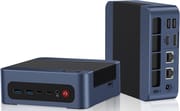
The chassis is a squat square, listed at roughly 5 by 4.84 by 1.73 inches, with a fine diamond-textured shell and mesh venting across the top and sides; the outer shell is plastic (Tek Syndicate’s hands-on flags the change from the all-metal case on Reatan’s earlier Alloy 9). The front face carries two USB-A ports, two USB-C ports, a 3.5mm combo jack, and the power button; the rear holds the DC input, both 2.5G LAN jacks, DisplayPort, HDMI, two more USB-A ports, and a Kensington slot. OCuLink gets its own connector, separate from the USB4 port that would otherwise be the only external-GPU path. One thing Reatan does not document is whether that connector shares PCIe lanes with either M.2 slot; some competing boxes wire OCuLink through a drive bay, and the specification sheet here simply does not say either way. Reatan ships a VESA bracket and screws in the box, so the unit can hang behind a monitor.
The Ryzen 7 8745HS pairs eight Zen 4 cores and sixteen threads with a 4.9GHz boost ceiling and Radeon 780M integrated graphics. PassMark’s published average for the chip sits near 28,600 in the multi-thread CPU Mark, which lands it in the same neighborhood as the 8845HS boxes that dominate this price bracket and comfortably ahead of the Ryzen 5 and Intel N-series machines a tier down. A buyer in 2026 is getting a 2024-generation chip: still quick enough for compiling, virtualization, 4K timeline work, and 1080p gaming at medium settings, but no longer the newest silicon on the shelf, and without the NPU that its 8845HS sibling and AMD’s newer mobile parts carry. If local AI acceleration matters to you, that omission is the reason to look at a newer chip instead.
The 32GB build is described as two 16GB DDR5 5600MHz modules, which fills both SO-DIMM slots and runs the 780M in dual-channel mode. The cheaper 16GB build is described in Reatan’s own product bullets as a single DDR5 module, quoted there at 4800MHz even though the same listing’s technical detail sheet says 5600MHz. A single stick means single-channel memory, and integrated Radeon graphics are unusually sensitive to that, so a second matching module is the upgrade to budget for on the 16GB machine. Both configurations cap out at 64GB across the two slots.
WiFi 6E (802.11ax) with Bluetooth 5.2 covers wireless, though Reatan’s listings are inconsistent on this point and one of them describes the same machine as WiFi 6. The two 2.5 Gigabit Ethernet ports open up uses a single-NIC mini PC cannot manage: link aggregation to a NAS, a software router or firewall with separate WAN and LAN legs, or simply keeping a lab network separate from the house. Display output runs four ways at once, with HDMI 2.0, DisplayPort 1.4, and one USB-C each carrying 4K@60Hz, while the USB4 port pushes 8K@60Hz and doubles as a 40Gbps data link. Storage expands through two M.2 2280 PCIe 4.0 slots for up to 4TB, and the OCuLink port runs PCIe 4.0 x4 for an external GPU enclosure, which is roughly 64Gbps of bandwidth against the 40Gbps a Thunderbolt or USB4 eGPU link provides.
Reviewer Insights

Tek Syndicate, which has reviewed ten to fifteen mini PCs a year for the last several years including Reatan’s earlier Alloy 9, has published a hands-on review of the A8. Cinebench came in at 1734 single-core and 16,352 multi-core, Geekbench at 2573 and 12,950. Baldur’s Gate 3 at 1080p medium averaged 47.6 fps with FSR 2.2 enabled (30.2 fps without upscaling), and Cyberpunk 2077 with FSR ran 44.5 fps on medium and 50.7 on low. A 52-minute all-core stress run peaked at 88.6C with, in his words, “no overheating whatsoever.” The preinstalled Kingston drive benchmarked at 6,106 MB/s reads and 5,335 MB/s writes, and after scrubbing 4K footage in Premiere he concluded “this thing can edit 4K video just fine.”
The fans are high-pitched, with “a whistle like a jet turbine,” louder than the same-chip MINIX box he tested a week earlier, and noise is the main reason he still prefers the all-metal Alloy 9 overall. That MINIX box also edged the A8 slightly in Unigine Valley (73.6 vs 69.9 fps) and Superposition (5233 vs 5029) despite the A8 posting the faster Cinebench run. Opening the bottom panel, he found a thermal pad on the M.2, the empty second slot, and name-brand Crucial memory. He walks through the OCuLink port and what it can do but never attaches an external GPU dock, so eGPU behavior over OCuLink is still unverified by a third party, and whether that connector shares PCIe lanes with an M.2 slot is something Reatan’s documentation still does not say either way. His overall verdict is that Reatan has “crammed this full of everything you need and then extra.”
Best Suited to a Home Lab or a Quad-Monitor Desk
Two 2.5G NICs, two M.2 2280 slots, and a dedicated OCuLink connector sit alongside the USB4 port here, on top of a Ryzen 7 that scores close to 29,000 in PassMark. The OCuLink port is the piece that lets the box borrow a desktop graphics card on weekends.
The 8745HS is a 2024 part with no NPU, the WiFi 6E stack is a generation behind the WiFi 7 boxes now arriving, HDMI tops out at 2.0, and the 16GB configuration starts life in single-channel memory, which holds the integrated graphics back. One hands-on review exists so far, and it left the OCuLink port untested with an actual external GPU, so a buyer is leaning on the specification sheet and a return policy for the feature that most distinguishes this machine. Starry Hope’s Mini PC Comparison Chart puts the A8’s specification sheet next to other models, and the Reatan X7 covers the same brand’s WiFi 7 chassis, while Beelink and Minisforum offer models with deeper review histories.
Frequently Asked Questions
Does the Reatan A8’s OCuLink port use up an M.2 slot?
Reatan does not say. The A8 has a dedicated OCuLink connector running at PCIe 4.0 x4 and two M.2 2280 PCIe 4.0 slots, but neither the manufacturer’s product page nor any of the Amazon listings state whether the OCuLink shares PCIe lanes with a drive slot. Some competing mini PCs do route OCuLink through an M.2 slot, so an external GPU costs a drive bay on those machines. Treat it as an open question until a teardown or Reatan settles it.
How much RAM does the Reatan A8 support?
Up to 64GB of DDR5 5600MHz memory across two SO-DIMM slots. The 32GB configuration ships with two 16GB modules, filling both slots. The 16GB configuration is described in Reatan’s listing as a single module, which leaves one slot open and runs memory in single-channel mode until you add a second stick.
How many displays can the Reatan A8 drive?
Four at once. HDMI 2.0, DisplayPort 1.4, and one USB-C port each carry 4K@60Hz, and the USB4 Type-C port supports up to 8K@60Hz. The USB4 port also doubles as a 40Gbps data connection.
What can the Ryzen 7 8745HS and Radeon 780M run?
The 8745HS is an eight-core, sixteen-thread Zen 4 processor boosting to 4.9GHz, with a PassMark CPU Mark averaging near 28,600. That is enough for software development with heavy browser use, virtualization, 4K video timeline work, and 1080p gaming at medium settings on the integrated Radeon 780M. Professional 3D rendering in Blender Cycles and local model training are beyond an integrated GPU; that is the workload the OCuLink port exists to solve.
Why does the Reatan A8 have two Ethernet ports?
Both jacks run at 2.5 Gigabit. A second NIC lets the machine act as a software router or firewall with separate WAN and LAN connections, run link aggregation to a NAS, or keep a lab network isolated from the household one. A single-port mini PC cannot do any of that without a USB adapter.
Has anyone independently tested the Reatan A8?
Yes. Tek Syndicate has published a hands-on review with gaming benchmarks (Baldur’s Gate 3, Cyberpunk 2077), Cinebench and Geekbench runs, and a 52-minute stress test that peaked at 88.6C without throttling. Fan noise under load is his main criticism. External GPU behavior over the OCuLink port has still not been tested by a third party.
What comes in the box with the Reatan A8?
A power adapter and cable, an HDMI cable, a VESA mount with screws, and a user manual ship alongside the mini PC. Windows 11 Pro comes pre-installed on the configured models.