
Acer Chromebook 11
Updated on

Note: This product has been discontinued and reached its Auto Update Expiration date in September 2021. It no longer receives Chrome OS updates or security patches.
Acer introduced the Chromebook 11 CB3-111 series at IFA 2014 as the successor to the 2013 C720. At launch prices between $169 and $199, it aimed at classroom buyers and first-time Chrome OS owners.
Most CB3-111 SKUs run Intel’s Baytrail-M platform with a Celeron N2830 paired with 2GB of DDR3L RAM. This combination handles basic Chrome OS tasks adequately (web browsing, document editing, and media streaming all work smoothly) though multitasking with numerous tabs can feel sluggish. The 16GB eMMC storage leaves little room for local files, so anything large lives in cloud storage or on an SD card.
Acer shipped the CB3-111 in several SKUs during its production run from late 2014 through early 2016, including the CB3-111-C670 and CB3-111-C8UB built around the N2830, and a later CB3-111-C4HT refresh with the slightly faster Intel Celeron N2840 (clocked to 2.58 GHz on burst). All of these variants shared the same 11.6-inch chassis, the same 36 Wh battery, the same fanless thermal design, and the same 2 GB of soldered RAM.
Pros and Cons
| Pros | Cons |
|---|---|
| Silent fanless operation | Cheap-feeling white plastic construction |
| 9+ hour battery life for typical use | Low screen brightness (208 cd/m²) limits outdoor visibility |
| Fast 9-second boot time | Only 2GB RAM restricts heavy multitasking |
| Lightweight at 1.25kg (2.75 lbs) | No backlit keyboard |
| Loud, clear speakers for an 11-inch chassis | Narrow viewing angles, with colors shifting off-axis |
| Original $169-199 pricing | Storage non-upgradeable |
Related Videos
Acer Chromebook 11 Comparison Chart
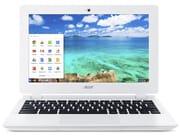 Acer Chromebook 11 | Acer Chromebook 11 | Acer Chromebook 11 | |
| Price | List Price: $199.99 Amazon Prices: | List Price: $169.99 Amazon Prices: | List Price: $199.99 Amazon Prices: |
| Model number | CB3-111-C8UB / NX.MQNAA.008 | CB3-111-C670 / NX.MQNAA.001 | CB3-111-C4HT / NX.MQNAA.011 |
| Performance Rating | 1.8 | 1.8 | 1.9 |
| Chromebook Plus | No | No | No |
| Processor | Dual-core 2.16 Ghz (max 2.41 Ghz) Intel Celeron N2830 | Dual-core 2.16 Ghz (max 2.41 Ghz) Intel Celeron N2830 | Dual-core 2.16 Ghz (max 2.58 Ghz) Intel Celeron N2840 |
| RAM | 2 GB | 2 GB | 2 GB |
| Internal Storage | 16 GB | 16 GB | 16 GB |
| Screen Size | 11.6" | 11.6" | 11.6" |
| Screen Resolution | 1366x768 | 1366x768 | 1366x768 |
| Screen Type | LED | LED | LED |
| Touch Screen | No | No | No |
| Stylus / Pen | No Stylus Support | No Stylus Support | No Stylus Support |
| Dimensions width x length x thickness | 11.8 x 8 x 0.73 inches (299.72 x 203.2 x 18.54 mm) | 11.8 x 8 x 0.73 inches (299.72 x 203.2 x 18.54 mm) | 11.8 x 8 x 0.73 inches (299.72 x 203.2 x 18.54 mm) |
| Weight | 2.65 lbs (1.2 kg) | 2.4 lbs (1.09 kg) | 2.65 lbs (1.2 kg) |
| Backlit Keyboard | No | No | No |
| Webcam | No Webcam | No Webcam | No Webcam |
| WiFi | 802.11ac MIMO | 802.11ac MIMO | 802.11ac MIMO |
| Bluetooth | Bluetooth 4.0 | Bluetooth 4.0 | Bluetooth 4.0 |
| Ethernet | No | No | No |
| Cellular Modem | No | No | No |
| HDMI | Full-Size HDMI | Full-Size HDMI | Full-Size HDMI |
| USB Ports | 1 USB 2.0, 1 USB 3 | 1 USB 2.0, 1 USB 3 | 1 USB 2.0, 1 USB 3 |
| Thunderbolt Ports | No | No | No |
| Card Reader | SD | SD | SD |
| Battery | 3 cell, 3220 mAh, Lithium-ion | 3 cell, 3220 mAh, Lithium-ion | 3 cell, 3220 mAh, Lithium-ion |
| Battery Life | 8.5 hours | 8.5 hours | 8.5 hours |
| Fanless | Yes | Yes | Yes |
| Auto Update Expiration Date | September, 2021 | September, 2021 | September, 2021 |
Related Chromebooks
-
 Acer Chromebook 311 (AMD)The Acer Chromebook 311 (CB311-10H) is an 11.6-inch ChromeOS laptop on an AMD A4-9120C with 4GB of…
 -
 Acer Chromebook 311 (CO731)The Acer Chromebook 311 (CO731) is a fanless 11.6-inch Chromebook with an Intel Celeron N4500, 4GB…
 -
 ASUS Chromebook C203XAThe ASUS Chromebook C203XA is a rugged 11.6-inch education laptop with a MediaTek MT8173C, an…
 -
 Lenovo Flex 3 ChromebookThe Lenovo Flex 3 Chromebook is a fanless 11.6-inch convertible with an IPS touchscreen, a MediaTek…
 -
 Dell Chromebook 3120The Dell Chromebook 3120 is a fanless 11.6-inch education Chromebook with an Intel N100, sold in…
 -
 Lenovo Chromebook 3 11"The Lenovo Chromebook 3 11 is a fanless 11.6-inch Chromebook with an Intel Celeron N4020, 4GB of…
A plastic shell NotebookCheck called cheap-feeling
The white plastic chassis keeps weight down to 1.25kg (2.75 lbs), light enough to carry in a backpack all day. NotebookCheck’s testing noted the plastics have a somewhat hollow sound when tapped, though after three weeks of use the unit remained “strong, well-assembled and scratch and smudge free.” The compact 299 x 202 x 18.7mm dimensions fit comfortably on small desks and airplane tray tables.
The keyboard is a standard Chrome OS layout with no backlight and no number pad. The trackpad responds reliably, though it lacks the glass-smooth feel of the premium alternatives sold alongside it.
Indoor-only brightness and off-axis color shift
The 11.6-inch panel runs at 1366x768, standard for a budget Chromebook of this era. NotebookCheck measured brightness at 208 cd/m² with a black level of 0.38, adequate for indoor use but struggling in bright environments. Colors wash out quickly when viewing from off-center positions. For document work and web browsing the display suffices; video enthusiasts and photo editors should look elsewhere.
Chrome OS stays responsive until the tabs pile up
The Intel Celeron N2830 clocks between 2.16-2.41 GHz across its two cores. NotebookCheck observed the applications menu takes over one second to respond, and loading large Google Drive documents can test patience. Email, social media, and light document work stay comfortable.
The 16GB eMMC storage achieves around 21,000 operations per second, respectable for the class. Cold boot to the login screen takes approximately 9 seconds.
All-day runtime with idle draw near 2 W
NotebookCheck’s testing recorded 9.2 hours of offline word processing, 9 hours 28 minutes of WiFi surfing, and 6 hours 34 minutes of 1080p H.264 video playback from the 36Wh battery. Real-world use typically falls between these figures depending on screen brightness and workload intensity. The fanless design keeps power draw low, at 2.1-6.8W idle and 8.6-9.4W under load.
The 32.7°C peak leaves it comfortable on a lap
The CB3-111 has no fan, so it makes no sound under any load. NotebookCheck measured a maximum chassis temperature of just 32.7°C (91°F) under load.
Audio good enough to skip headphones on a video call
NotebookCheck described the speakers as “stupid good: uncomfortably loud and clear for a computer this size.” Serious music listening still benefits from headphones connected via the combo audio jack.
Ports built for 2014, with no USB-C
The CB3-111 carries one USB 2.0 port, one USB 3.0 port, a full-size HDMI output for external displays, and a full-size SD card slot for storage expansion or photo transfer. The USB 3.0 port could also support a USB Ethernet adapter for wired networking. Wi-Fi 5 (802.11ac MIMO) and Bluetooth 4.0 handle wireless connectivity, a step behind Wi-Fi 6 on both range and speed.
Reviewer Insights
NotebookCheck faulted the display and the spacebar
NotebookCheck published a thorough review of the CB3-111 in November 2014 and awarded the device a 78% rating, concluding that “the CB3-111 appears to be the bargain of the bunch” against the other budget Chromebooks in their test pool. The reviewer’s broader summary praised the value: “The Acer CB3-111 is one of the cheapest laptops available and it does a good job of being clean, stable and efficient within 2GB of RAM and 16GB of storage.”
Their measurements cover 208 cd/m² peak display brightness, 0.38 cd/m² black level, 9.2 hours of offline word processing, 9 hours 28 minutes of WiFi surfing, 6 hours 34 minutes of 1080p H.264 video playback, idle power draw between 2.1 W and 6.8 W, and a maximum chassis temperature of 32.7°C (91°F) under sustained load. The reviewer’s main criticisms centered on the display’s limited brightness for outdoor use and the right spacebar area’s occasional unresponsiveness. They recommended the CB3-111 for “compact, affordable browsing-focused computing” while acknowledging its limitations for users needing more power or a better screen.
Battery and screen swaps are the repairs owners face
The failures that stop a CB3-111 now are mechanical. Swollen batteries and cracked screens are the common ones. The repair videos linked above (battery replacement and screen replacement, both from Screen Surgeons) walk through the two repairs an owner is most likely to need. Acer’s service manual for the CB3-111 documents the same disassembly path; the keyboard deck lifts after a row of screws around the perimeter, and the 36 Wh internal battery is held to the lower case by a few tabs and a single ribbon connector. None of this is technically difficult, but the white plastic chassis does scratch easily, so a plastic pry tool beats a screwdriver pried in at the seam.
Two software paths extend its life. One is Chrome OS Flex, Google’s own continuation of CloudReady, which targets older x86 hardware and is the closest “still feels like a Chromebook” option for a post-AUE CB3-111. The other is a lightweight Linux distribution loaded through developer mode and SeaBIOS; the CB3-111 has solid mainline Linux driver support thanks to its Bay Trail platform, and a minimal Xfce or LXQt desktop will run noticeably faster than the final Chrome OS build that shipped to the device.
Offline work is all that is left for it today
In its era the CB3-111 made sense as a lightweight note-taking machine for students and a low-stakes browser for family homework, where the silence and the battery life counted for more than speed.
Without security updates it is the wrong machine for online banking or any account worth protecting. Offline document work and media playback remain reasonable, and the Chrome OS Flex and Linux paths above buy the hardware more time for anyone willing to set them up.
For a similar budget Chromebook that still gets security updates, see our Chromebook comparison chart to find current options, or our guide to the best budget Chromebooks for updated recommendations.
Frequently Asked Questions
Is the Acer Chromebook 11 CB3-111 still supported?
No. The CB3-111 reached its Auto Update Expiration date in September 2021 and no longer receives Chrome OS updates or security patches from Google. It still boots and runs the last build that was pushed to the device, but it should not be used for online banking, password-protected accounts, or anything else that depends on current security fixes.
Can the RAM or storage be upgraded on the CB3-111?
The 2 GB of DDR3L RAM is soldered to the motherboard, and so is the 16 GB eMMC storage, so neither can be changed. Every CB3-111 shipped in the same 2 GB / 16 GB configuration, and the full-size SD card slot or an external USB drive is the only practical way to add space.
What processor came in the CB3-111?
Most CB3-111 SKUs shipped with the Intel Celeron N2830, a dual-core Bay Trail-M chip clocked between 2.16 and 2.41 GHz. A later refresh SKU (CB3-111-C4HT) shipped with the slightly faster Intel Celeron N2840, which raised the burst clock to 2.58 GHz. Both are fanless, use Intel integrated graphics, and sit behind the same 2 GB RAM ceiling.
How long does the battery last on a CB3-111?
On a healthy original 36 Wh battery, NotebookCheck measured 9.2 hours of offline word processing, 9 hours 28 minutes of WiFi surfing, and 6 hours 34 minutes of 1080p H.264 video playback. A cell that has been through a decade of charge cycles will do worse. If a CB3-111 only runs for two or three hours on a charge, the battery is the most likely cause, and the battery replacement video on this page covers the swap end-to-end.
Can I install Linux or Chrome OS Flex on the CB3-111?
Yes. The CB3-111 is a common target for post-AUE software extension. Chrome OS Flex is the closest “still feels like a Chromebook” option and is officially supported by Google for older x86 hardware. A lightweight Linux distribution (Xfce, LXQt, or similar) installed through developer mode and SeaBIOS is the other common path; the Bay Trail platform has good mainline Linux driver support, and a minimal desktop will run faster than the final Chrome OS build that shipped on the device.
What is the difference between the CB3-111 and the C720?
The CB3-111 was Acer’s 2014 successor to the C720. The biggest differences are the move to a fanless Bay Trail Celeron (N2830/N2840), a refreshed white plastic chassis with rounder edges, and the addition of 802.11ac WiFi. The C720 used the older Haswell Celeron 2955U (or Core i3 in higher trims), shipped with a small fan, and had user-upgradeable M.2 SATA storage; the CB3-111 traded that storage upgradeability for silent operation and lower idle power.
Where can I still buy a new Acer Chromebook 11 CB3-111?
You cannot. Acer and the major retailers stopped selling the CB3-111 years ago, and the remaining Amazon listings are refurbished or used. The $169 to $199 figures quoted here are the original list prices, not what a unit sells for now. For a current budget Chromebook with active Chrome OS updates, see the best budget Chromebooks guide.