
CTL Chromebox CBx1
Updated on

Note: This product has been discontinued and is no longer sold new. Google has set its Auto Update Expiration date to June 2028, so units still in service continue to receive Chrome OS updates until then. The information below is kept for owners of this device and for reference.
Released in 2018, the CTL Chromebox CBx1 was designed primarily for education and enterprise deployments where simplicity and reliability mattered more than consumer appeal. CTL, known for building rugged Chromebooks for K-12 classrooms, brought that same no-nonsense approach to this compact desktop. The CBx1 offered a compelling value proposition at its launch price of $219 for the base configuration, significantly undercutting competitors from ASUS and Acer while delivering comparable performance for web-based workflows.
The Intel Celeron 3865U processor at the heart of the CBx1 proved adequate for the Chrome OS experience, handling typical tasks like web browsing, Google Workspace applications, and light Android app usage without complaint. CTL offered configurations ranging from 4GB to 8GB of RAM and standardized on 32GB eMMC storage across all models, which kept costs down while providing sufficient space for Chrome OS and cached web content. The compact 5.83” x 5.85” footprint with a height of just 1.62” allowed the unit to tuck neatly behind monitors using a VESA mount or sit unobtrusively on desks alongside keyboards and mice.
CTL Chromebox CBx1 Comparison Chart
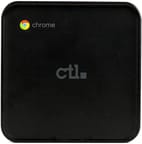 CTL Chromebox CBx1 | CTL Chromebox CBx1 | CTL Chromebox CBx1 | |
| Price | List Price: $539.00 Amazon Prices: | List Price: $299.00 Amazon Prices: | List Price: $719.00 Amazon Prices: |
| Model number | CBX1 2-in-1 | CBX1-4GB | CBX1-7 |
| Performance Rating | 2.6 | 2.6 | 6.0 |
| Chromebook Plus | No | No | No |
| Processor | Dual-core 1.80 Ghz Intel Celeron 3865U | Dual-core 1.80 Ghz Intel Celeron 3865U | Quad-core 1.80 Ghz (max 4.00 Ghz) Intel Core i7-8550U |
| RAM | 4 GB | 4 GB | 8 GB |
| Internal Storage | 32 GB eMMC | 32 GB eMMC | 32 GB eMMC |
| Screen Size | 21.5" | No Screen | No Screen |
| Screen Resolution | 1920x1080 | No Screen | No Screen |
| Screen Type | LED Backlight | No Screen | No Screen |
| Touch Screen | Yes | No | No |
| Stylus / Pen | No Stylus Support | No Stylus Support | No Stylus Support |
| Dimensions width x length x thickness | 18.8 x 10.6 x 6.5 inches (477.52 x 269.24 x 165.1 mm) | 5.83 x 5.85 x 1.62 inches (148.08 x 148.59 x 41.15 mm) | 5.83 x 5.85 x 1.62 inches (148.08 x 148.59 x 41.15 mm) |
| Weight | 8 lbs (3.64 kg) | 3 lbs (1.36 kg) | 3 lbs (1.36 kg) |
| Backlit Keyboard | No | No | No |
| Webcam | No Webcam | No Webcam | No Webcam |
| WiFi | 802.11 a/b/g/n/ac (2x2) | 802.11 a/b/g/n/ac (2x2) | 802.11 a/b/g/n/ac (2x2) |
| Bluetooth | Bluetooth 4.2 | Bluetooth 4.2 | Bluetooth 4.2 |
| Ethernet | Yes | Yes | Yes |
| Cellular Modem | No | No | No |
| HDMI | Full-Size HDMI | Full-Size HDMI | Full-Size HDMI |
| USB Ports | 2 USB 2.0, 3 USB 3, 1 USB-C (for dual monitor support) | 2 USB 2.0, 3 USB 3, 1 USB-C (for dual monitor support) | 2 USB 2.0, 3 USB 3, 1 USB-C (for dual monitor support) |
| Thunderbolt Ports | No | No | No |
| Card Reader | microSD Card Reader | microSD Card Reader | microSD Card Reader |
| Battery | No Battery | No Battery | No Battery |
| Battery Life | 0.0 hours | 0.0 hours | 0.0 hours |
| Fanless | No | No | No |
| Auto Update Expiration Date | June, 2028 | June, 2028 | June, 2028 |
Related Chromebooks
-
 ASUS Chromebox 5The ASUS Chromebox 5 delivers modern desktop Chrome OS performance with 12th-gen Intel processors,…
 -
 Lenovo Chromebox MicroAn ultra-compact, fanless Chromebox designed for digital signage and specialized deployments,…
 -
 Acer Chromebox CXI5A compact Chrome OS desktop with 12th Gen Intel processors, USB-C with DisplayPort output, and…
 -
 Acer Chromebook 311 (AMD)The Acer Chromebook 311 combines an 11.6-inch ComfyView screen, robust AMD processing, and 10-hour…
 -
 ASUS Chromebook C203XAThe ASUS Chromebook C203XA shines with military-grade durability, an 11.6-inch anti-glare HD…
 -
 CTL Chromebox CBx3The CTL Chromebox CBx3 brings 13th Gen Intel Raptor Lake processors to Chrome OS desktops,…
Detailed Insights
The CTL Chromebox CBx1 adopted a utilitarian design philosophy that prioritized function over form. The matte black plastic enclosure lacked the polish of consumer electronics but proved practical for institutional environments where aesthetics ranked lower than durability and ease of deployment. A single cooling fan kept the Celeron 3865U within safe temperatures during extended operation, though the noise remained unobtrusive enough for quiet office settings. The small footprint made it equally suitable for VESA mounting behind monitors, hiding the computer from view entirely, or placing on a desktop surface where space came at a premium.
Connectivity options covered the bases that IT administrators and end users needed most. Five USB Type-A ports (three USB 3.0 and two USB 2.0) provided ample room for keyboards, mice, webcams, and storage devices without requiring a hub. The single USB Type-C port offered additional flexibility for modern peripherals, though it predated the widespread adoption of USB-C displays. HDMI output supported dual-monitor configurations through USB-C adapters, enabling productive workstation setups for users who needed more screen real estate. Gigabit Ethernet ensured reliable network connections in environments where WiFi congestion or security policies favored wired networking, while 802.11ac WiFi and Bluetooth 4.2 handled wireless duties when cables proved impractical.
The 32GB eMMC storage remained the most significant constraint for users who wanted to install numerous Android applications or maintain large offline file libraries. While Chrome OS excels at leveraging cloud storage through Google Drive, those accustomed to keeping substantial local files found themselves managing space more carefully than on devices with larger drives. The microSD card slot offered some relief, accepting cards for photo storage, offline media, or additional Android application data, though internal storage expansion through hardware upgrades was not possible.
Reviewer Insights on the CTL Chromebox CBx1
Corbin Davenport’s Perspective (Android Police)
Corbin Davenport at Android Police reviewed the CBx1 at launch and found it to be a solid budget option for those who understood Chrome OS’s strengths and limitations. His testing revealed that the device proved “surprisingly capable, given it only has a dual-core processor,” handling around fifteen simultaneous Chrome tabs without noticeable slowdown during typical browsing sessions.
The review highlighted Chrome OS’s inherent advantages that made the CBx1 a sensible choice: “easy to set up, you’ll never notice the system updates, viruses/malware are non-existent, and it’s incredibly fast on low-end hardware.” Davenport noted the comprehensive port selection as a strength, particularly the five USB Type-A ports that eliminated the need for external hubs in most configurations. The $219 starting price positioned it as excellent value compared to competitors.
Criticism focused on the utilitarian design that lacked visual appeal compared to consumer-focused alternatives like Acer’s Chromebox lineup. Davenport also pointed out that unlike some competitors, CTL did not include a keyboard or mouse in the base package, adding to the total cost for buyers starting from scratch. Some Android applications underperformed on the non-touch display, a limitation inherent to Chromeboxes that relied on mouse and keyboard input rather than touchscreens.
Use Cases and Target Audience
The CTL Chromebox CBx1 found its natural home in educational institutions, libraries, and small businesses that needed simple, manageable computing solutions. IT departments appreciated the straightforward deployment through Google Admin Console, which allowed them to configure and monitor multiple devices remotely without touching each unit individually. The absence of local software installations and automatic Chrome OS updates eliminated the maintenance burdens that plagued traditional Windows deployments, freeing technical staff to focus on more complex issues.
Libraries deployed the CBx1 as public access terminals where patrons could check email, browse the web, and access digital resources without concern for malware or unauthorized software installations. The Chromebox’s ability to power-wash (factory reset) at logout ensured each user started with a clean session, protecting privacy while maintaining consistent performance. Educational environments used it for computer labs, media centers, and administrative workstations where the simplicity of Chrome OS and integration with Google Workspace aligned with existing infrastructure.
Home users who wanted a simple desktop experience for web browsing, streaming, and basic productivity also found value in the CBx1. The desktop form factor and USB ports made it suitable for connecting audio interfaces for music production using web-based DAWs like BandLab. The compact form factor suited entertainment centers and home offices where a full-sized tower would overwhelm the available space. Those who spent most of their computing time in a browser discovered that Chrome OS delivered everything they needed without the complexity or cost of traditional desktop operating systems.
Conclusion
The CTL Chromebox CBx1 served its target audience of education and enterprise customers well during its production run, delivering reliable Chrome OS desktop computing at an aggressive price point. While it never achieved the consumer recognition of Chromeboxes from ASUS or Acer, institutions that valued manageability and total cost of ownership over brand prestige found a dependable workhorse. CTL no longer sells the CBx1 new, but Google has set its Auto Update Expiration date to June 2028, so units still in service keep receiving Chrome OS updates until then. It represents an era when Chrome OS was still establishing itself in the desktop market.
For those seeking a modern Chromebox with current software support, consider the ASUS Chromebox 5 or explore our Chromebook Comparison Chart to find a device that meets current needs while receiving ongoing security updates.
Frequently Asked Questions
Is the CTL Chromebox CBx1 still receiving software updates?
Yes. Google has set the CTL Chromebox CBx1’s Auto Update Expiration (AUE) date to June 2028, so it continues to receive Chrome OS updates, security patches, and new features from Google until then. After June 2028 the device will keep working but will no longer receive updates, at which point using it for tasks involving sensitive information like banking or online shopping is not recommended due to potential security vulnerabilities.
Can I upgrade the RAM or storage on the CTL Chromebox CBx1?
The internal RAM and eMMC storage cannot be upgraded on the CTL Chromebox CBx1 as they are soldered to the motherboard. However, you can expand available storage using the microSD card slot, which accepts cards for additional photos, documents, and offline media files. External USB drives also work well for expanding storage capacity.
What was the difference between the CTL Chromebox CBx1 variants?
CTL offered three main configurations of the CBx1. The base CBX1-4GB model included 4GB of RAM and 32GB storage at $299. The CBX1-7 stepped up to 8GB of RAM while maintaining 32GB storage, priced at $719 (this variant used an Intel Core i7 processor). A 2-in-1 variant (CBX1 2-in-1) was also offered at $539 with touchscreen capabilities. All versions shared the same compact form factor and connectivity options.
Can the CTL Chromebox CBx1 support dual monitors?
Yes, the CTL Chromebox CBx1 supports dual monitor configurations. The built-in HDMI port handles one display, while the USB Type-C port can drive a second monitor through a USB-C to HDMI adapter or USB-C hub with video output. CTL specifically noted dual monitor support as a feature of this Chromebox model.
Is the CTL Chromebox CBx1 fanless?
No, the CTL Chromebox CBx1 includes an active cooling fan to keep the Intel Celeron 3865U processor within safe operating temperatures. However, reviewers noted that the fan noise remained minimal and unobtrusive during typical use, making it suitable for quiet office environments.
What should I do if I still own a CTL Chromebox CBx1?
If you still have a working CTL Chromebox CBx1, it continues to receive Chrome OS security updates through its June 2028 Auto Update Expiration date, so it remains usable for everyday web browsing, media, and productivity until then. Once updates end in June 2028, avoid using it for banking, online shopping, or any activity involving personal information. For a newer Chromebox with a longer support window, consider the ASUS Chromebox 5 or Acer Chromebox CXI5.