
Beelink EQ mini (Core 3 304)
Published on

The Beelink EQ mini (Core 3 304) is a small Windows desktop for office work in a home or small office that keeps its files on a fast NAS. The case is about 4.4 inches square, the power supply sits inside it, and the back carries a 10GbE port and two Thunderbolt 4 ports. Its 12GB of memory is soldered to the board, and Beelink sells no other amount. Buyers who expect to need more memory, or a second Ethernet port, should look at the larger Beelink EQi 304 instead.
Pros and Cons
| Pros | Cons |
|---|---|
| 10GbE RJ45 port for fast transfers to a NAS or server | 12GB of LPDDR5 is soldered, with no larger configuration |
| Two Thunderbolt 4 ports at 40Gbps with DisplayPort 1.4 | Memory runs single-channel, which limits graphics and multi-threaded work |
| Built-in 45W power supply, no external brick | Only one Ethernet port, where the EQi 304 adds a 2.5GbE port |
| Three 4K 60Hz displays from HDMI plus both Thunderbolt ports | M.2 slots are PCIe 4.0 x2 and x1, so neither runs at full x4 speed |
| Two M.2 2280 slots add up to 8TB beside the 512GB onboard flash | A single Xe3 graphics core rules out modern gaming |
| Weighs 0.82 pounds | Wi-Fi 6E support is unconfirmed, since Beelink lists both Wi-Fi 6 and Wi-Fi 6E |
Beelink EQ mini (Core 3 304) Comparison Chart
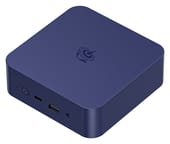 Beelink EQ mini (Core 3 304) | |
| Price | List Price: $429.00 Amazon Prices: Loading prices... |
| Version | 12GB/512GB/Intel Core 3 304 |
| Performance Rating | 3.4 |
| Operating System | Windows 11 Pro |
| Processor | 5-core 1.50 Ghz (max 4.30 Ghz) Intel Core 3 304 |
| GPU | Integrated Intel Graphics |
| RAM | 12 GB LPDDR5, single-channel (Soldered LPDDR5-5600, not upgradeable) |
| Internal Storage | 512 GB UFS 3.1 |
| Dimensions width x length x thickness | 4.41 x 4.41 x 1.46 inches (112.01 x 112.01 x 37.08 mm) |
| Weight | 0.82 lbs (0.37 kg) |
| WiFi | Wi-Fi 6 (802.11ax) |
| Bluetooth | Bluetooth 5.2 |
| Ethernet | 1 Ethernet port at 10 Gbps |
| HDMI | 1 Full-Size HDMI Port |
| DisplayPort | DP 1.4 via both Thunderbolt 4 ports |
| VGA | No VGA Ports |
| USB Ports | 2 USB 2.0, 1 USB 3, 1 USB-C Front: 1x USB-A 3.2 (10Gbps), 1x USB-C (10Gbps). Rear: 2x Thunderbolt 4, 2x USB 2.0 |
| Thunderbolt Ports | 2 |
| OCuLink | No |
| Internal SATA Ports | No SATA ports |
| Card Reader | No Card Reader |
| Headphone Jack | combo |
| Fanless | No |
| VESA Mount | No |
| In the Box | Mini PC, AC power cable, HDMI cable (100cm), user manual |
| Expandability | 12GB LPDDR5 soldered, not upgradeable. Dual M.2 2280 PCIe 4.0 slots to 8TB. |
Related Mini PCs
-
 Beelink EQi 304The Beelink EQi 304 pairs Intel's 5-core Core 3 304 "Wildcat Lake" chip with a 10GbE port, a 2.5GbE…
-
 Beelink EQi13The Beelink EQi13 is a five-inch-square Windows 11 Pro mini PC with its 85W power supply inside the…
-
 Lenovo Yoga Mini iLenovo's round 5-inch aluminum desktop puts Intel Panther Lake in a 1.3-pound chassis with dual…
-
 ACEMAGIC AD15The ACEMAGIC AD15 is an Intel mini PC sold with an 11th or 12th-gen Core i5 (or the 8-core Core…
-
 BOSGAME P4 PlusThe BOSGAME P4 Plus pairs an AMD Ryzen 7 5825U with dual 2.5GbE, Wi-Fi 6E, swappable DDR4, and one…
-
 iKOOLCORE R2The iKOOLCORE R2 is a palm-sized networking mini PC with four 2.5GbE ports (three Intel i226-V, one…
Ports, storage, and the Core 3 304

Without its rubber feet the case is about 4.4 inches square and 1.5 inches tall, and the bare unit weighs 0.82 pounds. The front panel holds a power LED, a 3.5mm audio jack, a USB-A 3.2 port at 10Gbps, a USB-C port at 10Gbps for data, the power button, and a clear CMOS pinhole. The back carries the AC inlet, the 10GbE RJ45 jack, an HDMI output rated for 4K at 60Hz, two USB 2.0 ports, and the two Thunderbolt 4 ports. Beelink notes that the Thunderbolt ports do not accept power, so the machine always runs from the internal supply. The product page also lists Wake-on-LAN and an automatic power-on setting.
The Intel Core 3 304 has five cores and five threads: one performance core that boosts to 4.3GHz and four low-power efficiency cores that reach 3.3GHz, with 6MB of cache and a 15W base power rating. Its PassMark CPU Mark of about 12,303 puts it in the everyday-productivity tier, comfortable for office suites, browsing, and video calls. The integrated graphics are a single Xe3 core that Beelink rates at up to 2.3GHz. Beelink quotes 24 TOPS of AI throughput across the chip, and Intel’s specification sheet credits 15 TOPS of that to the NPU. Intel launched the chip in 2026.
Storage starts with 512GB of UFS 3.1 flash on the board. Two M.2 2280 slots sit under a heatsink for NVMe drives up to 4TB each, but they are wired differently: the first runs at PCIe 4.0 x2 and the second at PCIe 4.0 x1, so the faster drive belongs in the first slot. Memory is 12GB of LPDDR5-5600, soldered in place, and the Core 3 304 provides only one memory channel. Wireless comes from a MediaTek MT7922 module with Bluetooth 5.2. Beelink calls it Wi-Fi 6 in its specification table and Wi-Fi 6E in its feature list, so 6E support is unconfirmed. The box includes a 100cm HDMI cable, an AC power cable, and a user manual, with no VESA mounting bracket listed.
How the EQ mini differs from the EQi 304

Beelink launched the EQ mini, the EQi, and the ME Pro NAS together in May 2026, all on the Core 3 304 with 10GbE and two 40Gbps ports. The EQi 304 is the larger of the two desktops at about 5 inches square, with an 85W internal supply, a second Ethernet port at 2.5GbE, and memory options up to a 64GB SO-DIMM. The EQ mini drops the 2.5GbE port and the memory slot to fit a smaller case with a 45W supply. The processor, the onboard UFS storage, the M.2 layout, and the rear Thunderbolt 4 pair are the same on both.
Reviewers have measured the same chip in the EQi 304, and its page has their speed, power draw, and noise results. The EQ mini runs that chip on the same single memory channel, so those numbers apply to the processor, though the smaller case and 45W supply could change fan noise and sustained clocks. Beelink quotes a 32 dB noise level for the EQ mini.
The Beelink EQ mini (Intel N150) shares the name and the small footprint but is a different machine. It has two HDMI ports and Gigabit Ethernet in place of the 10GbE jack and Thunderbolt 4 ports, and it uses the older Intel N150 chip.
Should you buy it?
The EQ mini makes sense on a cramped desk wired to a 10GbE NAS or server, where the fast network port and three-monitor support matter more than memory headroom. The Core 3 304 is enough for office work and browsing, and with the supply inside the case there is one power cord to route. Wake-on-LAN and automatic power-on suit a machine that stays on all day.
It is a poor fit if you may outgrow 12GB of memory, since none of it can be replaced, or if you need a second Ethernet port. Games are also out with one Xe3 graphics core on single-channel memory. The Beelink EQi 304 adds an upgradeable memory slot and a 2.5GbE port on the same chip, and the Beelink EQ mini (Intel N150) covers basic desk work without 10GbE. Starry Hope’s Mini PC Comparison Chart lines up the specifications side by side.
Frequently Asked Questions
What processor does the Beelink EQ mini 304 use?
The Intel Core 3 304, an entry-level “Wildcat Lake” chip made on Intel’s 18A process. It has five cores, one of them a performance core, and a PassMark CPU Mark of about 12,303.
Can I upgrade the RAM in the Beelink EQ mini 304?
No. The 12GB of LPDDR5-5600 is soldered to the board, with no slot for more. The larger Beelink EQi 304 has models with a DDR5 SO-DIMM slot that takes up to 64GB.
What ports does the Beelink EQ mini 304 have?
Two Thunderbolt 4 ports at 40Gbps, a 10Gbps USB-C port, a 10Gbps USB-A port, two USB 2.0 ports, one HDMI output, a 10GbE jack, and a 3.5mm audio jack. It has no card reader.
How many monitors can the Beelink EQ mini 304 drive?
Three, each at 4K and 60Hz. One connects to the HDMI port and the other two to the Thunderbolt 4 ports, which carry DisplayPort 1.4.
How much storage can the Beelink EQ mini 304 hold?
512GB of UFS 3.1 flash comes on the board. Two M.2 2280 slots take NVMe drives up to 4TB each, for up to 8TB more.
Does the Beelink EQ mini 304 need an external power brick?
No. The 45W supply sits inside the case, so a standard AC cord is the only power cable.
What is the difference between the Beelink EQ mini 304 and the EQi 304?
The EQi 304 is the larger box, with an 85W supply, an extra 2.5GbE port, and models with a DDR5 memory slot. The EQ mini gives those up for a smaller case and 12GB of soldered memory. The chip, the 10GbE port, and the Thunderbolt 4 pair are the same on both.
Is the Beelink EQ mini 304 good for gaming?
No. The integrated graphics are a single Xe3 core fed by single-channel memory, which handles video playback and three displays but not modern games. A mini PC with AMD Radeon graphics or a discrete GPU is a better fit for gaming.