
VZMORE AX9 Max
Published on

The VZMORE AX9 Max is a small desktop replacement for office work, photo and video editing, local AI with mid-size models, and 1080p gaming with upscaling. Wccftech called it the first Ryzen AI 400 mini PC it had tested with a vapor chamber cooler. The memory sits in two replaceable slots. The cooler held full load for an hour without throttling in Hubwood’s test, but Tech Notice saw the CPU reach 100°C with the PC stood on its side. TechRadar found the 32GB it ships with limiting for heavy creative work and larger AI models. VZMORE is a new brand that launched its mini PCs at IFA in September 2026, and it sells this model in one configuration.
Pros and Cons
| Pros | Cons |
|---|---|
| Ryzen AI 9 HX 470 (12 cores, 24 threads, about 36,900 on PassMark) with Radeon 890M graphics and a 55 TOPS NPU | The HX 470 is a small step over the HX 370; Tech Notice found the difference marginal in its side-by-side tests |
| Vapor chamber cooling held full load for an hour without throttling in Hubwood’s tests | The fan is audible under full load in the default and turbo modes (about 40 and 47 dB in Hubwood’s measurements) |
| 32GB of DDR5-5600 on two SO-DIMM slots, upgradeable to 256GB | TechRadar found 32GB limiting for creative work and larger AI models; runs much hotter mounted on its side (Tech Notice) |
| Two USB4 ports, two HDMI 2.1 outputs, and four displays at once | Both USB-C ports are on the back |
| Two 2.5GbE ports, WiFi 7, Bluetooth 5.4, and a full-size SD 4.0 reader | The second M.2 slot takes only short 2230 drives |
| Low power draw: 5.2W idle and about 30W peak in Neowin’s PCMark 10 run | Neowin found the Wi-Fi antenna leads short and hard to reconnect; LatencyMon results rule out audio production work |
Related Videos
VZMORE AX9 Max Comparison Chart
 VZMORE AX9 Max | |
| Price | List Price: $1499.00 Amazon Prices: Loading prices... |
| Version | 32GB/1TB/Ryzen AI 9 HX 470 |
| Performance Rating | 6.4 |
| Operating System | Windows 11 Pro |
| Processor | Twelve-core 2.00 Ghz (max 5.20 Ghz) AMD Ryzen AI 9 HX 470 |
| GPU | Integrated AMD Radeon 890M |
| RAM | 32 GB DDR5 SO-DIMM, 2-channel (2x 16GB DDR5-5600 SO-DIMM) |
| Internal Storage | 1 TB PCIe 4.0 NVMe SSD |
| Dimensions width x length x thickness | 5.31 x 5.19 x 2.27 inches (134.87 x 131.83 x 57.66 mm) |
| Weight | 1.71 lbs (0.78 kg) |
| WiFi | Wi-Fi 7 (802.11be) |
| Bluetooth | Bluetooth 5.4 |
| Ethernet | 2 Ethernet ports at 2.5 Gbps |
| HDMI | 2 Full-Size HDMI Ports |
| DisplayPort | DP 2.0 Alt Mode on both USB4 ports |
| VGA | No VGA Ports |
| USB Ports | 1 USB 2.0, 5 USB 3, 2 USB-C (2 USB4) 2x USB4 40Gbps (rear), 5x USB-A 10Gbps, 1x USB 2.0 |
| Thunderbolt Ports | No |
| OCuLink | No |
| Internal SATA Ports | No SATA ports |
| Card Reader | SD Card Reader |
| Headphone Jack | front |
| Fanless | No |
| VESA Mount | Yes |
| In the Box | Mini PC, 120W power adapter, HDMI cable, VESA mount, screws, manual |
| Expandability | 2x DDR5 SO-DIMM, up to 256GB. Free M.2 2230 slot (PCIe 4.0 x4). USB4 for an eGPU. |
Related Mini PCs
-
 GEEKOM A9 MaxA 0.8-liter metal Ryzen AI 9 mini PC for creators and developers, with memory and storage you can…
-
 HP Z2 Mini G1aProfessional-grade compact workstation with AMD Ryzen AI Max+ PRO processors and unified memory…
-
 MINISFORUM MS-S1 MAXA high-performance AI workstation powered by the AMD Ryzen AI Max+ 395 with 128GB unified memory,…
-
 ACEMAGIC F2AA 5-inch-square ACEMAGIC mini PC sold with either Intel's Core Ultra X7 358H and Arc B390 graphics…
-
 MINISFORUM M2 ProFor buyers who want strong integrated graphics and 10GbE in one box and can live with a fixed 32GB…
-
 GMKtec EVO-T2The GMKtec EVO-T2 is an Intel Panther Lake mini PC announced at CES 2026, rated by GMKtec at up to…
Vapor chamber cooling, two USB4 ports, and socketed DDR5

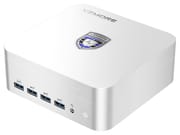
The AX9 Max measures about 5.3 x 5.2 x 2.3 inches and weighs about 1.7 pounds without its 120W external power brick. The shell is light gray metal with an embossed “VZ” on the front and a shield badge on the lid, and the base is a vented composite panel where all the intake air enters. The front holds four 10Gbps USB-A ports (one keeps powering devices while the PC is off), a 3.5mm headset jack, and the power button. The rear has two USB4 ports at 40Gbps with DisplayPort 2.0 output, one of which also accepts 100W USB-C power, plus a 10Gbps USB-A port, a USB 2.0 port, two HDMI 2.1 outputs, two 2.5GbE jacks, and the barrel power input. The SD 4.0 card slot sits on the side.
Inside, the Ryzen AI 9 HX 470 is AMD’s Zen 5 chip from January 2026, with four full Zen 5 cores and eight Zen 5c cores, a 5.2GHz boost, and a 16-compute-unit Radeon 890M. The BIOS has three power modes that VZMORE rates at 45W (silent), 54W (balanced), and 65W (performance), and there is no Windows app for switching them. Wccftech saw the performance mode reach 80W. Air flows from the base over the RAM and SSD, across the chamber, and out the rear vents.
Memory is two 16GB DDR5-5600 SO-DIMMs running in dual channel. Storage is a 1TB PCIe 4.0 SSD in the M.2 2280 slot, with a second PCIe 4.0 x4 slot that only fits 30mm (M.2 2230) drives. Getting inside means prying four small rubber feet off the base, removing screws, and lifting the bottom plate, and Neowin warns that the Wi-Fi antenna leads are short and hard to reconnect if they come off. Windows 11 Pro is preinstalled without bloatware, according to both Neowin and Hubwood.
Reviewer Insights

Neowin
Neowin scored the AX9 Max 9 out of 10 and ran it against two other HX 470 mini PCs, the ACEMAGIC F2A and a GEEKOM A9 MAX with a single memory stick. The AX9 Max posted 15,752 in Geekbench 6 multi-core, 5,023 in Cinebench 2026 multi-core, 125,311 in 7-Zip, and 4,078 in 3DMark Time Spy, leading both rivals on CPU tests and trailing the F2A slightly on graphics. Cyberpunk 2077 at 1080p with tweaked settings reached 95.25fps, and the review calls the Radeon 890M roughly equal to a GTX 1650.
The unit drew 1.0W switched off, 5.2W at idle, and about 30W at most during PCMark 10 Extended. The CPU peaked at 90.9°C, but the outer shell never passed 34°C on a thermal camera and the fan never made an annoying noise. File copies over the network saturated the 2.5GbE link. Neowin’s complaints were the price without a discount, the lack of a front USB-C port, and the short Wi-Fi antenna leads inside.
Wccftech
Wccftech opened by noting that “While we have tested many Ryzen AI 400 Mini PCs, the one from VZMORE is the first with a vapor chamber cooler and a TDP of up to 80W.” In its tests the AX9 Max ran close to Intel’s 16-core Core Ultra X7 358H and up to 25% ahead of the Ryzen AI 9 HX 370 in multi-threaded tests. On thermals: “We noticed a 10C drop versus the non-vapor-chamber Mini PCs that used the same chip, despite running at a higher TDP rating of 80W.”
For local AI, Wccftech wrote that “Based on the tests we conducted, most 7-20b AI LLMs ran decently on the machine, making it a replacement for many cloud services which you would otherwise have to pay for.” Its listed cons were the high price, which it tied to memory shortages, and GPU performance that it found a bit lacking next to newer integrated graphics.
TechRadar
TechRadar rated the AX9 Max 4 out of 5, with 15,845 in Geekbench 6 multi-core, 21,568 in Cinebench R23 multi-core, and SSD reads of about 6,048MB/s. The memory and storage were its main reservation: “Throughout the test, the creative applications and handling of video and image files were limited by the 32GB of RAM and 1TB SSD.” The 32GB limit also held back the local AI tests: “while general performance was good, especially for models that utilised the NPU, I could see where the 32GB RAM limit restricted what the machine could potentially do, limiting it as the best mini PC specifically for AI workloads.” The review concludes that buyers need to spend more on upgrades to get the most out of the CPU.
Yanko Design
Yanko Design ran local models, long heavy tasks, and Fortnite on it, and reported that “During our extended heavy tasks, the AX9 Max maintained performance without an observed sustained slowdown.” It described the fan as clearly audible under that load, but not exceptionally loud. In display tests, 5K and 6K monitors worked over USB-C DisplayPort, while HDMI flickered and then lost the picture with those screens; the review did not establish the cause.
Hubwood
Hubwood measured each power mode. In the default mode the CPU held about 55W at roughly 80°C in a 10-minute Cinebench 2026 run, at about 40 dB from 50cm; turbo raised that to 65W, about 86°C, and 47 dB, and silent mode dropped to 32 dB while losing only about 4% in Cinebench 2026 multi-core. “I did not experience any thermal throttling of the CPU, RAM, or anything else even after an hour of full power neither in games nor in benchmarks.” The unit scored 23,767 in Cinebench R23 multi-core and 5,112 in Cinebench 2026, and idled at 6.5W from the wall. The SSD read and wrote at about 4.6GB/s, and the Puget Systems benchmarks gave 10,819 in Photoshop and 30,105 in Premiere Pro, which Hubwood called enough for full HD and basic 4K editing.
At 1080p with FSR upscaling, Hubwood measured about 62fps in Arena Breakout and 61fps in Hogwarts Legacy at medium settings, 50fps in Kingdom Come Deliverance 2, and about 66fps in Forza Horizon 6. Fortnite ran at 121fps on the low preset. Cyberpunk 2077 showed no measurable difference between the three power modes. The weak spots were Blender rendering and audio work: “The LatencyMon test gives a clear no-no to any audio production.” On settings: “Personally, I would just ignore the turbo mode.” The same test also ran in German on the LaptopLiebe channel.
Tech Notice
Tech Notice set the AX9 Max beside a MINISFORUM mini PC with last year’s Ryzen AI 9 HX 370. In the default power mode the AX9 Max started at 65W and dropped to about 55W under a long CPU load, and it trailed the HX 370 machine in Cinebench multi-core; switching the BIOS fan setting to performance raised that to 80W at the start and 65W sustained; once he stopped a background Windows update, the two scored about the same in Cinebench. The HX 470 machine was faster on the GPU test and in a local chat with a Google Gemma model (20.2 versus 17.9 tokens per second), and its memory bandwidth was higher. Its conclusion was that “the performance is so marginally different that it doesn’t really matter that much.”
Tech Notice also tested orientation. With the PC stood on its side, the CPU climbed to 100°C and power fell from 80W toward 65W; laid flat again at the same 65W, it dropped from 97°C to 81°C. The reviewer estimated the worst orientation costs maybe 5 to 10% in performance and closed with “Don’t put it on the side.” Hanging it from the included VESA mount on the back of a monitor puts it on its side, a setup the reviewer raised while testing.
IceCubes
IceCubes ran Cinebench in each BIOS profile. Dropping from performance (65W) to normal (55W) cut the Cinebench multi-core score by about 4%, and silent (about 45W) took off about as much again, so “the quietest results come at the cost of about 8% overall CPU performance.” The CPU did not throttle in any of his Cinebench runs, but the fan stayed at low speed for about a minute and a half after a load started. Average temperatures were 77°C at 55W and 71°C at 45W, while in performance mode “temps can reach the mid-90s” before the fan fully kicks in. He suggested the normal or silent profile, because performance mode “doesn’t really offer enough benefit to warrant the extra power consumption, noise, and heat.”
He usually leaves FSR upscaling out of his game tests. At 1080p the AX9 Max averaged over 160fps in Counter-Strike 2 at low settings, over 60fps in GTA 5 Enhanced at high settings with dips into the 40s, a little over 30fps in Baldur’s Gate 3 at high, and 33fps in Kingdom Come Deliverance 2 at medium. The free edition of DaVinci Resolve, which leaves the work to the CPU, took about 7 minutes to render a 5-minute 4K60 timeline, and Blender’s classroom scene finished in just under 4 minutes on either the CPU or the GPU. Getting inside is “unnecessarily awkward” in his view, because the screws sit under rubber plugs that have to be pried out. He would also have liked an OCuLink port for an external graphics card, and noted that VZMORE sells only the one 32GB/1TB configuration.
zWORMz Gaming
zWORMz Gaming played recent games at 1080p in the 65W performance mode. Unreal Engine 5 titles were hard going: Gears of War: E-Day ran at about 30fps at native 1080p on its lowest settings. With FSR on quality, Arc Raiders ran at 60 to 70fps, Ghost of Tsushima averaged 60fps at low settings with 43fps 1% lows, and The Last of Us Part II Remastered held about 50fps on the low preset. Hogwarts Legacy stuttered, with 1% lows as low as 22fps, and he could not recommend it on this machine. His summary: “Older AAA titles will run pretty well. Optimized games will also run decently.”
He found the fan barely audible in the balanced and silent modes. “On performance mode, if you’re loading up GPU to 100% and the CPU at the same time to 100%, it is very audible,” though he added that “it’s still better than most mini PCs that I’ve tried here in the channel.” He wished one of the front ports were USB-C, and called it “a very expensive machine for what you’re getting in terms of gaming performance.”
WELSHYTECH
WELSHYTECH scored 4,926 multi-core and 667 single-core in Cinebench 2026 at 65W. At 1080p on low settings he measured 125fps in Fortnite, 68fps in Far Cry 6 (59fps 1% lows), and 46fps in Hogwarts Legacy (33fps 1% lows); at 1440p low those fell to 85, 44, and 26fps. In a 20-minute Cinebench 2026 run the CPU peaked at 80°C, and in his other tests the GPU reached 78°C, the two memory modules 55°C and 56°C, and the SSD 48°C. He said the fan “wasn’t even that loud when it was full blast.”
Our verdict
The AX9 Max suits someone who wants an HX 470 desktop that sits flat on a desk and lets you swap the memory later. Yanko Design saw no sustained slowdown in its long runs, its idle draw is low, and the two USB4 ports leave room for an external GPU. It has no OCuLink port; the GMKtec EVO-X1 Pro has one and ships with 64GB soldered, and the MINISFORUM AI X1 Pro-470 has one and also uses SO-DIMMs.
Skip it if you plan to mount it on its side, need a front USB-C port, want to run AI models that 32GB of memory cannot hold, or do low-latency audio work. Tech Notice measured only a small gap between the HX 470 and the HX 370, so an HX 370 machine is worth pricing against it. For more options, see our Mini PC Comparison Chart.
Frequently Asked Questions
What processor does the VZMORE AX9 Max use?
It uses the AMD Ryzen AI 9 HX 470, a 12-core, 24-thread Zen 5 chip from January 2026 that boosts to 5.2GHz and scores about 36,900 on PassMark’s CPU test. It has Radeon 890M graphics with 16 compute units and a 55 TOPS NPU, for 86 TOPS combined. VZMORE rates it at 45W, 54W, or 65W depending on the BIOS power mode.
Can I upgrade the RAM in the VZMORE AX9 Max?
Yes. It ships with two 16GB DDR5-5600 SO-DIMMs in dual channel, and VZMORE rates the two slots for up to 256GB.
What ports does the VZMORE AX9 Max have?
It has two USB4 ports, six USB-A ports, two HDMI 2.1 outputs, two 2.5GbE jacks, an SD 4.0 reader, and a headset jack. Both USB-C ports are on the back, so the front offers only USB-A.
How loud is the VZMORE AX9 Max?
It is near silent at idle and during video playback. Under full CPU load Hubwood measured about 40 dB at 50cm in the default mode, 47 dB in turbo mode, and 32 dB in silent mode, which cost only about 4% of Cinebench 2026 performance. Yanko Design heard the fan under heavy work but did not find it exceptionally loud.
Can the VZMORE AX9 Max play games?
Yes, at 1080p with upscaling. Neowin reached 95.25fps in Cyberpunk 2077 at 1080p with tweaked settings, and Hubwood measured 61 to 66fps in Hogwarts Legacy and Forza Horizon 6 at medium settings with FSR. Kingdom Come Deliverance 2 ran at 50fps in Hubwood’s test.
What’s included in the box with the VZMORE AX9 Max?
The box holds the mini PC, a 120W power adapter with its power lead, an HDMI cable, a VESA mounting plate with screws, and a user manual. Windows 11 Pro comes preinstalled and activated.