

Listen to this article:
Intel has spent the past year watching MediaTek’s Kompanio Ultra dominate the Chromebook conversation. The ARM chip pairs flagship performance with all-day battery life in a fanless package. For anyone shopping in the $500-$800 range, recommending an Intel Chromebook became difficult against that combination. At CES 2026, Intel finally unveiled its response: the Core Ultra Series 3 “Panther Lake” processors. At least six new Chromebooks are already in development to use them.
Intel promises a 50% performance uplift compared to Lunar Lake, battery life it bills as “the x86 Battery Life King,” and NPU capabilities designed for Google’s expanding suite of AI features. But promises aren’t benchmarks, and Intel’s track record on efficiency hasn’t exactly inspired confidence in the Chromebook space. The question for shoppers is whether waiting for these devices makes sense when proven alternatives are available today.
Panther Lake Is Intel’s First 18A Chip
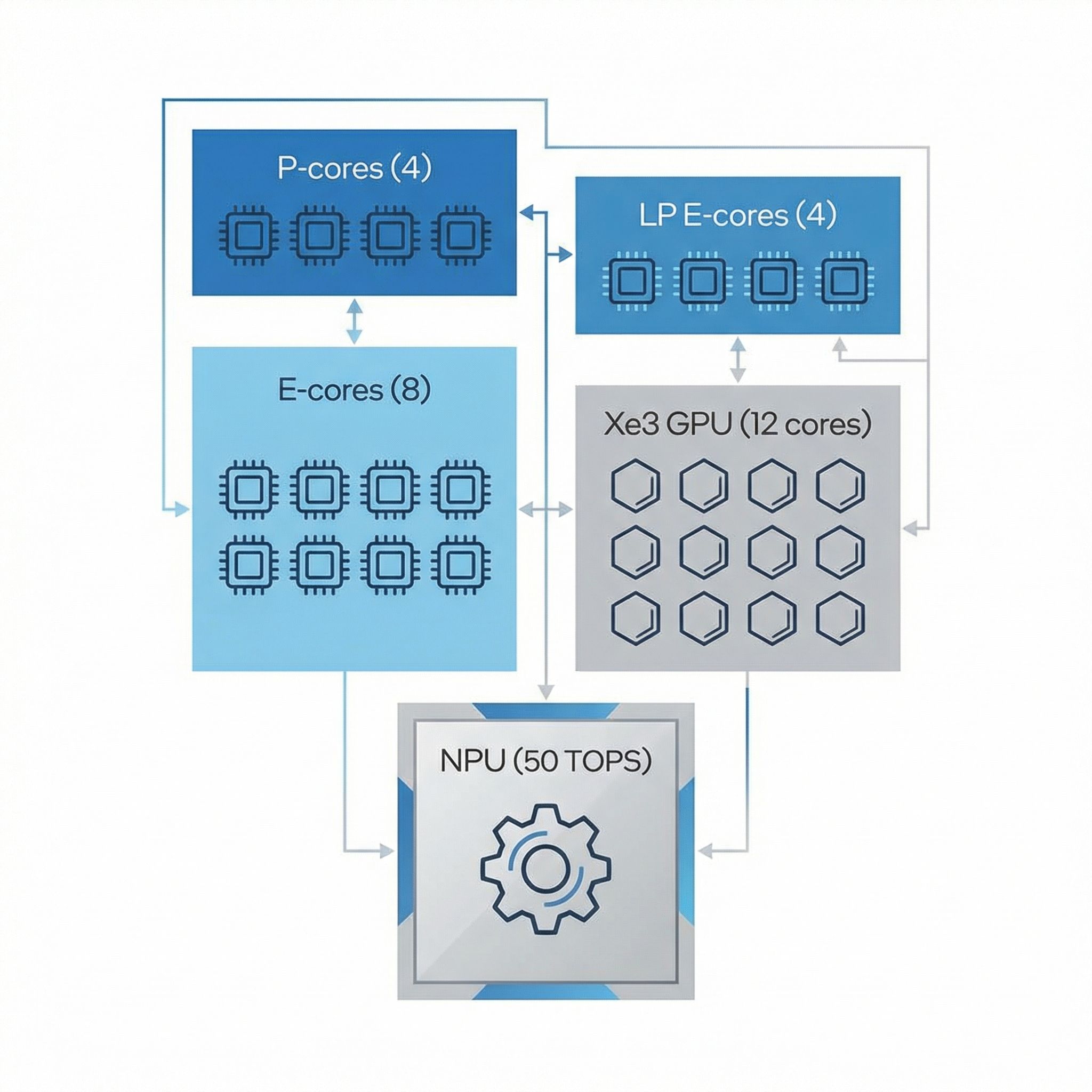
The 18A process is Intel’s own manufacturing technology, meant to restore the company’s manufacturing leadership. The architecture includes what Intel calls a “low-power island” (dedicated silicon for lightweight tasks that can run while the main cores sleep), along with PowerVia, a new power delivery network that places power connections on the back of the chip rather than competing with data signals on the front. Both changes chase the efficiency ARM chips have had for years through similar techniques.
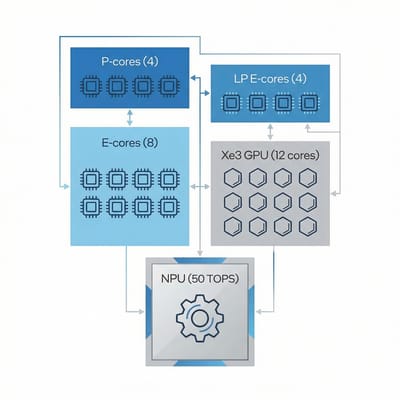
The CPU configuration runs up to 16 cores in a 4+8+4 arrangement: four Performance cores for demanding tasks, eight Efficiency cores for everyday work, and four Low-Power Efficiency cores for background tasks that don’t need much horsepower. The integrated graphics use Intel’s Xe3 architecture with up to 12 GPU cores, and the NPU delivers 50 TOPS of dedicated AI processing power. Combined with the GPU’s AI capabilities, Intel claims total AI performance of 180 TOPS, which matters for on-device features like live captions, photo editing enhancements, and the AI-powered tools Google continues rolling out on Chromebook Plus devices.
Intel’s claims are aggressive. They’re promising 24% better multi-threaded performance compared to Arrow Lake despite having fewer Performance cores, 50% better power efficiency than AMD’s Ryzen AI 300 series, and 73% better gaming performance against the competition. In their CES demonstrations, Panther Lake notebooks hit 81 fps in Cyberpunk 2077 compared to 37 fps in previous generations, though these are marketing conditions, not independent reviews. Battery life claims are equally bold: up to 27 hours for video streaming and 17 hours for office productivity work.
Six Panther Lake Chromebook Models Are in Development
The evidence sits in the Chromium Gerrit, the code repository where ChromeOS development happens publicly. Commits there name at least six distinct Chromebook devices being built on the Panther Lake platform: Lapis, Felino, Ruby, Moonstone, Kinmen, and Francka, all based on a development baseboard called “Fatcat” that has been tracked for over a year.
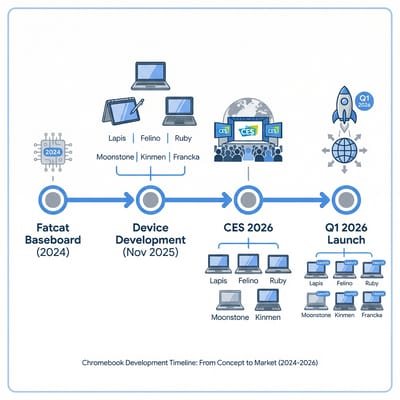
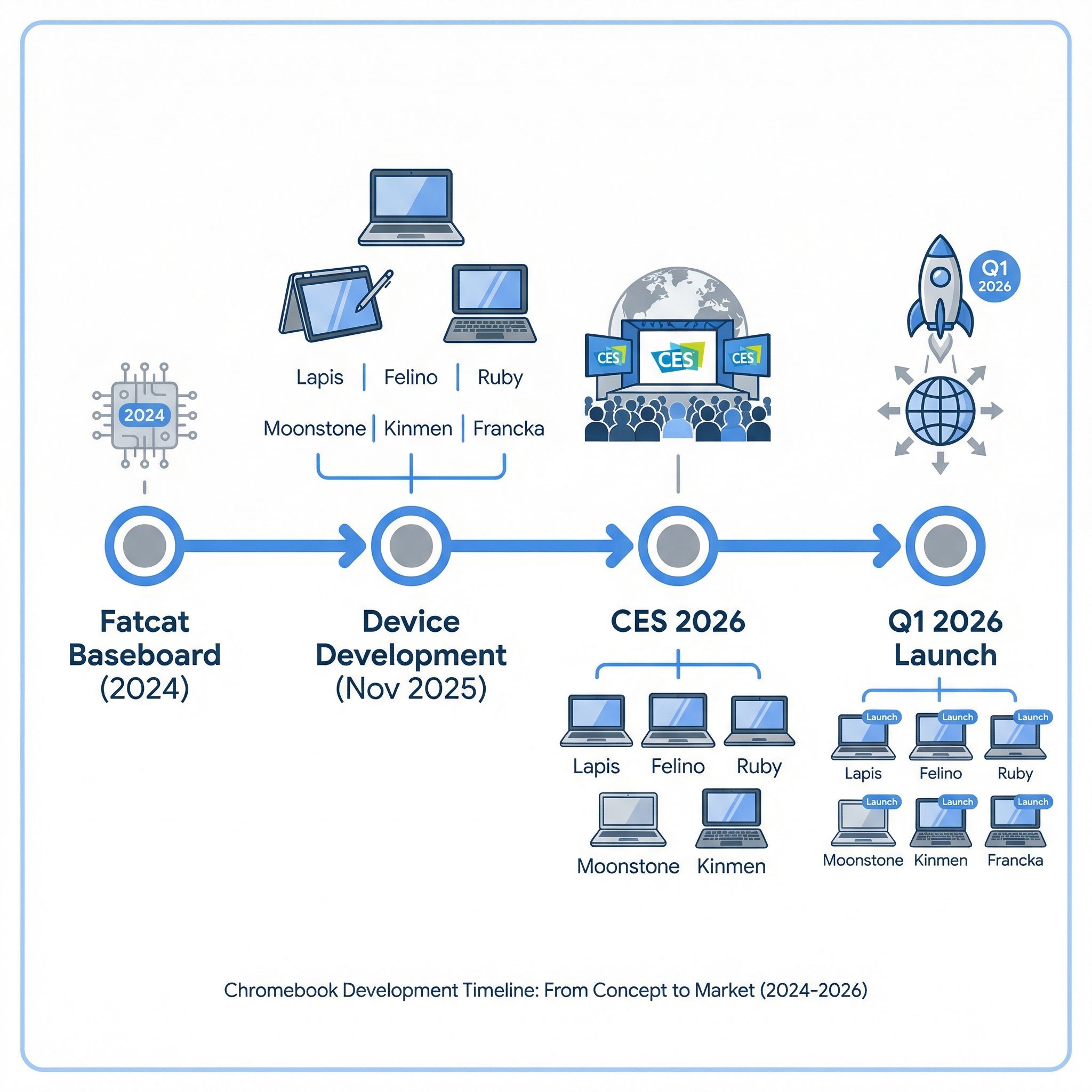
Codenames don’t tell us who’s making what, but the development activity suggests major OEMs (likely Acer, HP, Lenovo, and ASUS) are deep into the process. The first concrete identification comes from Felino, which appears to be from Acer based on ongoing development commits. Felino only entered development in November 2025, suggesting it might be targeting the later end of the Q1 2026 window, while other devices on the Fatcat baseboard have been in development longer.
What we don’t know yet: screen sizes, form factors (clamshell vs. convertible vs. detachable), RAM and storage configurations, or pricing. Those details typically emerge closer to launch when manufacturers file with regulatory bodies and prepare marketing materials. But the breadth of codenames suggests a coordinated launch across multiple price points and form factors, similar to how CES 2026 saw multiple manufacturers announce Chromebook Plus devices at once.
Q1 2026 means these devices could hit shelves between January and March, potentially overlapping with the refresh cycle for students and professionals planning spring purchases. Whether that timeline holds depends on both Intel’s chip production and the individual manufacturers’ readiness.
The ARM Competition You Can Buy Today
MediaTek’s Kompanio Ultra shipped in mid-2025 and has spent months proving itself in real-world use.
The Lenovo Chromebook Plus 14 OLED pairs a 14-inch OLED display with the Kompanio Ultra 910 processor, 16GB of RAM, completely fanless operation, and battery life that routinely exceeds 14 hours in testing. Tom’s Guide called it “simply the best Chromebook you can buy right now,” and that assessment has held up as more reviewers spent time with the device.
The Kompanio Ultra uses an “all-big-core” design: one Cortex-X925 at 3.62GHz, three Cortex-X4 cores, four Cortex-A720 cores, an 11-core Immortalis-G925 GPU with ray tracing support, and a 50 TOPS NPU. In benchmarks, it outperforms Intel’s Core Ultra 5 processors that powered premium Chromebooks throughout 2025, running 18% faster in single-threaded tasks and 40% better in multi-threaded workloads.
The ARM Race article on this site documents how reviewers consistently found the Kompanio Ultra Chromebooks handled demanding workloads (dozens of browser tabs, multiple virtual desks, heavy Android apps) without the devices warming up or performance degrading. The fanless operation means complete silence, and the battery life means you can leave the charger at home for all-day use.
ARM processors run Android apps natively rather than through translation, which historically gave them compatibility and performance advantages. The Kompanio Ultra extends this, making demanding Android games and professional apps smoother than on Intel alternatives. MediaTek is pushing the same efficiency story down into the budget tier too, powering a wave of Kompanio 540 student Chromebooks arriving in 2026.
How to Decide Between Panther Lake and Kompanio Ultra
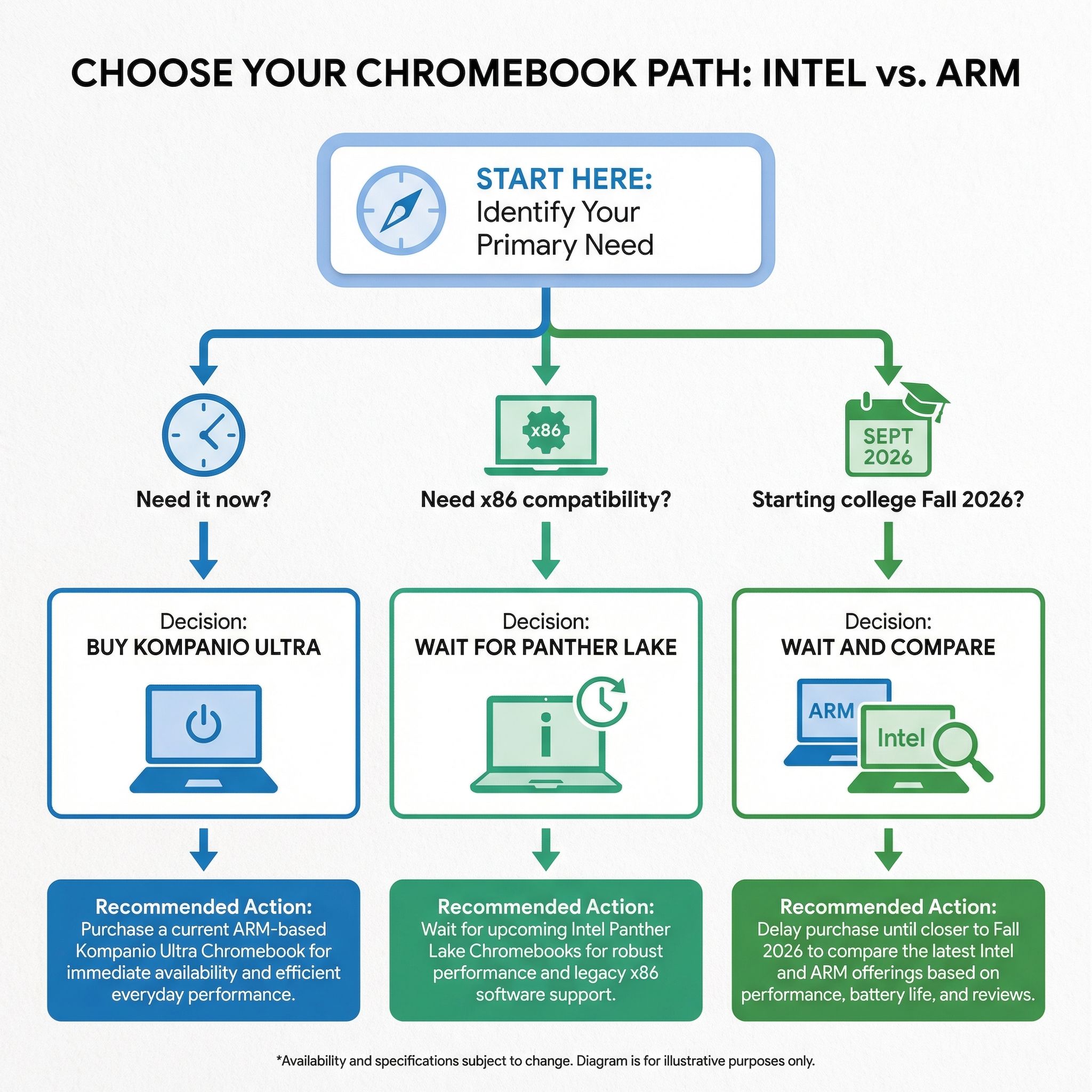
If your current Chromebook is dying or you need a device now, buy a Kompanio Ultra Chromebook today. The performance is proven, the battery life is long, and you’re not gambling on Intel’s ability to deliver on promises. First-generation products on new architectures sometimes have teething issues (driver problems, firmware bugs, unexpected battery drain in certain scenarios) that get resolved in later revisions. The Kompanio Ultra devices have already been through that refinement process.
Waiting makes sense for a Chromebook you need for college starting Fall 2026. You’ll have time to see real-world Panther Lake reviews, compare battery life and performance claims against independent testing, and potentially benefit from competitive pricing as Intel and MediaTek fight for market share. Student buyers in particular benefit from newer devices because Chromebooks have fixed Auto Update Expiration dates: a device bought later in 2026 will receive security updates longer than one bought today.
Panther Lake becomes more interesting if you specifically need x86 compatibility. While ChromeOS runs well on ARM and Android apps perform better, some Linux applications and development tools still work more smoothly on x86 processors. If you’re a developer who needs to run specific x86 software in the Linux environment on ChromeOS, Intel’s architecture advantage persists regardless of ARM’s performance gains.
If budget is your primary concern, watch the pricing carefully. Kompanio Ultra devices have already seen sale pricing, with the Lenovo Chromebook Plus 14 selling below list during Black Friday 2025. First-generation Panther Lake Chromebooks will likely launch at premium prices ($600-800+) before settling into more competitive ranges. If you can find a Kompanio Ultra device at $400-500 during a sale, that price is difficult to beat.
Core Ultra Series 3 Numbers Don’t Map Cleanly to Chromebooks
The 50% performance uplift versus Lunar Lake sounds dramatic, but Lunar Lake itself wasn’t available in Chromebooks, so the comparison matters more for Windows laptops than ChromeOS devices. Intel hasn’t compared Panther Lake to the Core Ultra 5 and Core Ultra 7 chips that actually shipped in 2025 Chromebooks.
Intel’s 27 hours for video streaming and 17 hours for productivity come from controlled testing conditions that manufacturers optimize for. Battery life depends heavily on screen brightness, workload mix, and whether you’re using WiFi or cellular. When reviewers test the actual devices, expect numbers closer to 12-16 hours for typical use, still excellent but not the headline figures.
Most of the 180 TOPS AI figure comes from the GPU rather than the dedicated NPU. For the AI features currently available on Chromebook Plus devices (background blur in video calls, photo enhancements, live captions), the Kompanio Ultra’s 50 TOPS NPU is already sufficient. The additional AI headroom might matter for future features Google hasn’t announced yet, but it’s not delivering obvious benefits today.
What I’m watching for: independent battery life testing on actual Chromebook devices, thermal performance in fanless designs (can Panther Lake run cool enough to skip the fan while maintaining performance?), and how the devices handle sustained workloads over time. Intel’s efficiency improvements are architecturally real, but whether they translate to the specific power and thermal constraints of Chromebooks remains to be proven.
Buy Now Unless You Can Wait for Reviews
Panther Lake aims at the efficiency gap that’s made ARM chips increasingly attractive for Chromebooks. The architectural changes (the 18A process, the low-power island, the PowerVia delivery) target the same advantages that made the Kompanio Ultra successful. If Intel delivers on even 70% of their promises, Panther Lake Chromebooks could offer an alternative for buyers who prefer x86 or want to wait for the latest technology.
Nothing Panther Lake promises is shipping yet, while MediaTek’s Kompanio Ultra has spent the past seven months proving itself in shipping devices. The battery life exceeds 14 hours in testing. For buyers who need a Chromebook now, the Kompanio Ultra devices are the known quantity: tested and available at increasingly competitive prices.
The Q1 2026 launch window means we’re potentially weeks away from seeing the first Panther Lake Chromebooks hit the market. If you can wait until March or April, you’ll have independent benchmarks and battery tests to compare. If you can’t wait, the Lenovo Chromebook Plus 14 OLED remains the device to beat.
Either way, the competition between Intel and ARM is producing better Chromebooks for everyone.


