
ASUS Ascent GX10
Published on

The ASUS Ascent GX10 is ASUS’s version of NVIDIA’s GB10 desktop AI machine, built for developers who want to run, test, and fine-tune large language models locally with CUDA. It has the same chip, the same 128GB of unified memory, and the same DGX OS software as NVIDIA’s own DGX Spark, so inference performance is the same. The differences are a metal body with a glossy top panel, ASUS’s own cooling design, a front power button, and a choice of 1TB, 2TB, or 4TB of storage. ASUS launched the 1TB model at $2,999 in October 2025, but its own store now lists the three configurations at $5,999, $6,999, and $7,999, all above the DGX Spark’s $4,699 list price.
Pros and cons
| Pros | Cons |
|---|---|
| 128GB of unified LPDDR5x the GPU can address directly | ASUS’s current list prices are above NVIDIA’s own DGX Spark |
| Front power button with a power light, unlike most GB10 machines | 1TB and 2TB models ship PCIe 4.0 drives; only the 4TB has PCIe 5.0 |
| Very quiet under load in written and video reviews | The 1TB drive had the slowest writes among the GB10 drives StorageReview tested |
| 10GbE plus two ConnectX-7 QSFP ports to pair two units | Dense models generate slowly: about 10 tokens per second on a 32B model |
| Mixture-of-experts models run quickly: 44 tokens per second on GPT-OSS 120B in one test | No USB-A ports, so a keyboard and mouse need a hub or adapter |
| Labeled 20Gbps USB-C ports and magnetic stacking feet | Arm64 and DGX OS rule out Windows and x86-only software |
| The storage slot accepts a 4TB PCIe 5.0 drive | ASUS’s own store does not accept returns |
Related Videos
ASUS Ascent GX10 Comparison Chart
 ASUS Ascent GX10 | ASUS Ascent GX10 | ASUS Ascent GX10 | |
| Price | List Price: $5,999.00 Amazon Prices: Loading prices... | List Price: $6,999.00 Amazon Prices: Loading prices... | List Price: $7,999.00 Amazon Prices: Loading prices... |
| Version | 128GB/1TB/NVIDIA GB10 | 128GB/2TB/NVIDIA GB10 | 128GB/4TB/NVIDIA GB10 |
| Performance Rating | -- | -- | -- |
| Operating System | Linux | Linux | Linux |
| Processor | Twenty-core NVIDIA GB10 Grace Blackwell Superchip | Twenty-core NVIDIA GB10 Grace Blackwell Superchip | Twenty-core NVIDIA GB10 Grace Blackwell Superchip |
| GPU | Integrated NVIDIA GB10 Blackwell GPU | Integrated NVIDIA GB10 Blackwell GPU | Integrated NVIDIA GB10 Blackwell GPU |
| RAM | 128 GB LPDDR5X (128GB unified, shared by CPU and GPU) | 128 GB LPDDR5X (128GB unified, shared by CPU and GPU) | 128 GB LPDDR5X (128GB unified, shared by CPU and GPU) |
| Internal Storage | 1 TB NVMe SSD | 2 TB NVMe SSD | 2 TB NVMe SSD |
| Dimensions width x length x thickness | 5.91 x 5.91 x 2.01 inches (150.11 x 150.11 x 51.05 mm) | 5.91 x 5.91 x 2.01 inches (150.11 x 150.11 x 51.05 mm) | 5.91 x 5.91 x 2.01 inches (150.11 x 150.11 x 51.05 mm) |
| Weight | 3.26 lbs (1.48 kg) | 3.26 lbs (1.48 kg) | 3.26 lbs (1.48 kg) |
| WiFi | Wi-Fi 7 (802.11be) | Wi-Fi 7 (802.11be) | Wi-Fi 7 (802.11be) |
| Bluetooth | Bluetooth 5.4 | Bluetooth 5.4 | Bluetooth 5.4 |
| Ethernet | 1 Ethernet port at 10 Gbps | 1 Ethernet port at 10 Gbps | 1 Ethernet port at 10 Gbps |
| HDMI | 1 Full-Size HDMI Port | 1 Full-Size HDMI Port | 1 Full-Size HDMI Port |
| DisplayPort | 3 DisplayPorts (DP 2.1 alt mode via 3 USB-C ports) | 3 DisplayPorts (DP 2.1 alt mode via 3 USB-C ports) | 3 DisplayPorts (DP 2.1 alt mode via 3 USB-C ports) |
| VGA | No VGA Ports | No VGA Ports | No VGA Ports |
| USB Ports | 4 USB-C 4x USB-C 20Gbps (1 power in, 3 with DP alt mode) | 4 USB-C 4x USB-C 20Gbps (1 power in, 3 with DP alt mode) | 4 USB-C 4x USB-C 20Gbps (1 power in, 3 with DP alt mode) |
| Thunderbolt Ports | No | No | No |
| OCuLink | No | No | No |
| Internal SATA Ports | No SATA ports | No SATA ports | No SATA ports |
| Card Reader | No Card Reader | No Card Reader | No Card Reader |
| Headphone Jack | -- | -- | -- |
| Fanless | No | No | No |
| VESA Mount | No | No | No |
| In the Box | Ascent GX10 unit, 240W USB-C adapter, power cord, user manual, warranty card. | Ascent GX10 unit, 240W USB-C adapter, power cord, user manual, warranty card. | Ascent GX10 unit, 240W USB-C adapter, power cord, user manual, warranty card. |
| Expandability | Memory is unified and soldered. One M.2 2242 slot wired for PCIe 5.0 x4. Two ConnectX-7 QSFP ports pair two units. | Memory is unified and soldered. One M.2 2242 slot wired for PCIe 5.0 x4. Two ConnectX-7 QSFP ports pair two units. | Memory is unified and soldered. One M.2 2242 slot wired for PCIe 5.0 x4. Two ConnectX-7 QSFP ports pair two units. |
Related Mini PCs
-
 MSI EdgeXpert MS-C931MSI's build of the NVIDIA DGX Spark platform puts the GB10 Grace Blackwell Superchip and 128GB of…
 -
 NVIDIA DGX SparkNVIDIA's own GB10 desktop puts a 20-core Arm CPU, a Blackwell GPU, and 128GB of unified LPDDR5x…
 -
 Beelink GTi15 UltraA high-end mini PC with Intel Core Ultra 9 285H, dual 10GbE networking, built-in 145W power supply,…
 -
 Beelink GTR9 ProA high-performance AI Mini PC featuring the AMD Ryzen AI Max+ 395 processor with 126 AI TOPS, 128GB…
 -
 BOSGAME M5The BOSGAME M5 puts the 16-core AMD Ryzen AI Max+ 395 and its Radeon 8060S graphics in a metal…
 -
 GMKtec EVO-X2The GMKtec EVO-X2 is a 3.6-pound upright mini PC built on the AMD Ryzen AI Max+ 395 with Radeon…
A metal 6-inch box with a front power button

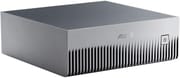
The Ascent GX10 measures about 5.9 x 5.9 x 2 inches and weighs 3.26 pounds, which makes it the heaviest of the GB10 machines reviewers have weighed side by side. The body is Stellar Grey metal under a glossy plastic top panel, with a full-width wavy fin grille on the front, a small ASUS logo, and a square power button at the right with a built-in power light. Every other port is on the back: a Kensington lock slot, four 20Gbps USB 3.2 Gen 2x2 Type-C ports, an HDMI 2.1 output, a 10GbE RJ-45 jack, and two QSFP cages driven by an NVIDIA ConnectX-7 NIC rated at 200 Gbps. The leftmost USB-C port takes power from the included 240W USB-C adapter, and the other three carry DisplayPort 2.1 alt mode. There is no USB-A port, no audio jack, and no card reader.
Wireless is WiFi 7 and Bluetooth 5.4 through an AW-EM637 module. The two QSFP ports exist to link a second GX10 directly with one cable, which gives the pair 256GB of memory to split a larger model across. Storage is a single M.2 2242 NVMe drive under the bottom grille and a second metal plate. The slot is wired for PCIe 5.0 x4, but ASUS ships PCIe 4.0 drives in the 1TB and 2TB models and a PCIe 5.0 drive only in the 4TB model. The rubber feet are magnets, so two units stack and hold together.
The same GB10 silicon as every DGX Spark variant
The GB10 Grace Blackwell Superchip pairs a 20-core Arm CPU (10 Cortex-X925 plus 10 Cortex-A725 cores) with a Blackwell GPU with fifth-generation Tensor cores, joined by NVIDIA’s NVLink-C2C link. Both share one 128GB pool of LPDDR5x-8533 on a 256-bit bus at 273 GB/s, and ASUS rates the platform at 1 petaFLOP of FP4 compute, a sparse and theoretical figure. The chip’s TDP is 140 W.
Reviewers found the GX10’s inference results in line with the DGX Spark, Dell, Acer, GIGABYTE, and MSI versions. Token generation is limited by memory bandwidth, so large dense models run slowly. The GX10 can load a 120B model that no single consumer graphics card can hold, and mixture-of-experts models such as GPT-OSS 120B generate at usable speeds, but a model that fits on a desktop GPU will generate tokens faster there. Batched serving with vLLM raised total throughput about tenfold in StorageReview’s test (70 to 680 tokens per second on GPT-OSS 120B). The DGX Spark and MSI EdgeXpert MS-C931 pages cover the same platform from NVIDIA and MSI, and our look at the DGX Spark and local AI hardware in 2026 compares this class with Apple and AMD options.
Reviewer Insights

The early reviews, from November 2025 to March 2026, ran when the GX10 1TB sold for about $3,000, and several of them call it the cheaper way into a GB10 system. That framing no longer holds at ASUS’s current prices; the hardware findings still apply.
ServeTheHome
Ryan Smith of ServeTheHome took the GX10 apart and found that ASUS built its own GX10 board rather than buying NVIDIA’s, with two Delta fans over a heatsink and copper plates and heat pipes covering the GB10, the ConnectX-7 NIC, and the memory. He praised the front button: “having a power button on the front instead of the rear is something we wish all GB10 systems had. This is a great usability feature.” He flagged the storage slot as a limit: “Atypically, this is an M.2 2242 (42mm) slot, so the GX10 is not able to take full-size (2280) SSDs.”
In Geekbench 5 the GX10 matched the DGX Spark, and it held its AI benchmark results after an hour of heat soak. “At idle, we were in the 42-47W range,” which he noted includes the ConnectX-7 NIC, and he pushed it to 120 to 130 W under load. His conclusion: “Regardless of the name on the outside, on the inside ASUS did a great job on the cooling.” He also wrote that “At a $1000 lower price point, great cooling, and small features like that front power button, this has become a really strong option,” a verdict tied to the January 2026 pricing, when the GX10 undercut the DGX Spark.
StorageReview
Lyle Smith of StorageReview ran the GX10 against the Founders Edition DGX Spark and the Dell, Acer, and GIGABYTE versions in a vLLM serving sweep and an hour-long thermal run. The power button stood out to him as well: “It is also unique in that ASUS incorporated a power indicator into the power button.” On GPT-OSS 120B the GX10 scaled from 70 tokens per second at batch 1 to 680 at batch 64 in balanced workloads, and decode-heavy runs went from 45 to 260. He found that “ASUS tracks very closely with the broader Spark ecosystem across all three workload types.”
He wrote that “Thermally, the GX10 ran toward the warmer end of the group during burst phases, with the CPU peaking at 87.3°C and the GPU at 82°C before stabilizing under sustained workloads.” The NVMe drive stayed under 57°C. The weak spot was the 1TB PCIe 4.0 SSD, which had the slowest writes of any GB10 drive he had tested and pulled GPU Direct Storage results to the bottom of the group: “A better SSD would help considerably in this unit.” He ended the review saying: “In practice, the decision comes down to storage configuration, thermals, physical design, and vendor alignment rather than raw compute capability.”
ITPro
Alun Taylor of ITPro tested a 4TB unit and wrote that “Compared to the rather baroque DGX Spark and the utilitarian offerings from the other OEMs, the Asus box is by far the most visually appealing.” He found it quiet: “Throughout all the test the GX10 impressed by how quiet it was, the dual fan system seldom making much more than a loud whisper.” The GB10 scored 3,104 single-core and 20,048 multi-core in Geekbench 6, against 3,986 and 22,857 for an M4 Pro Mac mini. A 1K image job in ComfyUI took 216 seconds on the GX10 against more than 400 seconds on a 32GB Framework Desktop.
He blamed part of the price on the networking: “one reason these Nvidia-system boxes are so expensive is because of that Nvidia ConnectX-7 interface, which easily accounts for upwards of one-third of the asking price.” He listed the Ubuntu-based Arm operating system and the 2242 SSD format as drawbacks, and noted that AMD Ryzen AI Max+ boxes cost less and run Windows 11.
Alex Ziskind
Alex Ziskind ran the GX10, the DGX Spark, the Dell Pro Max GB10, and the MSI EdgeXpert through heat-soak runs in a comparison video. The ASUS weighed 1,474 grams against 1,255 for the Spark, and he called the front power button “Very convenient” and liked that ASUS labels the USB-C ports as 20Gbps with DisplayPort. None of the four showed clock throttling. Under a GPU burn test all four hit a software power cap just under 100 W, and only the GX10 also logged software thermal slowdown events, even at 95°C, a lower temperature than the Dell reached without one. He looked at the charts and said “I don’t think it’s going to really matter that much here.” His GX10 had a PCIe Gen 4 drive and took about 11.5 seconds to load a Nemotron 30B model to its first token, against 8.49 seconds on the Spark’s Gen 5 drive.
In a follow-up video he opened his 1TB GX10 and pointed out that “these little feet are magnets, so they can just stack and they attach to each other.” He attributed the extra weight to “extra heat pipes to draw that heat away from the central processing unit.” He cloned the 1TB Phison Gen 4 drive onto a 4TB Corsair MP700 Micro Gen 5 drive with a UGREEN cloning dock, then extended the root partition by hand in the Disks utility; the slot ran the new drive at Gen 5 speed. “Not only did we upgrade the amount of space, we upgraded the speed of this drive, too. And that translates directly to model load time.”
Execute Automation
Karthik of Execute Automation received his 4TB unit from ASUS, which he thanked for sponsoring his unboxing video. In a second video he used the GX10 as an Ollama server for AI-assisted Playwright and Selenium tests, reached from his MacBook Pro through NVIDIA Sync. A self-healing test suite that took 47 seconds with a 30B Qwen coding model on his M1 Max finished in 19 seconds on the GX10, and a LangChain agent task that ran past two and a half minutes on the Mac finished in 12 seconds. GPT-OSS 120B loaded and ran but failed his test task, and he found the Qwen coding model better suited to the work. He said “this machine is really really powerful” and that he could not hear the fan while recording.
Techno Tim
In a May 2026 post, Timothy Stewart of Techno Tim ran two GX10 units: one as a local coding-agent server running a 35B Qwen mixture-of-experts model under vLLM, then both as a two-node cluster over a direct QSFP112 link. “Under load, I saw the active node pulling around 125 to 127 watts,” and “With the model loaded but idle, I saw about 50 watts.” The link tested at about 130 Gbps against the 200 Gbps he expected, and “GPUDirect RDMA is not supported on the GB10 systems, so this was not the direct GPU-to-NIC path I originally had in mind.” MiniMax M2.7 split across both units first ran at 26 to 28 tokens per second; after he ran the vLLM container as privileged, “I got closer to 41 tokens per second, which felt much more in line with what I expected from the two-node cluster.” The pair drew more power under load: “Two GX10s under load run between 280 and 330 watts total.”
He also hit a hang during a long compile: “My sessions disconnected, all CPU cores were pegged at 100%, and once the compile finished, I could SSH back in again.” ASUS could not reproduce it. His summary: “One GX10 made local agentic coding feel practical. Two GX10s made a much larger local model possible. But neither version made local AI effortless.”
PCMag Middle East
Abbas Jaffar Ali of PCMag Middle East benchmarked a GX10 against an ASUS ProArt RTX 5090 in an August 2026 article that the site labels as produced in partnership with ASUS; it states the benchmarks and conclusions are its own. Under Ollama the GX10 generated 90.54 tokens per second on qwen3:30b-a3b, 61.01 on gpt-oss:20b, 44.06 on gpt-oss:120b, and 10.06 on the dense qwen3:32b. The 5090 could not load the 120B model and ran the others three to six times faster, but prompt processing went the other way: “On gpt-oss:20b, the GX10 processed prompts at 1,905 tokens/sec against the 5090’s 549.” He wrote: “pick a dense model and the GX10 will feel broken. Pick a mixture-of-experts model, and it will feel quick.”
At the wall he measured 27 W at idle and 109 to 114 W sustained on the 120B model, with a 122 W peak. On noise, “from a metre away you would struggle to identify it as running if it weren’t for the discreet LED light on the power button.” He tested on the June 2026 DGX OS build.
TechRadar
A January 2026 hands-on by Mark Pickavance of TechRadar covered a 1TB unit without benchmarks. He wrote that “Asus did an excellent job of engineering on the GX10” and weighed it at 1.48 kg, heavier than any mini PC he had handled. His complaints were the ports and the narrow use case: “there are no Type-A USB ports at all, forcing the buyer to use an adapter or hub to attach a mouse and keyboard to this system,” and “if the AI path is not the one that is ultimately taken, this machine becomes mostly a beautifully engineered paperweight.”
Pronetic by Geeknetic
In November 2025 Javier Rodríguez of the Spanish site Pronetic by Geeknetic rated the GX10 4.9 out of 5. In his multi-core CPU tests the ASUS ran up to 5% faster than NVIDIA’s reference unit, which he credited to its more elaborate cooling. He measured under 42 dBA under sustained load and saw up to 50 tokens per second depending on the model. He called the 3,800 euro price its one drawback, though fair for a workstation, and wanted USB4 instead of the 20Gbps USB-C ports.
Stef from Samayas
Stef from Samayas bought the base 1TB GX10 and filmed its first setup in a May 2026 video. With no USB-A ports, he needed an adapter and a small hub to connect a mouse, and first boot ran through five reboots: “startup is actually quite slow for a supposedly very fast device.” Under load, “it still heats up quite a lot, but it’s virtually as good as silent compared to my RTX one,” and “It is, however, a lot slower than an RTX 5090.” He also crashed it several times, which he put down to settings he had pushed too far.
His second video covers swapping the 1TB drive for a 2TB Corsair MP600 Micro. That meant four screws on the bottom plate, five more under a second plate, and one on the drive. Without a cloning device he reinstalled DGX OS from the image on ASUS’s support site, which “is almost 10 GB big.” The BIOS recovery entry rejected his USB stick because “it did not find the bootloader,” but a normal USB boot installed the system, and the software updater still found updates afterward.
Alican Kiraz
In a Turkish-language April 2026 video made with ASUS’s support, Alican Kiraz served Qwen3.5-35B with vLLM on one GX10 at 23.7 tokens per second. He warned that setting GPU memory use above 95% makes a crash very likely. He then clustered the GX10 with an NVIDIA DGX Spark over the 200 Gbps QSFP link, copied the model between them in 1 minute 10 seconds, and reached 42.43 tokens per second on the same model and about 14.5 tokens per second on MiniMax M2.7 at 4-bit.
Programmer Network
Alex of Programmer Network runs a GX10 and a DGX Spark as a home AI cluster, shown in a July 2026 video, and calls both machines Sparks. “Basically, 110 watts is the two DGX Sparks idle,” he said, and fully loaded they drew “around 160 watts and 142.” With the cluster left fully closed up, the box temperature readings climbed to almost 100°C, and the GPU peaked around 87°C. He runs a DeepSeek V4 Flash model at “1 million tokens context, 60 tokens per second approximately,” and warned that these machines “will get out of memory, they will get stuck,” so he power-cycles them remotely with smart plugs.
Cluster videos from ServeTheHome and Alex Ziskind
ServeTheHome built an eight-node cluster in an April 2026 video that includes three GX10s, two of them bought “because they were the lowest cost ones when we purchased them and they’ve gone up in price since we have.” Across the mixed nodes, idle GB10 machines drew 35 to 45 W and loaded ones mostly 110 to 150 W, and the cluster “is relatively quiet. By far the loudest thing here is the MikroTik CRS 804 switch.” Alex Ziskind added a GX10 to an eight-node cluster of DGX Spark, Dell, and MSI units in a February 2026 video and found that “token generation is not that much faster. 64 and 61 tokens per second for Qwen3 4B across the cluster of eight nodes is only about 10 tokens per second faster than four nodes.”
Customer Reviews
Buyers of the 1TB model split between people who use it as a dedicated inference or development server and people who expected faster local AI for the money. Oliver pairs it with an RTX 4090 and wrote that he now points his “deep thinking model to a 120g moe model on the Gx10 with 256k context.” Morris L. “didn’t hear a whisper of the fan in 3 days of testing” and wrote “If you buy a Spark, the Asus Ascent is a good choice,” while Chris found the “Fan noise is modest for the compute, runs warm but not alarming.” A buyer posting as Regular Person, on a second unit, runs vLLM for agent workloads and likes the front power button.
Most complaints are about speed and software. Morris L. got “roughly 10-15 tokens per second” from GPT-OSS 120B under Ollama and hit CUDA version conflicts in DGX OS. Jackson Lim found that “Inference is bottlenecked by decoding which is extremely slow for this device’s memory bandwidth” and that small fine-tuning jobs ran faster on an RTX 3090. Regular Person warned to “expect FREQUENT UPDATES” that each need a reboot, and said the rear exhaust “can be like having a small space heater right next to you.” Robert Beckman said NVIDIA support closes tickets and points owners to the community forums, and Brad received one unit with a dead power adapter, which ASUS replaced within days. Read more owner reviews on Amazon.
The GX10 costs more than the DGX Spark for the same inference performance
Pick the GX10 over the DGX Spark only if the quiet metal chassis and front power button are worth the higher price; the NVIDIA DGX Spark also ships with 4TB of PCIe 5.0 storage. Check the current price of both, and of the MSI EdgeXpert MS-C931, before choosing. Anyone whose models fit in 32GB will get faster token generation from a desktop GPU, and our roundup of mini PCs for running local LLMs covers the x86 alternatives, including the Strix Halo systems with 128GB.
Frequently Asked Questions
Is the ASUS Ascent GX10 faster than the NVIDIA DGX Spark?
No. Both use the same GB10 chip and 128GB of memory, and StorageReview and ServeTheHome found the GX10’s results in line with the DGX Spark. The differences are the chassis, cooling, weight, front power button, and storage: the 1TB and 2TB GX10 models ship PCIe 4.0 drives, which load models more slowly than the DGX Spark’s PCIe 5.0 drive.
Can I upgrade the storage in the ASUS Ascent GX10?
Yes. The single M.2 slot takes a 2242-size NVMe drive and is wired for PCIe 5.0 x4, reached by removing the bottom grille and a metal plate. Alex Ziskind cloned his 1TB drive to a 4TB PCIe 5.0 drive and it ran at Gen 5 speed. Full-size 2280 drives do not fit. The 128GB of memory is soldered and cannot be upgraded.
How much does the ASUS Ascent GX10 cost?
ASUS launched the 1TB model at $2,999 in October 2025. Its US store now lists the 1TB, 2TB, and 4TB models at $5,999, $6,999, and $7,999, and says all sales are final. Reviews from early 2026 that call the GX10 the cheaper GB10 option were written before that increase.
What operating system does the ASUS Ascent GX10 run?
It ships with NVIDIA DGX OS, a version of Ubuntu 24.04 for Arm64 with NVIDIA’s drivers, CUDA, the DGX Dashboard, and NVIDIA Sync preinstalled. Windows is not supported, and x86-only software will not run natively. NVIDIA Sync lets you use it from a Mac or Windows computer on your network.
How fast does the ASUS Ascent GX10 run local LLMs?
Mixture-of-experts models run quickly and dense models run slowly. PCMag Middle East measured 44.06 tokens per second on GPT-OSS 120B and 90.54 on the Qwen3 30B mixture-of-experts model under Ollama, but only 10.06 on the dense Qwen3 32B. An RTX 5090 generates three to six times faster on models that fit in its 32GB, while the GX10 processed prompts about 3.5 times faster on GPT-OSS 20B and can hold models the 5090 cannot load. Batched serving with vLLM raises total throughput: StorageReview reached 680 tokens per second on GPT-OSS 120B at batch 64.
How much power does the ASUS Ascent GX10 use?
It ships with a 240W USB-C adapter, and the GB10 chip’s TDP is 140 W. ServeTheHome measured 42 to 47 W at idle, including the ConnectX-7 NIC, and 120 to 130 W under load. PCMag Middle East measured 27 W at idle and 109 to 114 W running GPT-OSS 120B, and Techno Tim saw 125 to 127 W under load. Alex Ziskind found the GPU capped in software at just under 100 W, the same limit as the other GB10 machines.
Is the ASUS Ascent GX10 quiet?
Yes. ITPro wrote that its two fans seldom made much more than a loud whisper, Pronetic by Geeknetic measured under 42 dBA under sustained load, and owners report little fan noise. It does run warm: StorageReview measured CPU peaks of 87.3°C during bursts, and one owner compares the rear exhaust to a small space heater.