
MSI EdgeXpert MS-C931
Published on

The MSI EdgeXpert MS-C931 is MSI’s build of NVIDIA’s DGX Spark platform, which means the silicon inside is the same GB10 Grace Blackwell Superchip that NVIDIA and its other partners ship: a 20-core Arm CPU (10 Cortex-X925 plus 10 Cortex-A725) tied to a Blackwell GPU by NVLink-C2C, with 128GB of LPDDR5x unified memory that both halves address directly. NVIDIA rates the package at 1000 AI TOPS in FP4, and the memory runs on a 256-bit interface for 273 GB/s of bandwidth. It runs NVIDIA DGX OS, an Ubuntu derivative, on Arm64; there is no Windows option and no x86 fallback. The whole thing occupies 1.19 liters, weighs 1.2 kg, and takes its power from a single USB-C adapter. It is a developer appliance for running and fine-tuning large models locally; most of this catalog uses “mini PC” for a different kind of machine.
Pros and cons
| Pros | Cons |
|---|---|
| 128GB of unified LPDDR5x the GPU can address directly | 273 GB/s of memory bandwidth is a fraction of a discrete Blackwell card |
| NVIDIA rates the GB10 package at 1000 AI TOPS (FP4) | Arm64 and DGX OS mean a narrower software catalog than x86 Linux |
| 10GbE RJ-45 plus two ConnectX-7 QSFP ports to pair two units | Official PyTorch builds did not cover GB10 when buyers tried in early 2026 |
| 1.19L chassis, 1.2 kg, powered over one USB-C adapter | Memory is soldered and the single M.2 ships populated; nothing is upgraded later |
| DGX OS arrives preconfigured with NVIDIA’s CUDA and container stack | No USB-A, no audio jack, no card reader |
| Buyers report sustained inference loads without thermal throttling | The 4TB SKU lists at $3,000 above the 1TB SKU |
Related Videos
MSI EdgeXpert MS-C931 Comparison Chart
 MSI EdgeXpert MS-C931 | MSI EdgeXpert MS-C931 | |
| Price | List Price: $2,999.00 Amazon Prices: | List Price: $5,999.00 Amazon Prices: Loading prices... Best Buy: Loading price... |
| Version | 128GB/1TB/NVIDIA GB10 | 128GB/4TB/NVIDIA GB10 |
| Performance Rating | 0.6 | 0.6 |
| Operating System | Linux | Linux |
| Processor | Twenty-core NVIDIA GB10 Grace Blackwell Superchip | Twenty-core NVIDIA GB10 Grace Blackwell Superchip |
| GPU | Integrated NVIDIA GB10 Blackwell GPU | Integrated NVIDIA GB10 Blackwell GPU |
| RAM | 128 GB LPDDR5X (128GB unified, shared by CPU and GPU) | 128 GB LPDDR5X (128GB unified, shared by CPU and GPU) |
| Internal Storage | 1 TB NVMe SSD | 2 TB NVMe Gen5 SSD |
| Dimensions width x length x thickness | 5.94 x 5.94 x 2.05 inches (150.88 x 150.88 x 52.07 mm) | 5.94 x 5.94 x 2.05 inches (150.88 x 150.88 x 52.07 mm) |
| Weight | 2.65 lbs (1.2 kg) | 2.65 lbs (1.2 kg) |
| WiFi | Wi-Fi 7 (802.11be) | Wi-Fi 7 (802.11be) |
| Bluetooth | Bluetooth 5.4 | Bluetooth 5.4 |
| Ethernet | 1 Ethernet port at 10 Gbps | 1 Ethernet port at 10 Gbps |
| HDMI | 1 Full-Size HDMI Port | 1 Full-Size HDMI Port |
| DisplayPort | 3 DisplayPorts (DP 1.4a via 3 USB-C ports) | 3 DisplayPorts (DP 1.4a via 3 USB-C ports) |
| VGA | No VGA Ports | No VGA Ports |
| USB Ports | 4 USB-C 4x USB 3.2 Type-C (1 power in, 3 with DP alt mode) | 4 USB-C 4x USB 3.2 Type-C (1 power in, 3 with DP alt mode) |
| Thunderbolt Ports | No | No |
| OCuLink | No | No |
| Internal SATA Ports | No SATA ports | No SATA ports |
| Card Reader | No Card Reader | No Card Reader |
| Headphone Jack | -- | -- |
| Fanless | No | No |
| VESA Mount | No | No |
| In the Box | EdgeXpert unit, USB-C power adapter, quick start guide. | EdgeXpert unit, USB-C power adapter, quick start guide. |
| Expandability | Memory is unified and soldered. One M.2 M-key NVMe from the factory (1TB or 4TB). Two ConnectX-7 QSFP ports pair two units. | Memory is unified and soldered. One M.2 M-key NVMe from the factory (1TB or 4TB). Two ConnectX-7 QSFP ports pair two units. |
Related Mini PCs
-
 Beelink GTi15 UltraA high-end mini PC with Intel Core Ultra 9 285H, dual 10GbE networking, built-in 145W power supply,…
 -
 Beelink GTR9 ProA high-performance AI Mini PC featuring the AMD Ryzen AI Max+ 395 processor with 126 AI TOPS, 128GB…
 -
 BOSGAME M5The BOSGAME M5 puts the 16-core AMD Ryzen AI Max+ 395 and its Radeon 8060S graphics in a metal…
 -
 GMKtec EVO-X2The GMKtec EVO-X2 is a 3.6-pound upright mini PC built on the AMD Ryzen AI Max+ 395 with Radeon…
 -
 NIMO Mini PC AMD Ryzen AI Max+ 395The NIMO Mini PC packs the flagship AMD Ryzen AI Max+ 395 with 16 Zen 5 cores and Radeon 8060S…
 -
 GEEKOM XT12 ProThe GEEKOM XT12 Pro is a compact aluminum mini PC with an Intel Core i9-12900H (or i7-12650H), 32GB…
128GB of unified memory in a box with no USB-A port

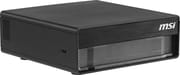
The EdgeXpert measures 5.94 x 5.94 x 2.05 inches (151 x 151 x 52 mm) and weighs 2.65 pounds, so it is a square metal slab a little larger than a CD case and about twice as thick. The front is a brushed bar over a honeycomb intake mesh, with a Kensington lock slot on the left side and vent slits down both flanks. Every port is on the back: a power button, four USB 3.2 Type-C ports, a full-size HDMI 2.1a output, a 10GbE RJ-45 jack, and two QSFP cages driven by an NVIDIA ConnectX-7 NIC rated at 200 Gbps. One of the four USB-C ports is the power input and three carry DisplayPort 1.4a alt mode, which is how MSI reaches its claim of four independent displays. There is no USB-A, no 3.5mm jack (audio goes out over HDMI), and no card reader.
The GB10 Superchip pairs a 20-core Arm CPU cluster with a Blackwell GPU carrying fifth-generation Tensor cores, and both halves address the same 128GB of coherent unified memory, which the GPU can use as if it were VRAM. That capacity is the entire argument for the platform, because an RTX 5090 tops out at 32GB. The tradeoff is bandwidth. LPDDR5x on a 256-bit bus delivers 273 GB/s, a fraction of what GDDR7 on an RTX 5090’s 512-bit bus moves, so the EdgeXpert wins on model size and loses on raw token throughput. No PassMark CPU Mark exists for the GB10, so there is no directly comparable score against x86 chips.
Alongside WiFi 7 and Bluetooth 5.4, the 10GbE port handles ordinary LAN duty while the two ConnectX-7 QSFP ports connect a second EdgeXpert directly, with no switch in between, so the pair shares 256GB of memory. MSI sells that pairing as a bundle SKU (EdgeXpert-02SKUS, two units plus a QSFP cable) rather than as a storage option, and Tom’s Hardware reported at the Computex 2025 announcement that a GB10 system handles models up to 200 billion parameters alone and up to 405 billion when two are linked this way. Storage is a single M.2 M-key slot holding a self-encrypting NVMe drive, filled at the factory with either 1TB or 4TB.
The 1TB build holds the identical compute
The case for this hardware is the same case we walked through in our look at the DGX Spark and local AI hardware in 2026: holding a very large model in memory is a job a fast consumer GPU cannot do at any price, while streaming tokens quickly through a small model is a job the EdgeXpert loses to that GPU. Which of those matters depends on your workload, and it is worth reading our comparison of Ollama Cloud versus local AI hardware before spending four figures on a box whose main job you might be renting for dollars a month.
The GB10 is a platform several vendors build on, so the chip is common ground. ASUS sells the Ascent GX10 on the same superchip, and NVIDIA sells its own DGX Spark; the differences that remain are thermals, storage configuration, chassis, and price. MSI’s list prices are $2,999 for the 1TB EdgeXpert-99SUS and $5,999 for the 4TB EdgeXpert-13SUS, so the 4TB step costs $3,000, far more than a 4TB Gen5 NVMe drive is worth on its own. If a second SSD is not the reason you are buying, the 1TB configuration holds the identical compute. Readers weighing this class against x86 alternatives should also see our roundup of mini PCs for running local LLMs and our coverage of dual-unit Strix Halo clustering, which chases the same large-model goal from the AMD side.
Reviewer Insights

Independent testing of MSI’s specific build is thin. Most published GB10 coverage evaluates the DGX Spark platform generally, using NVIDIA’s own unit or a different partner’s box, and those results describe the chip more than MSI’s chassis or cooling.
ETA PRIME found NVIDIA’s setup easy and the rest of the software unfinished
ETA PRIME spent a first-look video with the EdgeXpert, confirming the hardware on camera by opening the RPCS3 GPU configuration and reading back the NVIDIA GB10. He said, “MSI and NVIDIA have created a supercomputer that you could throw in your backpack.” Walking the rear panel, he confirmed the four USB 3.2 Type-C ports with the end one reserved for power input, the full-size HDMI, the 10GbE jack, and the ConnectX-7 200 gig cages, and he noted that pairing two units needs only a direct cable rather than a switch.
He was direct about the audience: “I do think that this is a great platform for AI developers, and it’s definitely not a consumer product.” He pointed to the memory: “The main things this has going for it versus, let’s say, the RTX 5090 and an x86 setup is 128 GB of RAM that the GPU can also access.” He ran GPT-OSS-20B through Open WebUI and generated images in ComfyUI without trouble, and he credited NVIDIA’s onboarding, saying “This is made for AI development and NVIDIA has actually made it really easy to get started with this.”
He also reported problems. The bundled DGX Dashboard showed memory and GPU utilization but nothing else, and he said “I have not found a way to add anything else like CPU utilization.” PS3 emulation through RPCS3 held 60 FPS at 1080p but was not perfectly clean: “Every once in a while, I do notice a little bit of a stutter.” Getting a Steam client running on the Arm build defeated him during the video, and he reported “I’ve been trying to get Steam installed on this. Having a few issues.”
Customer Reviews
The 4TB EdgeXpert averages 4.6 stars across 16 Amazon ratings, with 77% at five stars, 15% at four, and 8% at two. Several of the written reviews separate MSI’s build from NVIDIA’s platform.
The praise clusters on thermals and memory capacity. B. Jester, a verified buyer writing in April 2026, said MSI’s version of the DGX Spark is “definitely one of the best” and that under concurrent inference load “it stays under 80C and performs well,” though he added a 140mm fan underneath for extra airflow. Another verified buyer, santa, listed “better thermal design” as the headline pro and reported the box “seems to work fine during heavy load without thermal throttling.” Haruyuki Shini described running NVIDIA’s Nemotron 3 Super alongside Stable Diffusion, writing “You can easily get a 400k context window while also running Stable Diffusion and generating images that are 1080p or bigger.”
The complaints are almost all about software maturity. santa wrote, “Official distribution of Pytorch does not support Blackwell GB10 yet,” with NVIDIA’s own PyTorch container as the workaround. Rob M., who raised his own rating from one star to four over a month of use, still concluded that “It is immature and the software landscape is in such a state of flux that every document you find was obsolete a week before you read it,” and described renting B200 or dual-H100 time to convert a 70B model into the NVFP4 format vLLM wanted. B. Jester made the same bandwidth tradeoff explicit: “what you’re really getting is the 128GB of unified RAM at the cost of slower bandwidth,” and recommended a Blackwell card instead for anyone who wants raw speed. Patrick Bolen, five stars, still wished “there was faster bandwidth or cheaper price but it is what it is.” Read more owner reviews on Amazon.
Worth buying only when the model must stay resident in memory
The EdgeXpert suits a developer or researcher who needs a large model resident in memory on hardware they own, who is comfortable on Arm64 Linux, and who values NVIDIA’s CUDA and container tooling enough to accept a narrower software catalog than x86. For that person, 128GB of coherent unified memory in a 1.19-liter box that a single USB-C adapter powers is an unusual offer, and the owners quoted above credit MSI’s cooling for holding up under sustained load.
Token throughput on small and mid-size models will disappoint anyone coming from a discrete Blackwell card, the software stack was still moving under buyers’ feet through mid-2026, and nothing inside is upgradeable. If your models fit in 32GB, a GPU tower is faster for less money. If you want a general-purpose desktop, this is the wrong machine at any price. The 1TB configuration carries identical compute for $3,000 less, so pay for the larger SSD only if you need the capacity.
For those comparing options, see our Mini PC Comparison Chart to find the best match for your needs.
Frequently Asked Questions
What processor does the MSI EdgeXpert MS-C931 use?
The EdgeXpert MS-C931 uses the NVIDIA GB10 Grace Blackwell Superchip. Its CPU half is a 20-core Arm cluster made up of 10 Cortex-X925 performance cores and 10 Cortex-A725 efficiency cores, and its GPU half is a Blackwell design with fifth-generation Tensor cores, joined to the CPU by NVIDIA’s NVLink-C2C interconnect. NVIDIA rates the package at 1000 AI TOPS in FP4. There is no published PassMark CPU Mark for the GB10, so it cannot be scored against x86 chips on that benchmark.
Can I upgrade the RAM in the MSI EdgeXpert MS-C931?
No. The 128GB of LPDDR5x is unified memory soldered as part of the GB10 package, shared coherently between the Arm CPU and the Blackwell GPU, and every EdgeXpert configuration ships with the same 128GB. Storage is a single M.2 M-key slot that arrives populated with a self-encrypting NVMe drive of either 1TB or 4TB. Choose the capacity you need at purchase time.
What ports does the MSI EdgeXpert MS-C931 have?
All I/O sits on the rear panel: four USB 3.2 Type-C ports, one full-size HDMI 2.1a output with multichannel audio, one 10GbE RJ-45 jack, and two QSFP cages fed by an NVIDIA ConnectX-7 NIC rated at 200 Gbps. One USB-C port is the power input and the other three support DisplayPort 1.4a alt mode, for up to four independent displays counting HDMI. There is no USB-A, no 3.5mm audio jack, and no card reader.
What operating system does the MSI EdgeXpert run?
It ships with NVIDIA DGX OS, an Ubuntu-based Linux distribution built for NVIDIA’s AI hardware, running on Arm64. Setup is a username, a password, and updates, after which you get a customized Ubuntu desktop with NVIDIA’s CUDA and container tooling in place. Windows is not an option on this machine, and x86-only Linux software will not run without emulation.
How large a model can the EdgeXpert run?
Tom’s Hardware reported at the Computex 2025 announcement that a single unit handles large language models up to roughly 200 billion parameters in the 128GB unified memory pool, and that two units linked over their ConnectX-7 QSFP ports reach about 405 billion. Throughput at those sizes sits well below a discrete Blackwell card, because memory bandwidth of 273 GB/s is the limiting factor rather than the 128GB capacity.
What is the difference between the EdgeXpert SKUs?
The compute is identical across all of them. EdgeXpert-99SUS is the 1TB storage configuration and EdgeXpert-13SUS is the 4TB configuration; both carry the same GB10 Superchip and the same 128GB of unified memory. MSI also sells bundle SKUs, including EdgeXpert-02SKUS, which is two complete units plus the QSFP cable needed to link them, rather than a different single machine.
Is the MSI EdgeXpert fanless?
It has a fan. MSI’s specification lists a smart fan, and the honeycomb mesh across the front panel is its intake. One verified Amazon buyer called the machine “pretty quiet,” and noted that running an LLM and Stable Diffusion at the same time pushed it into “somewhat uncomfortable thermal territory” while a single workload stayed in the 70s-degree range. The rated operating range is 0 to 35 degrees Celsius.