
ACEMAGIC Kron K5
Updated on

The ACEMAGIC Kron K5 is a 5-inch square desktop built on Intel’s Wildcat Lake platform, the Series 3 replacement for the Alder Lake-N and Twin Lake chips that filled the budget mini PC shelf for the past three years. Two processor tiers exist. The one you can buy on Amazon today pairs the Core 3 304 with 12GB of soldered LPDDR5-5600 and a 256GB or 512GB NVMe drive; the one ACEMAGIC announced first, and the one both published reviews actually tested, pairs the six-core Core 5 320 with 16GB of LPDDR5-6400. Both share the same chassis, the same port set, and the same limits: triple 4K@60Hz across HDMI 2.0, DisplayPort 1.4, and a full-function USB-C port, 2.5GbE, Wi-Fi 6, two M.2 2280 slots, and memory that is soldered to the board.
The naming takes a moment to untangle. ACEMAGIC’s own announcement calls it the Kron Mini K5, the Amazon listing calls it the K5 Mini PC, and reviewers have used both. It is also a separate machine from the ACEMAGIC boxes that carry a K1 badge: the K1 on the Ryzen 7 5700U, the Kron K1 on the Ryzen Embedded R2544, and the ACEMAGICIAN Kron Mini K1 on the Ryzen 7 7730U. The K5 is a new chassis on a new Intel platform, not a refresh of any of them. ACEMAGIC also sells the same K5 case with an AMD board; that build is covered on the ACEMAGIC K5 (Ryzen 5 PRO 7640HS) page.
Pros and Cons
| Pros | Cons |
|---|---|
| Wildcat Lake single-core speed is a step change over the N-series it replaces | The Core 3 304 tier has one performance core against the Core 5 320’s two |
| Triple 4K@60Hz across HDMI 2.0, DisplayPort 1.4, and USB-C | Memory is soldered LPDDR5 on both tiers, so 12GB or 16GB is permanent |
| Full-function USB-C: 20Gbps data, DP 1.4 output, and 100W power input | BOSGAME’s E6 ECO carries the same chip with Wi-Fi 7 for roughly a third less |
| AV1 hardware encode, which the Alder Lake-N generation never had | All-plastic chassis that flexes under hand pressure |
| 2.5GbE and Wi-Fi 6 as standard, plus a two-year warranty | Cooling peaked at 93C under all-core load in testing |
| Two M.2 2280 slots behind a tool-less lid, up to 4TB total | No Thunderbolt 4, and the BIOS exposes very little |
Related Videos
ACEMAGIC Kron K5 Comparison Chart
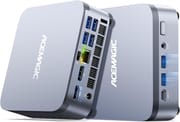 ACEMAGIC Kron K5 | ACEMAGIC Kron K5 | ACEMAGIC Kron K5 | |
| Price | List Price: $569.99 Amazon Prices: Loading prices... | List Price: $600.00 Amazon Prices: | List Price: Amazon Prices: Loading prices... |
| Version | 12GB/512GB/Core 3 304 | 16GB/512GB/Core 5 320 | 12GB/256GB/Core 3 304 |
| Performance Rating | 3.3 | 3.9 | 3.3 |
| Operating System | Windows 11 Pro | Windows 11 Pro | Windows 11 Pro |
| Processor | 5-core 1.50 Ghz (max 4.30 Ghz) Intel Core 3 304 | Hexa-core 1.50 Ghz (max 4.60 Ghz) Intel Core 5 320 | 5-core 1.50 Ghz (max 4.30 Ghz) Intel Core 3 304 |
| GPU | Integrated Intel Graphics | Integrated Intel Graphics | Integrated Intel Graphics |
| RAM | 12 GB LPDDR5, single-channel (12GB LPDDR5-5600, soldered) | 16 GB LPDDR5, single-channel (16GB LPDDR5-6400, soldered) | 12 GB LPDDR5, single-channel (12GB LPDDR5-5600, soldered) |
| Internal Storage | 512 GB NVMe | 512 GB NVMe PCIe 3.0 | 256 GB NVMe |
| Dimensions width x length x thickness | 5.05 x 5.05 x 1.61 inches (128.27 x 128.27 x 40.89 mm) | 5.05 x 5.05 x 1.61 inches (128.27 x 128.27 x 40.89 mm) | 5.05 x 5.05 x 1.61 inches (128.27 x 128.27 x 40.89 mm) |
| Weight | 0.96 lbs (0.44 kg) | 0.96 lbs (0.44 kg) | 0.96 lbs (0.44 kg) |
| WiFi | Wi-Fi 6 (802.11ax) | Wi-Fi 6 (802.11ax) | Wi-Fi 6 (802.11ax) |
| Bluetooth | Bluetooth 5.2 | Bluetooth 5.2 | Bluetooth 5.2 |
| Ethernet | 1 Ethernet port at 2.5 Gbps | 1 Ethernet port at 2.5 Gbps | 1 Ethernet port at 2.5 Gbps |
| HDMI | 1 Full-Size HDMI Port | 1 Full-Size HDMI Port | 1 Full-Size HDMI Port |
| DisplayPort | 1 DisplayPort (DP 1.4 (4K@60Hz); third 4K screen via USB-C) | 1 DisplayPort (DP 1.4 (4K@60Hz); third 4K screen via USB-C) | 1 DisplayPort (DP 1.4 (4K@60Hz); third 4K screen via USB-C) |
| VGA | No VGA Ports | No VGA Ports | No VGA Ports |
| USB Ports | 6 USB 3, 1 USB-C USB-C (20Gbps, DP 1.4, 100W PD in) + 2x USB-A 10Gbps front, 4x USB-A 5Gbps rear | 6 USB 3, 1 USB-C USB-C (20Gbps, DP 1.4, 100W PD in) + 2x USB-A 10Gbps front, 4x USB-A 5Gbps rear | 6 USB 3, 1 USB-C USB-C (20Gbps, DP 1.4, 100W PD in) + 2x USB-A 10Gbps front, 4x USB-A 5Gbps rear |
| Thunderbolt Ports | No | No | No |
| OCuLink | No | No | No |
| Internal SATA Ports | No SATA ports | No SATA ports | No SATA ports |
| Card Reader | No Card Reader | No Card Reader | No Card Reader |
| Headphone Jack | combo | combo | combo |
| Fanless | No | No | No |
| VESA Mount | Yes | Yes | Yes |
| In the Box | Mini PC, power adapter, HDMI cable, VESA bracket with screws, manual | Mini PC, power adapter, HDMI cable, VESA bracket with screws, manual | Mini PC, power adapter, HDMI cable, VESA bracket with screws, manual |
| Expandability | Memory is soldered. Two M.2 2280 slots, up to 4TB total, behind a tool-less lid. | Memory is soldered. Two M.2 2280 slots, up to 4TB total, behind a tool-less lid. | Memory is soldered. Two M.2 2280 slots, up to 4TB total, behind a tool-less lid. |
Related Mini PCs
-
 ACEMAGIC K1 (Ryzen 7030 Series)The Ryzen 7030-series ACEMAGIC K1 puts a 6-core Ryzen 5 7530U or 7430U, or a 4-core Ryzen 3 7330U,…
 -
 ACEMAGIC K1The ACEMAGIC K1 is a 5-inch mini PC built on the AMD Ryzen 7 5700U (a Ryzen 3 4300U variant also…
 -
 GMKtec NucBox K17Quiet 0.7-litre Lunar Lake mini PC with the Core Ultra 5 226V, Arc 130V graphics, a spare PCIe Gen5…
 -
 KAMRUI E3BThe KAMRUI E3B is a 5-inch-square AMD mini PC sold in Ryzen 7 PRO 5875U, Ryzen 7 5825U, Ryzen 5…
 -
 GEEKOM A5 (2025 Edition)The GEEKOM A5 (2025 Edition) is a Ryzen 5 7430U mini PC with 16GB of DDR4, a 512GB or 1TB drive, a…
 -
 GEEKOM A5 ProThe GEEKOM A5 Pro packs an AMD Ryzen 5 7530U into a premium all-metal chassis measuring just 0.47…
Two M.2 slots, soldered memory, and one full-function USB-C port
The chassis is about 5 inches square and 1.6 inches tall, roughly 0.67 liters. Nick at Retro Handhelds measured his Core 5 320 review unit at just under a pound on a postal scale; the Amazon listing for the Core 3 304 tier gives about two pounds, a weight that looks like it counts packaging. It is plastic rather than the metal the finish suggests, and Robtech, who reviewed the Core 5 320 unit, was direct about it: “it’s all plastic and flexes all over the place, but otherwise, it holds together okay.” The front face carries a USB-C port, two USB-A 3.2 Gen 2 ports at 10Gbps, a 3.5mm combo jack, and a power button whose label lights up; the rear adds HDMI 2.0, DisplayPort 1.4, 2.5GbE, four USB-A 3.2 Gen 1 ports at 5Gbps, a Kensington lock slot, and the barrel DC input. Wireless is Wi-Fi 6 and Bluetooth 5.2 on an M.2 2230 card, a generation behind the Wi-Fi 7 radios now appearing in this price bracket. A VESA bracket ships in the box and ACEMAGIC covers the machine for two years.
ACEMAGIC specifies the USB-C port as a three-in-one connector: 20Gbps of data, DisplayPort 1.4 output good for a 4K screen at 60Hz, and 100W Power Delivery as an input, so a single cable from a docking monitor can carry video, peripherals, and power. Combined with HDMI 2.0 and DisplayPort 1.4 on the back, that gets you three 4K displays at 60Hz, which is the ceiling Intel lists for the platform. It is not a Thunderbolt port, though. Robtech flagged the gap while running through his checklist: “USB-C PD is supported, but it’s not Thunderbolt 4, which this chip does support.” Intel’s spec sheet for the Core 5 320 does list Thunderbolt 4, so this is ACEMAGIC leaving a platform feature on the table rather than a silicon limitation.
The two M.2 2280 storage slots sit under a tool-less lid, top out around 3.9 GB/s each, and ship with a stock drive that does not reach even that. ACEMAGIC lists them as NVMe PCIe 4.0 x2 with a combined 4TB ceiling. VideoCardz flagged the lane arithmetic in its writeup of the announcement: Intel’s official Core 5 320 spec lists only six PCIe 4.0 lanes in total, so the storage layout needed confirming once hardware shipped. Robtech confirmed it by dropping a fast Gen 4 drive into each slot, and reported that “both NVMe slots max out at the full Gen 3 X4 spec,” which is roughly the same bandwidth as PCIe 4.0 x2 and about 3.9 GB/s. The stock drive on his unit was a Colorfire Gen 3 x2 part, so the shipped SSD does not saturate what the slot can do. If you want the full speed the platform allows, plan on your own drive.
Both tiers use soldered LPDDR5, which Robtech described plainly: “it’s not easily replaceable since LPDDR5 is used, which is stuck right on the board.” Intel lists the Wildcat Lake chips with a maximum of one memory channel and a 64GB ceiling, and ACEMAGIC has chosen 12GB at 5600 MT/s on the Core 3 304 tier and 16GB at 6400 MT/s on the Core 5 320 tier. Neither is upgradeable, and 12GB is a thin allocation for a Windows 11 Pro machine whose iGPU shares that same pool. If you intend to keep the box for five years or run more than a handful of browser tabs against a video call, the 16GB tier is the one to want.
The Core 3 304 in the Amazon configuration is a five-core, five-thread part: one performance core, four low-power efficient cores, a 4.3GHz boost, 6MB of cache, and a single Xe graphics core. Intel rates it at 15W base power with a 35W turbo ceiling, and it scores 11,645 on PassMark. ACEMAGIC configures the K5 at a 22W design target and advertises 24 TOPS of combined AI throughput, a figure that lines up with Intel’s own per-block numbers for the 304: 15 TOPS on the NPU and 9 TOPS on the integrated graphics. The listing also prints a Geekbench 6.7.1 comparison chart claiming 2,472 single-core and 6,708 multi-core against 1,250 and 3,000 for the N150. Those are vendor-supplied figures, not measured ones, so treat them as marketing until an independent review of the 304 tier lands.
Adding a second performance core and a second Xe graphics core gives the Core 5 320 six cores, six threads, a 4.6GHz boost, 16 TOPS on the NPU, 20 TOPS on the graphics, and a PassMark score of 15,109. ACEMAGIC quotes 25W sustained for that tier. On the practical difference between the two, Robtech’s summary of the architecture is the useful line: “Intel’s gone with a two-performance core design that smokes the competition for OS responsiveness and apps that rely on single fast cores.” The Core 3 304 has one of those two performance cores. Whatever single-thread advantage the platform brings, the Amazon configuration gets a smaller share of it, and it costs more than a directly comparable box built around the same chip. BOSGAME’s E6 ECO carries the same Core 3 304 with 12GB of memory and a 512GB drive, adds Wi-Fi 7 and a second Ethernet port (two gigabit jacks against the K5’s single 2.5GbE), and listed on Amazon for roughly a third less when this page was written. That price gap is the central problem with the Core 3 304 tier.
Reviewer Insights
Robtech and Retro Handhelds both tested the Core 5 320 configuration ahead of retail; Retro Handhelds discloses that ACEMAGIC supplied its unit. No independent review of the Core 3 304 tier that Amazon sells has appeared, so these performance findings describe the faster half of the family. Robtech closed his review by saying two more Wildcat Lake minis with the Core 3 304 are in his pipeline.
Robtech
Robtech’s hands-on covers the Core 5 320 unit end to end, from teardown to thermals. Against the best N150 score in his comparison charts, the 320 posted a 90 percent gain in Cinebench single core and a 101 percent gain in Geekbench single core, and in Geekbench multi-core the gap widened to 135 percent. His verdict on that jump: “This isn’t a generational improvement, it’s a whole different class of CPU.” He then ran the chip against much more expensive silicon in Geekbench 7 and reported that “it just manages to beat Geekom’s mini PC with a Core Ultra 9 185H in single core, which is bananas,” while noting it gets trounced in multi-core against those same chips. Multi-threaded work is where the ceiling shows: he measured the 320 losing to both the Ryzen 5 5500U and the Ryzen 5 5600H, and found it could not keep up with the 5600H for compiling code.
Graphics improved by even larger margins from a low base. He recorded gains of 136.5 percent in 3DMark Fire Strike, 229.5 percent in Time Spy, and 238.5 percent in Steel Nomad Light against the N150, and singled out AV1 hardware encoding as new to the tier, since the previous N-series parts only had an AV1 decoder. In games, Counter-Strike 2 ran decently without upscaling and GTA 5 managed around 30 FPS at 1080p high, while Forza Horizon 6 was not what he would consider playable. Emulation moved further: “Where PS3 emulation was impossible on the previous chips, here it’s running at a higher resolution and a faster frame rate than the original game,” and he expects the Wii U library to run at full speed at 1080p, with Xbox 360 at 720p still out of reach. He also cautions that with only two performance cores, some games and applications will use the chip like a fast dual core rather than a six-core part.
Idle power draw was a new low in his testing, but maximum draw climbed to 54 watts at the wall, and heat followed: “the cooling struggles when all cores are under load, hitting a high of 93°C.” He notes the safe thermal limit for the platform is 100C, so the machine is not throttling hard, though it runs hotter than the lower-end minis he is used to. Fan noise topped out at 39 dBA, which he called reasonable next to the 44 dBA he measured from Peladn’s AMD units. Windows 11 Pro came preinstalled with a clean malware scan, and he confirmed Ubuntu 26.04 LTS ran without trouble. The BIOS was the weak spot: it runs at a 35W PL2 out of the box, raising both power limits made no difference, and beyond a couple of power-state options there is very little in it. He rated the K5 “a pretty decent mini PC with no major issues,” with the choice between it and AMD coming down to which core mix matches your work.
Retro Handhelds
Nick reviewed the Core 5 320 unit for Retro Handhelds on 15 August 2026 to find out whether the NPU makes this a usable local-LLM box. His Geekbench AI numbers say the hardware is capable. Running OpenVINO on the NPU produced 28,037 in quantized INT8 work against 4,372 for the same test on the CPU, and since language models lean heavily on quantized processing, that gap is the point of the chip. His Geekbench 6 CPU run on the K5 landed at 2,283 single-core and 7,637 multi-core.
Getting there took most of two weeks, and that is his central complaint. LM Studio Bionic defaults to a Vulkan back end with no OpenVINO support, so it could not touch the NPU at all. The OpenVINO-based NoLlama tool took the right path but kept failing: “The system could see the NPU, but when it attempted to initialize the chip for an LLM workload, it crashed.” An Intel driver release late in his testing window fixed it, after which he hosted TinyLlama-1.1B-Chat locally and measured a sustained 17.1 tokens per second, with CPU usage holding between 12 and 15 percent and memory never passing 60 percent because the NPU was carrying the load. Power behaviour matched: he describes the machine as remaining whisper quiet through that work, which tracks with the 15W base rating.
He credits the K5 with advantages against the Mac mini it is priced against, naming the 2.5GbE port that Apple charges to upgrade, the dual M.2 slots against Apple’s storage pricing, and three-display output without proprietary dongles. But the software is not ready: “It’s difficult for me to recommend running out to pick something up that is barely just getting on its feet.” He frames the machine as purpose-built hardware for a niche audience that knows it wants an NPU, and says he would rather wait before committing to a technology still in its infancy.
Wait for the Core 5 320 tier
The Wildcat Lake platform under the Kron K5 is new for this price tier. Two performance cores and a modern Xe graphics block turn the budget Intel mini PC from a machine you tolerate into one that feels responsive. Robtech measured a 101 percent single-core gain over the N150 and singled out the AV1 encoder, and Nick ran a small language model on the NPU at 17.1 tokens per second. The chassis around it is competent, with triple 4K output, a useful USB-C port, 2.5GbE, two M.2 slots behind a tool-less lid, and a two-year warranty, all more than the N100 boxes this platform replaces offered.
Amazon has the Core 3 304 tier, which halves the performance-core count that makes the platform interesting, pairs it with 12GB of soldered memory you can never change, and asks noticeably more than BOSGAME’s same-chip E6 ECO, which also carries Wi-Fi 7 and a second Ethernet port. Its only performance figures are ACEMAGIC’s own. Add the plastic chassis, the 93C all-core ceiling, the missing Thunderbolt 4, and a BIOS with almost nothing in it, and the case for buying this particular box today is thin. If the Core 5 320 tier reaches retail at a sensible price, or if the 304 version drops toward what the E6 ECO asks, the calculus changes. Until then, compare it against current options in our Mini PC Comparison Chart.
Frequently Asked Questions
Which processor does the ACEMAGIC Kron K5 use?
It depends on the configuration. The version listed on Amazon uses the Intel Core 3 304, a five-core, five-thread Wildcat Lake chip with one performance core, four low-power efficient cores, a 4.3GHz boost, and a PassMark score of 11,645. ACEMAGIC’s announced configuration uses the Core 5 320, which adds a second performance core and a second Xe graphics core for six cores, a 4.6GHz boost, and a PassMark score of 15,109. Both are 15W base-power parts with a 35W turbo ceiling.
Can you upgrade the RAM in the Kron K5?
Not on either tier. Both use LPDDR5 soldered directly to the board, so the 12GB in the Core 3 304 configuration and the 16GB in the Core 5 320 configuration are permanent. Robtech confirmed this on his review unit. Storage is the only upgradeable part: two M.2 2280 slots sit behind a tool-less lid and take up to 4TB between them.
How many monitors can the Kron K5 drive?
Three, all at 4K and 60Hz. HDMI 2.0 and DisplayPort 1.4 on the rear handle two of them, and the front USB-C port carries DisplayPort 1.4 output for the third. Three displays is also the ceiling Intel lists for the Wildcat Lake graphics block, so there is no headroom beyond that.
What speed are the M.2 slots in the Kron K5?
ACEMAGIC lists both M.2 2280 slots as NVMe PCIe 4.0 x2. Robtech tested them with a fast Gen 4 drive and found both slots run at the full PCIe 3.0 x4 spec, which is roughly the same bandwidth. The drive ACEMAGIC ships is a Colorfire Gen 3 x2 part, so the stock SSD is slower than the slot allows.
Does the Kron K5 have Thunderbolt?
Not on this machine. The single USB-C port handles 20Gbps of data, DisplayPort 1.4 output, and 100W Power Delivery as an input, which covers most single-cable docking setups, but it is not a Thunderbolt 4 port. Intel’s spec sheet lists Thunderbolt 4 support for the Core 5 320, so this is an implementation choice rather than a platform limit.
Can the ACEMAGIC Kron K5 run local AI models?
The hardware can. The software was not ready at the time of that review. Retro Handhelds measured the Core 5 320’s NPU at 28,037 in Geekbench AI quantized INT8 work against 4,372 for the CPU, and ran TinyLlama-1.1B-Chat at a sustained 17.1 tokens per second while CPU usage stayed between 12 and 15 percent. Getting there required an OpenVINO-specific tool driven from a PowerShell terminal and a driver update from Intel; LM Studio had no NPU support at the time of that review.