

Late last week, a pair of commits in the Chromium Gerrit repositories confirmed something the Chromebook community has been watching for: Intel’s next-generation Nova Lake silicon is officially headed to the Chromebook ecosystem. The baseboard is codenamed “Atria,” and its driver configurations leave little ambiguity about what’s underneath. Chrome Unboxed first reported the discovery, noting that the commit structure follows the same pattern used for every previous Chromebook baseboard that eventually became shipping hardware. The commits themselves confirm the silicon, not the operating system; based on the 2027 launch window, Atria is most likely the leading edge of hardware that will ship in Google’s Aluminium OS era rather than alongside today’s ChromeOS Classic devices.
Before the hype train leaves the station, let’s be precise about what Atria is and isn’t. It’s a reference baseboard, not a retail product. You won’t walk into Best Buy and ask for “the Atria Chromebook.” What it represents is Intel and Google collaborating on hardware around Nova Lake’s capabilities, hardware whose late-2027 timing puts it in the same window as Aluminium OS rather than the current ChromeOS Classic generation. That distinction matters, because the question everyone keeps asking in r/chromeos threads and comment sections is whether knowing this hardware exists should change anyone’s purchase plans today.
Commits Show Atria Targets Nova Lake
The two Gerrit commits (depthcharge config and board configuration) show Atria configured for Intel’s Nova Lake architecture, branded commercially as Core Ultra Series 4. Tucked into the driver configurations is a clear reference to the SoC family this board will house, and the commit pattern matches every previous Chromebook baseboard that eventually materialized as real hardware on store shelves. For context, Chrome Unboxed has tracked these baseboard commits for years, and their track record of connecting codenames to shipping devices is strong.
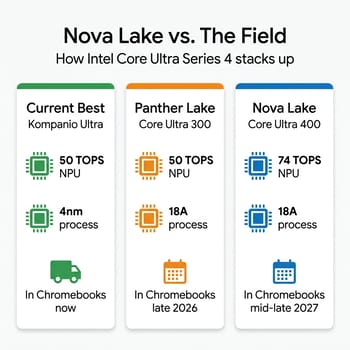
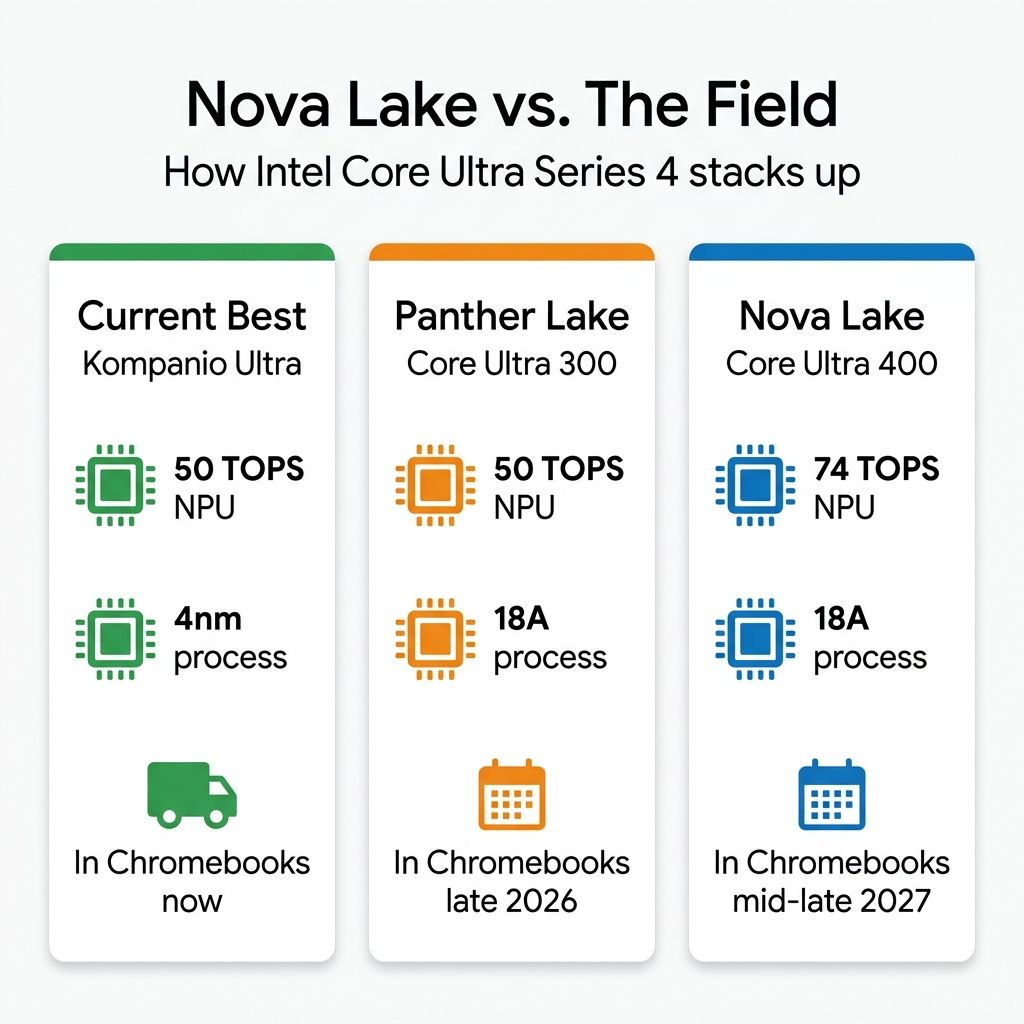
Nova Lake itself represents Intel’s next major architectural leap beyond the Panther Lake chips just now reaching Chromebook devices. The specs that matter for buyers: Xe3 graphics architecture (a significant jump from current Xe2), an NPU6 neural processing unit capable of up to 74 TOPS of AI performance, and CPU cores built on new Coyote Cove and Arctic Wolf designs. Intel CEO Lip-Bu Tan confirmed during a Q4 2025 earnings call that Nova Lake silicon is on track for the end of 2026, with mobile processors arriving first.
That 74 TOPS figure deserves context. Microsoft’s Copilot+ PC standard requires 40 TOPS of dedicated NPU performance, and that threshold has become the industry benchmark for AI-capable laptops. The Panther Lake chips arriving this year offer about 50 TOPS, while the current Kompanio Ultra delivers 50 TOPS as well. Nova Lake nearly doubles that bar, which strongly suggests that Google’s AI ambitions for Aluminium OS go well beyond what today’s hardware can deliver. Google has since put a public face on those ambitions with the Googlebook announcement and its Gemini-centric pitch. Whatever Google is planning for the 2027-2028 Aluminium OS software stack, Nova Lake’s silicon is being built to support it.
The Timeline Reality Check
Intel saying “end of 2026” for Nova Lake silicon doesn’t mean you’ll be shopping for a Nova Lake Chromebook by Christmas. The path from silicon availability to shipping consumer hardware typically adds six to twelve months, and the Aluminium OS software stack introduces another variable entirely. That’s two separate timelines that both need to converge before a polished product hits shelves.
The most realistic timeline looks like this. Intel ships Nova Lake mobile processors in late 2026 or early 2027. OEMs like Acer, Lenovo, and HP integrate them into laptop designs during the first half of 2027. Those devices appear in stores sometime in mid-to-late 2027 at the earliest. Meanwhile, court documents from Google’s antitrust case revealed that Aluminium OS won’t see full commercial release until 2028, though trusted-tester devices are expected in late 2026. Google’s Android Ecosystem President Sameer Samat confirmed in March 2026 that he’s “super excited about later this year,” but “later this year” for testers and “later this year” for retail buyers are very different commitments.
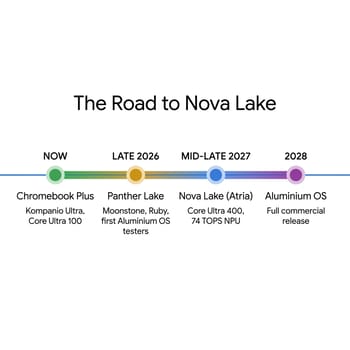
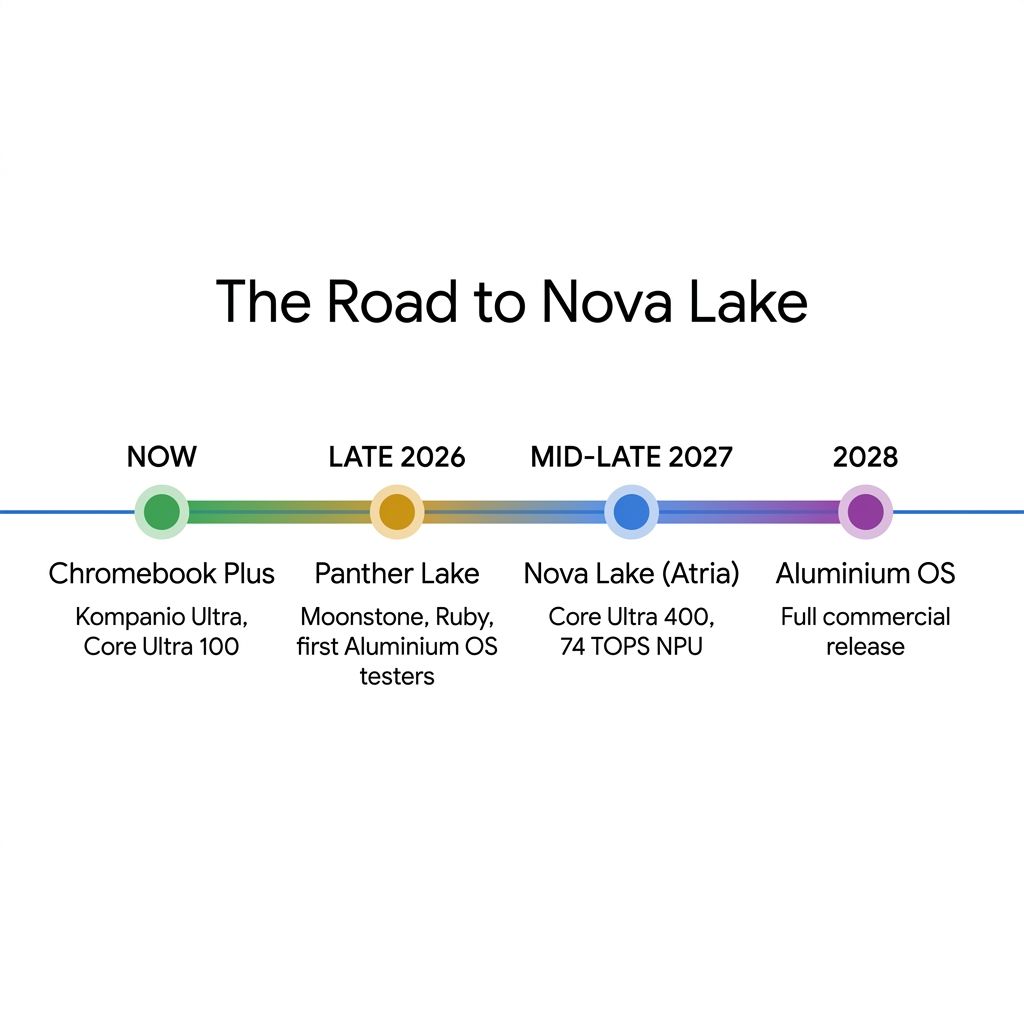
The practical upshot: if you’re waiting specifically for a Nova Lake Chromebook running a mature version of Aluminium OS, you’re looking at 12 to 18 months minimum. Probably closer to 18 to 24 months for a polished retail experience. That’s a meaningful wait, and worth understanding before you put your wallet away.
Atria Isn’t Alone: The Full Hardware Wave
Zooming out, Atria is one piece of a much larger hardware wave heading toward Aluminium OS, and it’s not even the first to arrive. On the Intel side, Acer’s “Moonstone” baseboard is built on Panther Lake (Core Ultra Series 3) and its Gerrit commit explicitly references “ALOS” testing, which is shorthand for Aluminium OS. Moonstone represents the first generation of Intel Aluminium OS hardware, and it ships before Nova Lake arrives. Lenovo’s “Ruby” board is another Panther Lake device in the same pipeline.
The ARM side of the equation is equally active. Google is developing Snapdragon-based Aluminium OS devices alongside the “Bluey” baseboard that’s getting Google’s signature lightbar treatment. Lenovo’s “Sapphire” board, powered by Kompanio Ultra, adds an ARM option to the Aluminium OS device lineup. Google isn’t betting on a single chip architecture; they’re building across Intel, Qualcomm, and MediaTek simultaneously, which means the ARM processor race remains as relevant as ever to anyone shopping for their next device.
This matters for the buying decision because Panther Lake Chromebooks arriving later this year will likely be the first consumer hardware running Aluminium OS. Nova Lake’s Atria comes after, positioned as the more capable second generation with better AI processing and graphics. Buyers who want to be on the Aluminium OS train don’t necessarily have to wait for Nova Lake to board it.
What Happens to Current Chromebooks
If you already own a Chromebook, the Atria news changes exactly nothing about your device’s support timeline. Google has been explicit about continued ChromeOS support: your device keeps receiving updates through its Auto Update Expiration date, and recent Chromebook Plus models carry support windows stretching well into the 2030s. The Acer Chromebook Spin 714 is covered through June 2032. The Lenovo Chromebook Plus 14 OLED carries an AUE date of June 2035. Your device won’t stop working or lose features because newer hardware is in development somewhere.
Whether your current Chromebook eventually gets Aluminium OS is a separate question we’ve covered in our compatibility guide. Google VP John Maletis confirmed that “not all devices will be able to [migrate] just because there are technical specifications.” The most likely migration candidates are Chromebook Plus devices from 2023 forward, but Google hasn’t published an official compatibility list. What is confirmed: ChromeOS Classic will remain supported through at least 2033, with a full phaseout not expected until 2034.
Three Buyer Scenarios
So you’re shopping for a Chromebook this spring, and you’ve read enough about Aluminium OS to feel uncertain. Does knowing about Atria change the math? Here are three scenarios with no vendor spin.
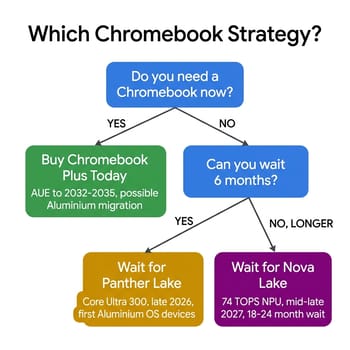
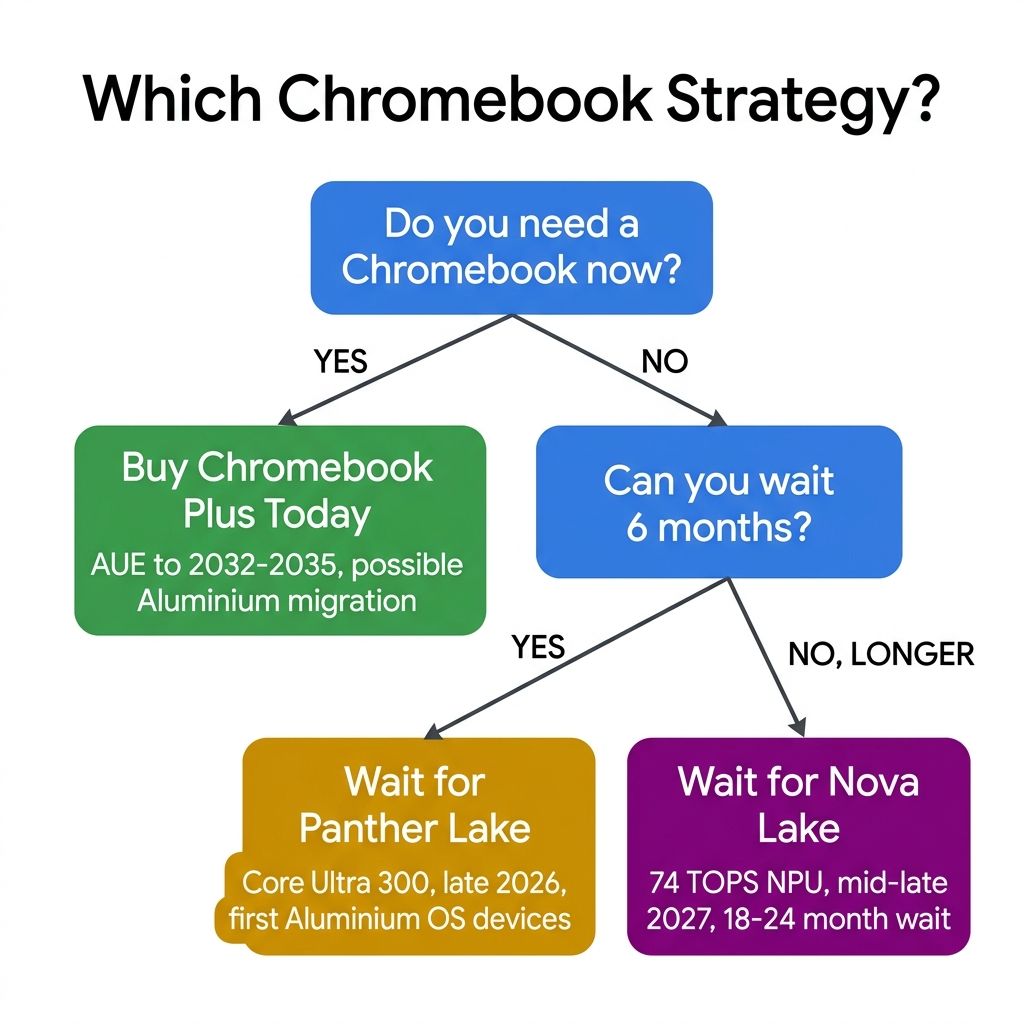
If you need a Chromebook now, buy one now. A current Chromebook Plus with a long AUE date is the lowest-risk play. You get every AI feature Google offers today, guaranteed support for nearly a decade, and a real chance of qualifying for Aluminium OS migration when it arrives. If you are unsure which tier to target, our breakdown of the premium-first direction of the Googlebook lineup explains where Google is steering buyers. Spending $400 to $700 on a proven device with a 2033-plus support tail is not settling; it’s practical. Two strong options:
Lenovo Chromebook Plus 14" OLED
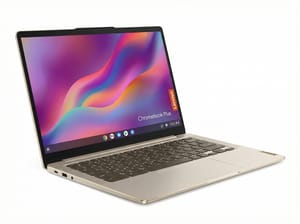
- ✓Kompanio Ultra speed
- ✓OLED display
- ✓June 2035 AUE
- ✓fanless design
- ✗ARM processor (some niche Linux apps may not run)
- ✗single 16GB configuration
- ✗not upgradeable
Acer Chromebook Spin 714

- ✓Intel processor
- ✓2-in-1 convertible
- ✓solid build quality
- ✓June 2032 AUE
- ✗Fan noise under load
- ✗heavier than ARM alternatives
If you can wait six months, watch for Panther Lake. The Chromebooks arriving in Q3 and Q4 of 2026 bring Intel’s Core Ultra Series 3 with 50 TOPS of NPU performance, meaningfully better battery life, and in some cases, explicit Aluminium OS readiness built into the hardware design. We broke down the details in our Panther Lake analysis, and the bottom line is that these are not speculative devices. Baseboards are confirmed, OEMs are building, and retail availability is months away rather than years.
If you’re considering waiting for Nova Lake, know the cost. You’re looking at 18 to 24 months of waiting for a first-generation product running first-generation Aluminium OS software. That 74 TOPS NPU and Xe3 graphics are exciting specs, but the gap between “exciting specs in a Gerrit commit” and “a polished laptop you can buy” is wide. And the tech upgrade cycle never pauses; by the time Nova Lake ships, there will be leaks about the generation after that. Unless your current device is failing or unsupported, the waiting cost is real: that’s 18 months of not having a device that works for you today.
What to Watch For
The Atria commit is significant because it confirms Intel’s Nova Lake silicon is on its way to Chromebooks, and the late-2027 timing makes Aluminium OS the most likely software target. Nova Lake’s capabilities, particularly that 74 TOPS NPU, tell us that whatever Google is planning for the 2027-2028 software stack goes well beyond what current Chromebook Plus hardware can deliver. That’s a signal worth tracking.
But a Gerrit commit is not a product announcement, and the devices built on Atria are at least a year from store shelves. If you need a Chromebook today, today’s devices are good. If you can wait a few months, Panther Lake offers the first taste of hardware designed with Aluminium OS in mind. And if you’re the type who always wants to wait for the next thing, you now have a codename to follow. Just don’t let it keep you on the sidelines forever.


