
GMKtec EVO-X1
Updated on

The EVO-X1 opens GMKtec’s Evolution Series with a redesigned metal chassis aimed at power users. AMD’s Ryzen AI 9 HX-370 runs the machine, paired with Radeon 890M integrated graphics that Lon.TV put close to entry-level discrete cards from a year or two ago. An Oculink port sits alongside USB4 on the back, so an external GPU can be attached without giving up the sub-one-liter footprint.
Pros and cons
| Pros | Cons |
|---|---|
| CPU and integrated GPU performance from AMD Zen 5 architecture | Soldered LPDDR5X RAM cannot be upgraded or replaced |
| Oculink port for high-speed external GPU connectivity (PCIe 4.0 x4) | Fan noise reaches 40 to 53 dBA under sustained load |
| 0.94L volume with a metal chassis | WiFi 6 range falls off at distance |
| Dual 2.5GbE ethernet ports for wired connectivity | RGB fan lighting hidden inside and cannot be controlled |
| CPU under 70C at the 65W TDP setting in TechTablets’ test | Costs more than budget-oriented mini PCs |
| Triple 8K display output via HDMI 2.1, DisplayPort 2.1, and USB4 | 120W power brick is bulky |
Related Videos
GMKtec EVO-X1 Comparison Chart
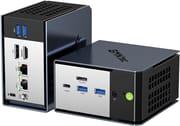 GMKtec EVO-X1 | |
| Price | List Price: $899.99 Amazon Prices: Loading prices... |
| Version | 32GB/1TB |
| Performance Rating | 6.3 |
| Operating System | Windows 11 Pro |
| Processor | Twelve-core 2.00 Ghz (max 5.10 Ghz) AMD Ryzen AI 9 HX 370 |
| GPU | Integrated AMD Radeon 890M |
| RAM | 32 GB LPDDR5 |
| Internal Storage | 1 TB |
| Dimensions width x length x thickness | 4.34 x 4.22 x 2.49 inches (110.24 x 107.19 x 63.25 mm) |
| Weight | 1.31 lbs (0.6 kg) |
| WiFi | Wi-Fi 6 (802.11ax) |
| Bluetooth | Bluetooth 5.2 |
| Ethernet | 2 Ethernet ports at 2.5 Gbps |
| HDMI | 1 Full-Size HDMI Port |
| DisplayPort | 1 DisplayPort (DisplayPort 2.1) |
| VGA | No VGA Ports |
| USB Ports | 2 USB 2.0, 2 USB 3, 1 USB-C (1 USB4) USB4 40Gbps with DP Alt Mode and PD; 2x USB 3.2 Gen 2 10Gbps; Oculink PCIe 4.0 x4 for eGPU |
| Thunderbolt Ports | No |
| OCuLink | PCIe 4.0 x4 for eGPU |
| Internal SATA Ports | No SATA ports |
| Card Reader | No Card Reader |
| Headphone Jack | combo |
| Fanless | No |
| VESA Mount | Yes |
| In the Box | Mini PC, 120W power adapter, HDMI cable, vertical stand, user manual |
| Expandability | Storage expandable via dual M.2 2280 PCIe 4.0 slots (up to 8TB). RAM is soldered LPDDR5X and cannot be upgraded. |
Related Mini PCs
-
 GMKtec NucBox K16The GMKtec NucBox K16 is a CNC-aluminium mini PC on the AMD Ryzen 7 7735HS with Radeon 680M…
 -
 GMKtec Nucbox K2The GMKtec Nucbox K2 is a compact AMD Ryzen 7 7735HS mini PC with Radeon 680M graphics, DDR5 to…
 -
 PELADN HO5The PELADN HO5 puts AMD's 12-core Ryzen AI 9 HX 370 and Radeon 890M graphics in a plastic five-inch…
 -
 HP EliteDesk 8 Mini G1iHP's 1-liter EliteDesk 8 Mini G1i puts an Arrow Lake-S desktop chip, three M.2 Gen4 slots,…
 -
 Beelink EQR7The Beelink EQR7 pairs an AMD Ryzen 7 7735U with a built-in power supply, dual Gigabit Ethernet,…
 -
 Beelink SER5 MAX (Ryzen 7 7735HS)The Beelink SER5 MAX pairs an 8-core Ryzen 7 7735HS and Radeon 680M graphics with 24GB of LPDDR5,…
Soldered memory in a 0.94-liter metal shell

GMKtec dropped the NucBox name for this line and gave it a boxy metal shell that measures 110.2 x 107.3 x 63.2 mm. At 0.94 liters the shape lets several units stack together. The rear panel carries dual 2.5 Gigabit Ethernet, HDMI 2.1, DisplayPort 2.1, and the Oculink connector, while USB 3.2 ports and the power button sit on the front for quick access.
The Ryzen AI 9 HX-370 is a 12-core, 24-thread Zen 5 processor that boosts to 5.1 GHz, with year-over-year gains of 20-25 percent over the previous generation Ryzen 7 8845HS. Radeon 890M graphics with 16 compute units cover 1080p gaming in many titles, and Lon.TV places the chip near an RTX 3050 from recent years once FSR and frame generation are switched on. A 50 TOPS NPU meets the Windows Copilot+ PC requirement, so AI-accelerated workloads have somewhere to run as software support expands.
Two M.2 2280 PCIe 4.0 slots take up to 8TB of NVMe storage, while the LPDDR5X-7500 memory is soldered and stays at whatever capacity you buy. The USB4 port runs at 40Gbps with DisplayPort Alt Mode and Thunderbolt 3 compatibility, and the Oculink port gives an external GPU enclosure PCIe 4.0 x4 bandwidth (64Gbps). Wireless is WiFi 6 and Bluetooth 5.2, and reviewers found the WiFi range wanting at distance, which leaves the two 2.5GbE ports doing the heavy network work.
Reviewer Insights

ETA PRIME: cooling held below throttling thresholds
ETA PRIME was thoroughly impressed with the GMKtec EVO-X1, declaring that the company has “taken their line to a whole new level with this PC.” Temperatures stayed well under throttling thresholds in his testing even when running at the boosted 65W TDP mode. The reviewer praised the dual connectivity options for external GPUs via Oculink and USB4 as a major selling point for gamers and content creators who want the option to add dedicated graphics power without replacing their entire system. He recommended the machine for anyone seeking the highest performing integrated graphics in a mini PC form factor with eGPU expansion potential.
An unlocked BIOS, found in TechTablets’ teardown
TechTablets took the EVO-X1 apart and found that the device contains three M.2 slots (2x 2280 and 1x 2242), all running at PCIe 4.0 speeds. Their testing put CPU temperatures under 70 degrees Celsius even at the 65W TDP setting. The reviewer noted that the BIOS is fully unlocked, allowing power users to adjust TDP limits and even overclock the memory to 8000MT/s. The main criticisms centered on fan noise in performance mode and the non-upgradeable soldered RAM, though TechTablets still highly recommended the device for power users wanting the latest AMD architecture in a thermally-efficient package.
Ubuntu ran without trouble on Lon.TV’s unit
Lon Seidman of Lon.TV noted upfront that “if you don’t like noisy PCs, this one is probably not going to be for you.” On graphics, he observed that the AMD processor “comes close to what we were seeing out of an RTX 3050 from just a year or two ago.” Lon specifically tested Linux compatibility with Ubuntu 24.10, finding the system stable and well-supported. While acknowledging the premium price point compared to lower-powered mini PCs, he recommended the EVO-X1 for power users who need high performance in a compact frame and will make use of the Oculink port for external GPU expansion.
NotebookCheck: sleep states and LEDs that will not switch off
According to NotebookCheck, the EVO-X1 earned a 72% score with praise for its fast CPU and GPU performance relative to its compact size, unique stackable design, and Oculink expandability. Their technical testing found the Ryzen AI 9 HX 370 beats the competing Intel Core Ultra 9 185H by approximately 15 percent in performance benchmarks. They noted software issues including problematic power states during sleep mode and RGB LEDs that cannot be toggled off, suggesting the device could have benefited from additional pre-launch refinement. The lack of WiFi 6E or WiFi 7 and absence of an SD card reader were also cited as missed opportunities at this price point.
TechRadar credited the Oculink port for the verdict
TechRadar’s Alastair Jennings gave the EVO-X1 a 4.75 out of 5 stars, calling it “far more than I’d expected from a mini PC all due to that Oculink port.” The review emphasized how the external GPU connectivity transforms the device into something that “truly rivals desktop-sized machines in terms of graphics computing power” when paired with an appropriate GPU enclosure. The premium metal casing and triple 8K display capability were highlighted as standout features, though the soldered RAM and fan noise under load were noted as the primary compromises.
TechDweeb found the fans quiet under load
TechDweeb was impressed by the stylish metal build and a cooling system that stays quiet even under load. He found the CPU rivaling desktop-class i7 chips, while the integrated Radeon 890M managed demanding titles like Assassin’s Creed Shadows at playable frame rates on low-to-medium settings.
Worth the premium only if the Oculink port gets used
The Ryzen AI 9 HX-370 and Radeon 890M cover gaming, content creation, and productivity work in a sub-one-liter box, and the dual 2.5GbE ports and display outputs keep connectivity from becoming the bottleneck. The metal chassis and the temperatures reviewers measured show GMKtec aiming the Evolution Series at a more premium market segment.
Soldered LPDDR5X means the memory capacity is permanent, the fan becomes noticeable under sustained heavy loads (if silence matters for your setup, the fanless vs active cooling tradeoffs are worth understanding before you commit), and WiFi may disappoint anyone leaning on wireless at distance. At approximately $900 for the 32GB/1TB configuration, this sits well above budget mini PCs on price.
Whether that price makes sense depends on the Oculink port. Without an external GPU in the plan, most of what the premium buys goes unused, and a cheaper machine with socketed memory covers the same daily work. Starry Hope’s Mini PC Comparison Chart lists the alternatives side by side.
Upgrades
Accessories that fit the GMKtec EVO-X1's OCuLink and USB4 or Thunderbolt ports.
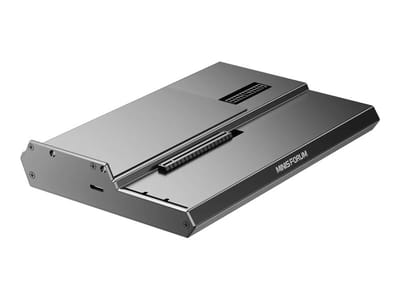
DEG1 eGPU Dock
A plain OCuLink dock with a PCIe 4.0 x4 link for a desktop graphics card; it takes an ATX or SFX power supply that you supply.
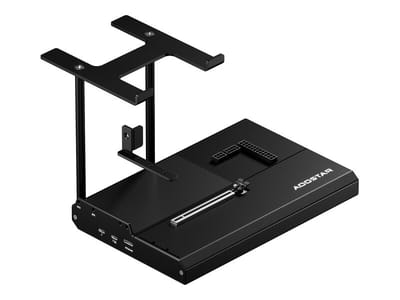
EG02 eGPU Dock
Connects over OCuLink for the full PCIe 4.0 x4 link and has Thunderbolt 5 as a second input; the graphics card and power supply are sold separately.
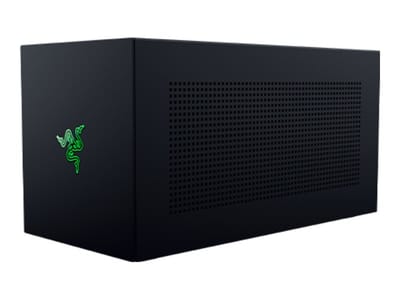
Core X V2
A Thunderbolt 5 enclosure that Razer lists as working with Thunderbolt 4 and USB4 hosts; it fits a four-slot card and needs an ATX power supply.
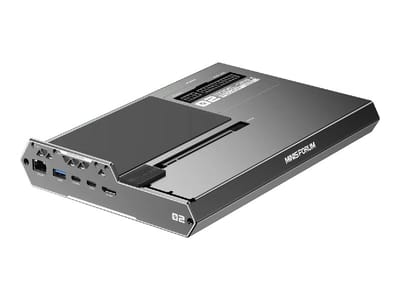
DEG2 eGPU Dock
Connects over USB4 or Thunderbolt 5, with an OCuLink input behind a switch, and adds an M.2 slot; it needs an ATX or SFX power supply.
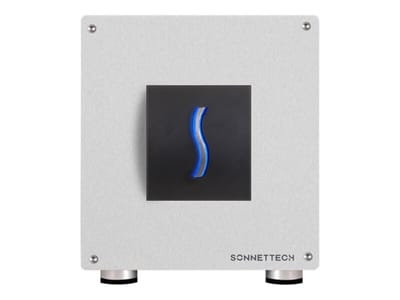
Breakaway Box 850 T5
Has an 850W power supply built in, so only the graphics card is extra, and works with Thunderbolt 4 and USB4 Windows PCs.
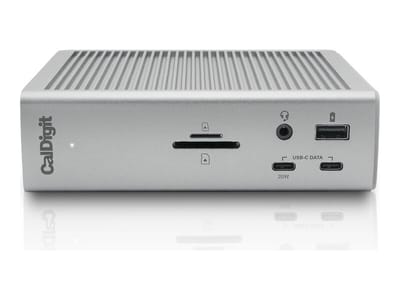
TS4 Thunderbolt 4 Dock
An 18-port dock that CalDigit lists for Thunderbolt 4 and USB4 hosts, with 2.5GbE and a DisplayPort 1.4 output.
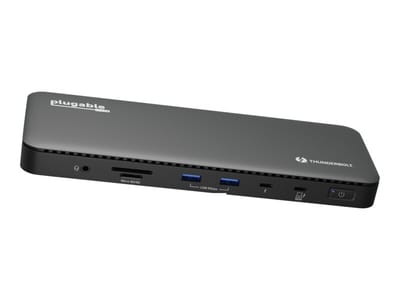
TBT4-UD5 Thunderbolt 4 Dock
Two HDMI ports drive two 4K60 monitors from one Thunderbolt 4 or USB4 port on a Windows PC.
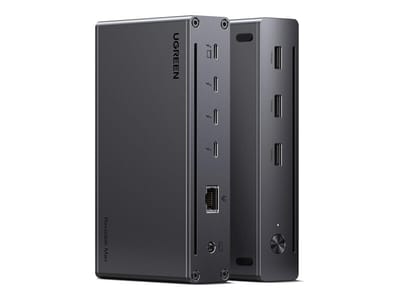
Revodok Max 208 Thunderbolt 4 Dock
Adds three Thunderbolt 4 ports for dual 4K60 displays plus gigabit Ethernet; it has no HDMI port, so monitors connect over USB-C or an adapter.
Frequently Asked Questions
Can I upgrade the RAM on the GMKtec EVO-X1?
No. The memory is soldered LPDDR5X-7500, so the capacity is fixed at the time of purchase and cannot be replaced later. Compact mini PCs commonly trade the upgrade path for a small footprint and faster memory speeds.
What is Oculink and why is it important on the EVO-X1?
Oculink is a high-speed connector carrying PCIe 4.0 x4 bandwidth (64Gbps), used mainly for external GPU enclosures. On this machine it lets a full desktop graphics card do the work the integrated Radeon 890M cannot, which is faster than running an eGPU over USB4 or Thunderbolt.
How loud is the GMKtec EVO-X1 under load?
Fan noise tracks the power mode. Balanced mode sits around 30-32 dBA. Sustained load in performance mode (65W TDP) pushes it to roughly 40-53 dBA, and both Lon.TV and TechTablets called the noise out. Staying in balanced mode for everyday tasks keeps it manageable.
Can the GMKtec EVO-X1 run games at 1080p?
Yes, in many titles. Reviewers place the Radeon 890M near RTX 3050 levels, and TechDweeb ran Assassin’s Creed Shadows at playable frame rates on low-to-medium settings. AMD FSR and frame generation help in demanding games, and the Oculink port takes an external GPU when the integrated graphics run out.
How many displays can the GMKtec EVO-X1 support?
Three at once, with 8K resolution capability. The outputs are one HDMI 2.1 port, one DisplayPort 2.1 port, and one USB4 port with DisplayPort Alt Mode, which covers a productivity workstation or a multi-monitor home office setup.
Does the GMKtec EVO-X1 work with Linux?
Lon.TV confirmed stable operation with Ubuntu 24.10. The AMD Ryzen processor and Radeon graphics have good open-source driver support in modern distributions, and a recent kernel is worth having for the Ryzen AI 9 HX-370.
What storage options does the GMKtec EVO-X1 offer?
Two M.2 2280 PCIe 4.0 NVMe slots hold up to 8TB in total. The machine ships with a 1TB NVMe SSD, which leaves the second slot open, and TechTablets’ teardown found a third M.2 2242 slot inside. All of them run at full PCIe 4.0 speeds.