
MINISFORUM AI X1 Pro
Updated on

The MINISFORUM AI X1 Pro puts AMD’s Ryzen AI 9 HX 370 into a 7.68-inch square chassis with a 135W power supply built in, so a standard power cable is the only thing that runs to the wall. The rest of the volume goes to expansion: two DDR5 SO-DIMM slots reaching 128GB, three M.2 2280 slots, and an OCuLink port for an external GPU. That mix suits local AI work and content creation, at the cost of a footprint larger than typical mini PCs.
Expansion and cooling lead, size and memory type lag
| Pros | Cons |
|---|---|
| Powerful AMD Ryzen AI 9 HX 370 with 12 cores/24 threads and 50 TOPS NPU | Larger than typical mini PCs at 7.68” x 7.68” x 1.87” |
| Expandability with 3x M.2 slots (up to 12TB) and 128GB RAM | SODIMM DDR5-5600 is slower than LPDDR5X, limiting iGPU gaming performance |
| Built-in 135W PSU eliminates external power brick | Only 3 USB-A ports for legacy peripherals |
| OCuLink PCIe 4.0 x4 port for high-speed external GPU | High DPC latencies can affect real-time audio and video editing (NotebookCheck) |
| Dual 2.5GbE LAN ports for redundancy or link aggregation | One reviewer hit Wi-Fi connectivity trouble that may be unit-specific |
| Excellent cooling keeps temps well under 80C in sustained testing (ETA PRIME) | NPU software ecosystem still maturing |
Related Videos
MINISFORUM AI X1 Pro Comparison Chart
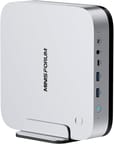 MINISFORUM AI X1 Pro | MINISFORUM AI X1 Pro | MINISFORUM AI X1 Pro | MINISFORUM AI X1 Pro | |
| Price | List Price: $899.90 Amazon Prices: Loading prices... | List Price: $1,059.90 Amazon Prices: Loading prices... | List Price: $1,249.90 Amazon Prices: | List Price: $1,449.90 Amazon Prices: |
| Version | Barebone | 32GB/1TB | 64GB/1TB | 96GB/2TB |
| Performance Rating | 5.9 | 6.3 | 6.5 | 6.5 |
| Operating System | Windows 11 Pro | Windows 11 Pro | Windows 11 Pro | Windows 11 Pro |
| Processor | Twelve-core 2.00 Ghz (max 5.10 Ghz) AMD Ryzen AI 9 HX 370 | Twelve-core 2.00 Ghz (max 5.10 Ghz) AMD Ryzen AI 9 HX 370 | Twelve-core 2.00 Ghz (max 5.10 Ghz) AMD Ryzen AI 9 HX 370 | Twelve-core 2.00 Ghz (max 5.10 Ghz) AMD Ryzen AI 9 HX 370 |
| GPU | Integrated AMD Radeon 890M | Integrated AMD Radeon 890M | Integrated AMD Radeon 890M | Integrated AMD Radeon 890M |
| RAM | 0 GB DDR5 SO-DIMM | 32 GB DDR5 SO-DIMM | 64 GB DDR5 SO-DIMM | 96 GB DDR5 SO-DIMM |
| Internal Storage | 0 GB | 1 TB | 1 TB | 2 TB |
| Dimensions width x length x thickness | 7.68 x 7.68 x 1.87 inches (195.07 x 195.07 x 47.5 mm) | 7.68 x 7.68 x 1.87 inches (195.07 x 195.07 x 47.5 mm) | 7.68 x 7.68 x 1.87 inches (195.07 x 195.07 x 47.5 mm) | 7.68 x 7.68 x 1.87 inches (195.07 x 195.07 x 47.5 mm) |
| Weight | 3.3 lbs (1.5 kg) | 3.3 lbs (1.5 kg) | 3.3 lbs (1.5 kg) | 3.3 lbs (1.5 kg) |
| WiFi | Wi-Fi 7 (802.11be) | Wi-Fi 7 (802.11be) | Wi-Fi 7 (802.11be) | Wi-Fi 7 (802.11be) |
| Bluetooth | Bluetooth 5.4 | Bluetooth 5.4 | Bluetooth 5.4 | Bluetooth 5.4 |
| Ethernet | 2 Ethernet ports at 2.5 Gbps | 2 Ethernet ports at 2.5 Gbps | 2 Ethernet ports at 2.5 Gbps | 2 Ethernet ports at 2.5 Gbps |
| HDMI | 1 Full-Size HDMI Port | 1 Full-Size HDMI Port | 1 Full-Size HDMI Port | 1 Full-Size HDMI Port |
| DisplayPort | 1 DisplayPort (DisplayPort 2.0) | 1 DisplayPort (DisplayPort 2.0) | 1 DisplayPort (DisplayPort 2.0) | 1 DisplayPort (DisplayPort 2.0) |
| VGA | No VGA Ports | No VGA Ports | No VGA Ports | No VGA Ports |
| USB Ports | 1 USB 2.0, 2 USB 3, 2 USB-C (2 USB4) 2x USB4 (40Gbps) with PD support, OCuLink PCIe 4.0 x4 for external GPU | 1 USB 2.0, 2 USB 3, 2 USB-C (2 USB4) 2x USB4 (40Gbps) with PD support, OCuLink PCIe 4.0 x4 for external GPU | 1 USB 2.0, 2 USB 3, 2 USB-C (2 USB4) 2x USB4 (40Gbps) with PD support, OCuLink PCIe 4.0 x4 for external GPU | 1 USB 2.0, 2 USB 3, 2 USB-C (2 USB4) 2x USB4 (40Gbps) with PD support, OCuLink PCIe 4.0 x4 for external GPU |
| Thunderbolt Ports | No | No | No | No |
| OCuLink | PCIe 4.0 x4 for eGPU | PCIe 4.0 x4 for eGPU | PCIe 4.0 x4 for eGPU | PCIe 4.0 x4 for eGPU |
| Internal SATA Ports | No SATA ports | No SATA ports | No SATA ports | No SATA ports |
| Card Reader | Full-size SD | Full-size SD | Full-size SD | Full-size SD |
| Headphone Jack | combo | combo | combo | combo |
| Fanless | No | No | No | No |
| VESA Mount | Yes | Yes | Yes | Yes |
| In the Box | AI X1 Pro unit, power cable, HDMI cable, vertical stand, VESA bracket, 2x M.2 heatsinks with thermal pads, user manual | AI X1 Pro unit, power cable, HDMI cable, vertical stand, VESA bracket, 2x M.2 heatsinks with thermal pads, user manual | AI X1 Pro unit, power cable, HDMI cable, vertical stand, VESA bracket, 2x M.2 heatsinks with thermal pads, user manual | AI X1 Pro unit, power cable, HDMI cable, vertical stand, VESA bracket, 2x M.2 heatsinks with thermal pads, user manual |
| Expandability | RAM: 2x DDR5-5600 SO-DIMM slots (up to 128GB). Storage: 3x M.2 2280 slots (max 12TB total). OCuLink PCIe 4.0 x4 for external GPU. Built-in 135W PSU. | RAM: 2x DDR5-5600 SO-DIMM slots (up to 128GB). Storage: 3x M.2 2280 slots (max 12TB total). OCuLink PCIe 4.0 x4 for external GPU. Built-in 135W PSU. | RAM: 2x DDR5-5600 SO-DIMM slots (up to 128GB). Storage: 3x M.2 2280 slots (max 12TB total). OCuLink PCIe 4.0 x4 for external GPU. Built-in 135W PSU. | RAM: 2x DDR5-5600 SO-DIMM slots (up to 128GB). Storage: 3x M.2 2280 slots (max 12TB total). OCuLink PCIe 4.0 x4 for external GPU. Built-in 135W PSU. |
Related Mini PCs
-
 MINISFORUM AI X1 Pro-470The MINISFORUM AI X1 Pro-470 drops AMD's Ryzen AI 9 HX 470 (Gorgon Point) into the flagship X1 Pro…
 -
 MINISFORUM M1-1390The MINISFORUM M1-1390 is a 13th-gen refresh of the M1-1295: the same 7.7-inch case with a 24-core…
 -
 ACEMAGIC F5AA one-liter AMD Ryzen AI 9 HX 470 mini PC with Radeon 890M graphics, dual USB4, an OCuLink eGPU…
 -
 HP EliteDesk 8 Mini G1iHP's 1-liter EliteDesk 8 Mini G1i puts an Arrow Lake-S desktop chip, three M.2 Gen4 slots,…
 -
 ASUS NUC 15 Pro+The ASUS NUC 15 Pro+ is a 0.7-liter toolless mini PC with Intel Arrow Lake Core Ultra processors,…
 -
 GMKtec NucBox M3 ProA compact office and home-server box for three-monitor desks and small Linux setups; its 2023 Core…
The extra volume buys an internal power supply and room to expand

The chassis is a square box with an aluminum top, rounded corners, and a silver finish, close in shape to a Mac Mini. At 7.68 inches square and 1.87 inches tall it is bigger than most competing mini PCs, and that extra height is where the internal power supply and the cooling system live. Lawrence Systems calls the unit “hefty” and “well-built” despite the plastic lower portion. The front panel carries two USB-A 3.2 Gen2 ports, a USB4 port with 15W Power Delivery, a full-size SD card slot, and a fingerprint sensor with Windows Hello support.
The Ryzen AI 9 HX 370 is a 12-core, 24-thread Zen 5 chip that boosts to 5.1GHz and delivers approximately 35,000 in CPU Mark benchmarks. Integrated Radeon 890M graphics on RDNA 3.5 handle 1080p gaming capably, though the SODIMM memory’s higher latency compared to soldered LPDDR5X in competing systems holds back peak frame rates. The chip’s NPU contributes 50 TOPS for AI workloads, with the total system capable of 80 TOPS when combining CPU, GPU, and NPU resources. The Radeon 890M and DDR5 bandwidth also make it a capable host for open-weight models; see our guide to running Gemma 4 locally for how each RAM tier maps to specific model variants.
Two 2.5GbE Ethernet ports on Realtek controllers give this box redundancy for network-attached workloads or link aggregation. WiFi 7 comes from MediaTek’s MT7925 chipset, though one reviewer experienced connectivity issues that may be unit-specific. The OCuLink port runs at PCIe 4.0 x4, connecting an external GPU at higher bandwidth than USB4 or Thunderbolt alternatives, so graphics-intensive work has an upgrade path the chassis itself cannot provide. Our eGPU connector guide breaks down how much performance each port type preserves and when the upgrade pencils out.
Reviewer Insights

ETA PRIME: cooling held and the RAM comes out
ETA PRIME ran the machine through benchmarking and real-world testing. He notes that “This is one of their most interesting PCs they’ve released in 2025 so far” and emphasizes the significance of having user-upgradeable SODIMM RAM in a mobile processor platform: “Since this system is using SODIMM RAM, it is upgradeable and we can go up to 96 gigs.” Thermal performance impressed him particularly, with the system staying well under 80 degrees Celsius even during sustained testing. He concludes that it’s “a really good looking mini PC and the way it’s set up out of the box, it’s a great performer.”
Level1Techs: Linux runs well and the NPU saves power
Wendell was surprised by the memory support on this platform: “I wasn’t aware that you could use DDR5 SODIMMs with the mobile processors,” noting this is unusual for the HX 370 platform. His Level1Techs testing reveals “the best cooling of any Minisforum machine that I’ve taken a look at,” and he praises the Linux support, stating “This platform supports Linux quite well.” He also clarifies the purpose of the NPU: “The point of the NPU is not more performance, the point of the NPU is power savings.” If you plan to lean on that NPU under Ubuntu, our guide to Ubuntu’s Inference Snaps and the hardware that benefits covers what accelerates today.
Lawrence Systems: GPU offload carried a local LLM
The business and productivity angle came from Lawrence Systems, who describes the build quality as “This is a hefty unit even though it’s only 3.3 pounds. It’s well-built, it’s sturdy.” For local LLM applications, he found that “the ability to offload to the GPU led to a level of performance that was more than enough to run a local LLM.” The machine also has a dedicated Copilot button, though Lawrence notes the NPU software ecosystem remains limited. Readers who want more local AI headroom can compare Strix Halo mini PCs for LLM inference, which offer 128GB of unified memory, and our breakdown of when local AI hardware beats Ollama Cloud covers whether buying hardware is the right move at all.
NotebookCheck: 83% with a DPC latency warning
According to NotebookCheck, which scored the AI X1 Pro at 83%, the device excels as “an all-round mini PC for the office, multimedia, gaming, and creative tasks.” They praise the premium aluminum case, dual 2.5G LAN ports, and the 36-month warranty. However, they note limitations including only three USB-A ports for traditional peripherals and high DPC latencies that could affect real-time audio and video editing workflows.
NAS Compares: 8.8/10 and 19W at idle
NAS Compares awarded an 8.8/10 rating, praising the balance of performance, expandability, and AI acceleration in the compact form factor. Their power consumption testing revealed efficient operation at 19-23W idle and 59-63W under load. They particularly valued the three M.2 expansion slots and OCuLink support, though noted the PSU placement above the SSD slots could affect thermal management during extended operations.
Chigz Tech Reviews: the hardware extras did the selling
Chigz Tech Reviews positioned the AI X1 Pro near the top of 2025’s mini PCs, built around the Ryzen AI 9 HX 370 with Radeon 890M. He liked the hardware extras as much as the speed: a built-in power supply with no external brick, a fingerprint reader, a sturdy metal chassis, three M.2 SSD slots, and an OCuLink port for high-bandwidth eGPU expansion.
A big mini PC that pays for its size in slots and ports
Two DDR5 SO-DIMM slots reaching 128GB and three M.2 2280 slots make this a box to grow into. It runs local LLMs and video work today with room to add memory and storage later, and the OCuLink port keeps a graphics upgrade open once integrated Radeon 890M performance runs out. The lineup starts as a barebone unit and tops out at a 96GB, 2TB configuration, so the memory and SSD decision can be made at purchase or deferred until the workload demands it.
Gaming at 1080p works, though SO-DIMM latency costs frame rates against machines with soldered LPDDR5X, so shoppers whose priority is integrated-graphics gaming should look at those systems. Buyers who will fill the M.2 slots, push past 32GB of memory, or hang an eGPU off the OCuLink port are the ones who get their money’s worth from the extra chassis volume. Starry Hope’s Mini PC Comparison Chart puts this machine next to other high-performance mini PCs side by side.
Upgrades
Accessories that fit the MINISFORUM AI X1 Pro's OCuLink and USB4 or Thunderbolt ports.
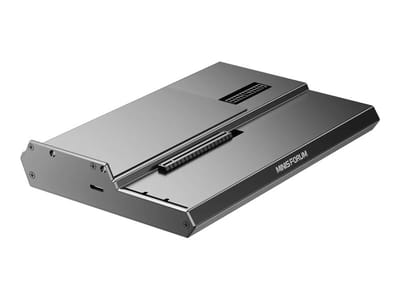
DEG1 eGPU Dock
A plain OCuLink dock with a PCIe 4.0 x4 link for a desktop graphics card; it takes an ATX or SFX power supply that you supply.
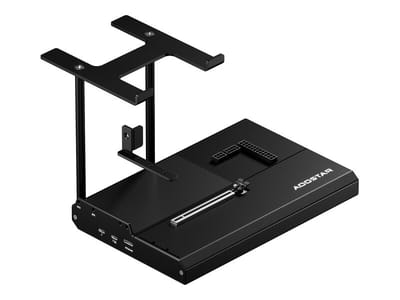
EG02 eGPU Dock
Connects over OCuLink for the full PCIe 4.0 x4 link and has Thunderbolt 5 as a second input; the graphics card and power supply are sold separately.
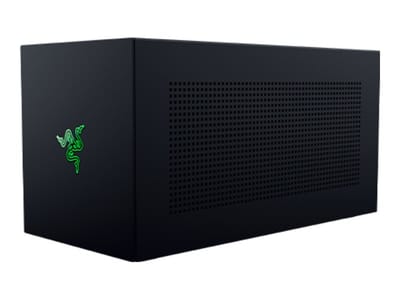
Core X V2
A Thunderbolt 5 enclosure that Razer lists as working with Thunderbolt 4 and USB4 hosts; it fits a four-slot card and needs an ATX power supply.
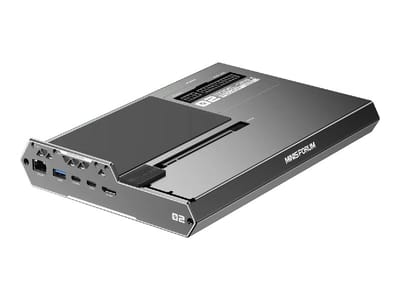
DEG2 eGPU Dock
Connects over USB4 or Thunderbolt 5, with an OCuLink input behind a switch, and adds an M.2 slot; it needs an ATX or SFX power supply.
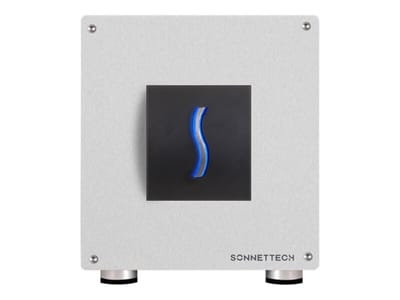
Breakaway Box 850 T5
Has an 850W power supply built in, so only the graphics card is extra, and works with Thunderbolt 4 and USB4 Windows PCs.
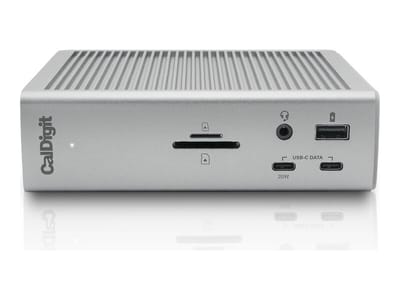
TS4 Thunderbolt 4 Dock
An 18-port dock that CalDigit lists for Thunderbolt 4 and USB4 hosts, with 2.5GbE and a DisplayPort 1.4 output.
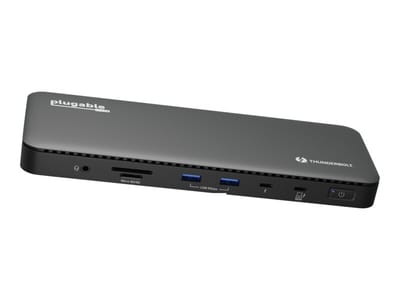
TBT4-UD5 Thunderbolt 4 Dock
Two HDMI ports drive two 4K60 monitors from one Thunderbolt 4 or USB4 port on a Windows PC.
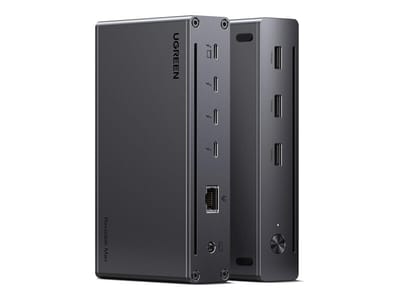
Revodok Max 208 Thunderbolt 4 Dock
Adds three Thunderbolt 4 ports for dual 4K60 displays plus gigabit Ethernet; it has no HDMI port, so monitors connect over USB-C or an adapter.
Frequently Asked Questions
What is the AMD Ryzen AI 9 HX 370 processor and how powerful is it?
It is AMD’s flagship mobile processor on the Zen 5 architecture, with 12 cores and 24 threads, boost clocks up to 5.1GHz, and a score of approximately 35,000 in PassMark’s CPU benchmark. A dedicated Neural Processing Unit (NPU) adds 50 TOPS for AI workloads, and the CPU, GPU, and NPU together reach 80 TOPS.
Can I upgrade the RAM and storage in the AI X1 Pro?
Yes. Two DDR5 SO-DIMM slots take up to 128GB of RAM at 5600MHz speeds, and three M.2 2280 slots (two running at PCIe 4.0 x4 and one at PCIe 4.0 x1) support up to 12TB total capacity.
What is OCuLink and why is it useful?
OCuLink is a high-speed external connection standard running at PCIe 4.0 x4 speeds (approximately 64Gbps), which is faster than Thunderbolt 4 or USB4. The port lets you attach an external GPU with less bandwidth bottleneck than other connection types, which is how this machine reaches desktop-class graphics performance for gaming or GPU-accelerated work.
Does the AI X1 Pro require an external power brick?
No. A 135W power supply sits inside the chassis, which is unusual for mini PCs, so a standard power cable is all that connects to the wall outlet. The tradeoff is a larger unit in exchange for a cleaner desk setup.
How many displays can I connect to the AI X1 Pro?
Up to four at once, using one HDMI 2.1 port, one DisplayPort 2.0 port, and two USB4 ports that support DisplayPort Alt Mode. This covers multi-monitor productivity setups without additional adapters or docking stations.
Is the AI X1 Pro good for gaming?
It handles 1080p gaming on the Radeon 890M integrated graphics, built on RDNA 3.5 architecture. The SODIMM DDR5 memory configuration costs some frame rate against competing systems with soldered LPDDR5X. For serious gaming, the OCuLink port allows connection of an external GPU to achieve desktop-class graphics performance.
What is the Copilot button on the AI X1 Pro?
It is a dedicated hardware key that opens Microsoft’s Copilot assistant in Windows 11. Paired with the NPU’s 50 TOPS of AI processing power, it signals the AI-enhanced productivity workflows the system is built for, though the button is not straightforward to repoint at a different AI assistant.
Does the AI X1 Pro support Linux?
According to Level1Techs’ review, the AI X1 Pro “supports Linux quite well.” The AMD hardware platform generally has good Linux compatibility. Users planning to run Linux should verify driver support for specific features like the fingerprint reader and NPU, as these may have varying levels of support depending on the distribution.