

ChromeOS has tried the premium tablet thing before. It did not go well. When Google launched the Pixel Slate in 2018, it was supposed to prove that ChromeOS could hold its own against the iPad Pro as a serious tablet platform. Instead, Google abandoned the entire product category shortly after. Now, more than seven years later, code discoveries in the Chromium repositories suggest that Lenovo is building something called “Sapphire”: a 13-inch detachable tablet that would become the first Chromebook Plus tablet ever made. Sapphire sounds good on paper. The harder question is what had to change in the entire ChromeOS ecosystem to make a device like this possible, and whether those changes are enough to succeed where the Pixel Slate failed.
Sapphire sits at the intersection of several trends we’ve been tracking for months: the rise of ARM processors in Chromebooks, the upcoming ChromeOS-to-Android kernel transition known as Aluminium OS, and the steady elevation of the Chromebook Plus brand as Google’s premium tier.
The Pixel Slate Failed on Software
Google launched the Pixel Slate in late 2018 as a premium ChromeOS tablet with Intel Core processors, a 12.3-inch display, and a starting price of $599 that climbed to $1,599 for the fully loaded model. The execution was a mess.
ChromeOS tablet mode in 2018 was essentially an afterthought: laggy animations, inconsistent touch targets, and an interface that never felt like it was designed for fingers first. The i5 model developed a reputation for storage failures, and even the expensive configurations struggled with basic tablet tasks that an iPad handled effortlessly. Google discontinued the Pixel Slate line within a year and publicly stated they were exiting the tablet hardware business. ChromeOS wasn’t ready for tablets, and Google wasn’t willing to keep trying.
That decision left a vacuum in the ChromeOS tablet space that persisted for years. Lenovo’s Chromebook Duet series filled part of the gap with affordable, competent detachables, but these were budget devices. They were great for media consumption and light productivity, but not a premium tablet experience. No ChromeOS tablet competed with the iPad Pro after that.
No ChromeOS Tablet Met Chromebook Plus Specs
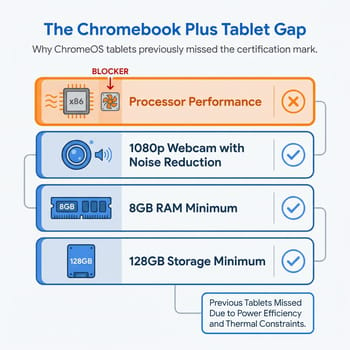
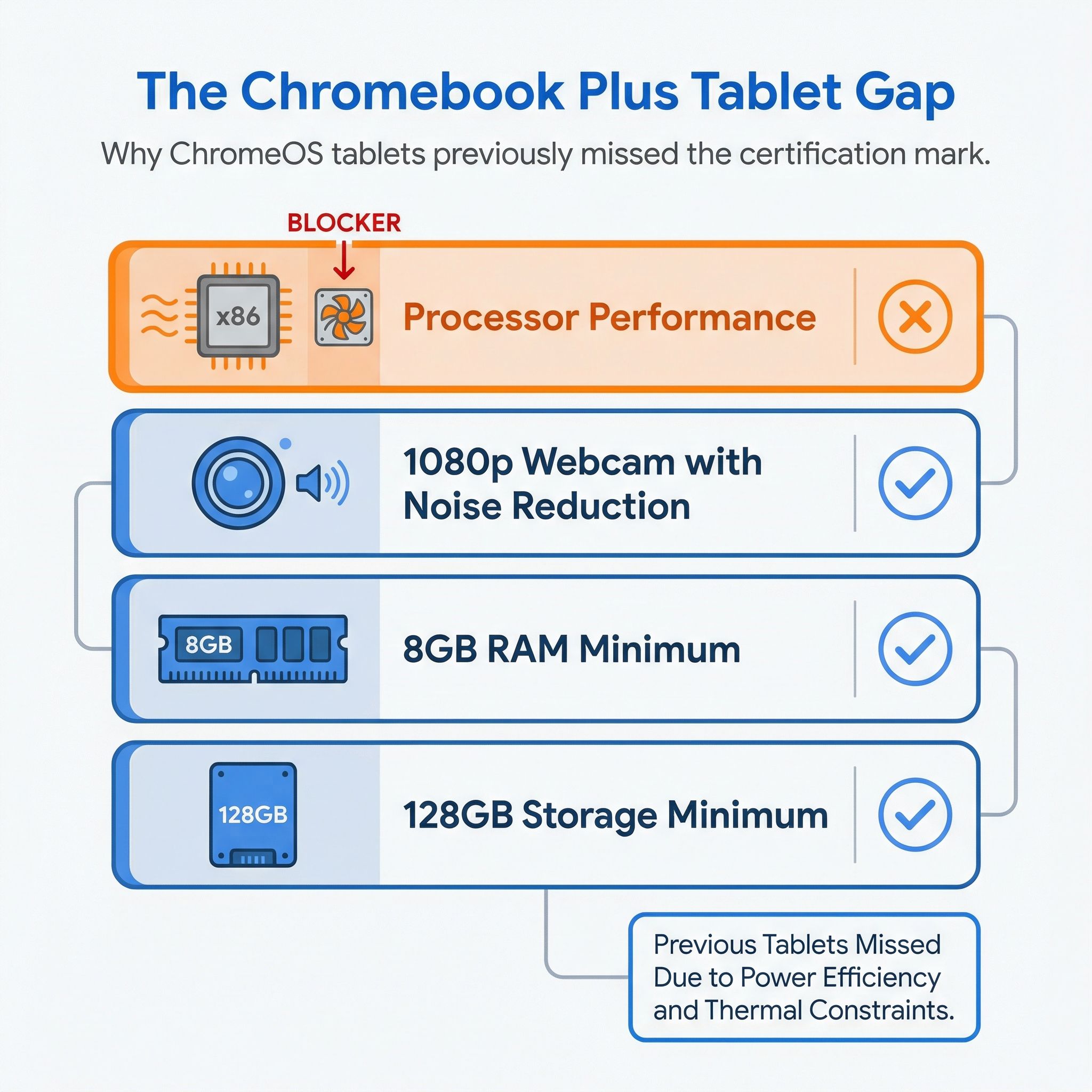
When Google introduced the Chromebook Plus certification in 2023, it established minimum hardware requirements that any device needed to meet in order to earn the badge and access exclusive features like Magic Editor in Google Photos, Gemini integration, and enhanced Live Caption. Those requirements included specific processor performance thresholds, a 1080p webcam with temporal noise reduction, at least 8GB of RAM, and 128GB of storage.
The Lenovo Chromebook Duet series, the HP Chromebook x2, the ASUS Chromebook Detachable: none of them qualified. The processor requirements were originally built around Intel Core i3 12th-gen and AMD Ryzen 3 7000-series chips, which are laptop-class processors that generate significant heat and demand active cooling. Cramming that kind of silicon into a thin tablet with acceptable battery life was essentially impossible without design compromises that would undermine the entire point of a tablet.
This created an odd situation where you could buy a Chromebook Plus clamshell or convertible, but if you wanted a pure tablet or detachable form factor, you were locked out of Google’s premium tier entirely. It is the same tension we worked through when comparing a Chromebook Plus against Android tablets: for years, choosing a tablet form meant giving up the Plus-tier features. The AI features, the enhanced photo editing, the Gemini assistant: all of it was reserved for devices with keyboards permanently attached. For anyone who preferred the tablet form factor, the Plus features were unavailable.
How ARM Silicon Changed the Equation
The Chromebook Plus tablet gap existed because of a heat problem: the processors powerful enough to qualify generated too much heat for a tablet form factor. The MediaTek Kompanio Ultra closed the gap, an ARM chip built on TSMC’s 3nm process that finally delivers laptop-class performance without laptop-class thermal demands.
The Kompanio Ultra’s architecture abandons the traditional big.LITTLE approach of mixing powerful and efficient cores. Instead, it uses what MediaTek calls an “all-big-core” design: one Arm Cortex-X925 running at 3.62GHz, three Cortex-X4 cores, and four Cortex-A720 cores. There are no small efficiency cores dragging down performance when you need it. The result, as we covered in our ARM processor wars analysis, is a chip that scores 2,542 in Geekbench 6 single-core tests, ahead of both the Intel Core 5 120U and the Intel Core Ultra 7 155U. That’s Chromebook Plus-qualifying performance, delivered in a package that enables fanless designs with up to 17 hours of battery life.
This is the piece that was missing for seven years. When the Pixel Slate launched, there was no ARM processor capable of competing with Intel on raw performance while simultaneously enabling the thin, fanless, all-day-battery design that tablets demand. MediaTek changed that in 2025, and Sapphire is the first tablet designed to capitalize on it. The 50 TOPS of NPU performance doesn’t hurt either. That’s the kind of on-device AI horsepower that makes Chromebook Plus features like real-time translation and photo enhancement work without constant cloud dependency.
What We Know About Sapphire
Everything we know about Sapphire comes from code commits discovered in the Chromium Gerrit, the public repository where ChromeOS development happens in the open. Lenovo hasn’t confirmed anything publicly.
Chrome Unboxed confirmed that Lenovo is the manufacturer behind Sapphire through a Gerrit commit that linked the device’s board name to Lenovo’s coreboot configuration. This was initially surprising because the device features a four-color light bar, a design element historically associated with Google’s own hardware, from the original Chromebook Pixel through the Pixelbook line, and one that has started showing up again on premium Chromebooks like the Snapdragon-powered Bluey light-bar models. But Lenovo already builds premium ChromeOS hardware: the Chromebook Plus 14, which Chrome Unboxed and multiple reviewers have called the best Chromebook ever made.
The display appears to be a 13-inch BOE panel, identified by its model number NS130069-M00. BOE’s naming convention consistently uses the first two digits after the prefix to indicate screen size; the HP Chromebook x2 11 used a BOE “NV110” panel, for instance. A 13-inch screen puts Sapphire in iPad Pro and Surface Pro territory, sized for productivity rather than casual consumption.
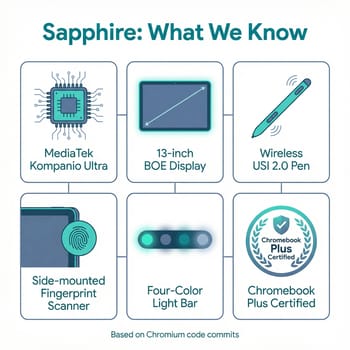
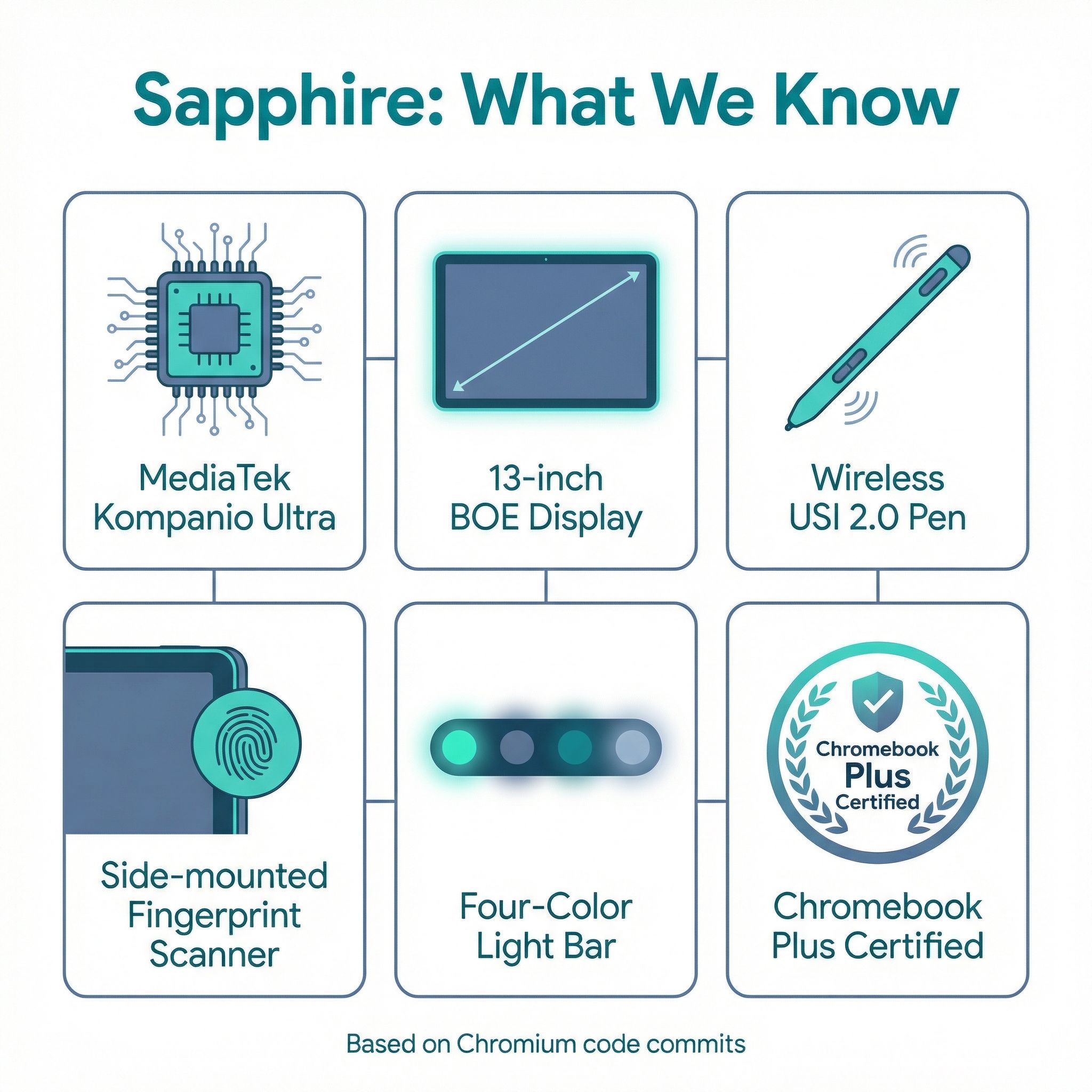
Additional code commits reveal a wirelessly charging USI 2.0 stylus that magnetically docks to the tablet and charges via NFC at up to one watt, enough to keep a stylus topped up while it sits idle. This is a significant step up from the USB-C or AAAA battery-powered styluses that current ChromeOS tablets use. A side-mounted fingerprint scanner integrated into the power button rounds out the known hardware. The Pixel Slate used the same biometric approach.
What We Don’t Know
Price is the obvious unknown. Display resolution and refresh rate haven’t been confirmed in the Chromium code, and on a 13-inch tablet designed for stylus work, anything less than a high-DPI panel with 120Hz refresh would be a significant disappointment. RAM and storage configurations are unknown. And there’s no confirmed release date beyond “later in 2026.”
Apple’s 13-inch iPad Pro starts at $1,299 with an OLED display, M-series silicon, and access to the most mature tablet app ecosystem in the world. Microsoft’s Surface Pro starts at $999 for the LCD model and $1,499 for OLED, running full Windows 11 with desktop application compatibility. Both include proven stylus ecosystems and years of tablet-optimized software refinement.
Sapphire will need to find a price point that acknowledges ChromeOS’s more modest tablet software library while using its own strengths: Google integration, web app performance, battery life, and built-in Linux development environment. The Aluminium OS transition should help close that app gap, since the new platform treats Android apps as first-class citizens rather than running them through today’s compatibility layer. At $799, it would offer an alternative for users who don’t need iPadOS’s creative app ecosystem or Windows’ desktop software compatibility. At $999 or above, that price becomes much harder to justify against established competitors. Price, more than any spec, will determine whether Sapphire opens a new market or repeats the Pixel Slate’s mistake of asking premium prices for a platform that hasn’t fully proven itself in tablet mode.
Aluminium OS Should Not Decide the Purchase
Google is actively developing Aluminium OS, the project that will rebuild ChromeOS on the Android kernel, creating a more unified platform with deeper Android app integration. Code references suggest that Sapphire is being used internally as a testing platform for Aluminium OS development, which makes sense: a high-end tablet with powerful ARM silicon is exactly the kind of device you’d want to validate a touch-first Android-based operating system.
If Sapphire ships in late 2026 running traditional ChromeOS, and Aluminium OS arrives as a full platform later, buyers face the “should I wait?” problem. Sapphire would presumably receive Aluminium OS as a software update when the platform is ready; Google has consistently maintained that existing Chromebooks will transition. Early Aluminium OS might have the same kind of growing pains that plagued the Pixel Slate’s software at launch.
This shouldn’t stop anyone from buying Sapphire if the price is right. ChromeOS in 2026 is a more mature tablet operating system than what the Pixel Slate launched with. The improvements to tablet mode, split-screen multitasking, and Android app integration over the past seven years have been substantial. Sapphire on current ChromeOS should be a good experience. If Aluminium OS eventually makes it better, that’s a bonus, not a prerequisite.
Sapphire and the ASUS CM32 Target Different Buyers
Sapphire isn’t the only ChromeOS detachable in the pipeline. At CES 2026, ASUS announced the Chromebook CM32 Detachable with a 12.1-inch 2.5K display at 120Hz, powered by the MediaTek Kompanio 540. The CM32 and Sapphire sit at opposite ends of the ARM tablet spectrum. The CM32 is an affordable detachable aimed at education and casual use, while Sapphire is positioning itself as a premium productivity device.
Together, though, they show OEMs taking the ChromeOS tablet form factor seriously again for the first time since the Pixel Slate era. The combination of ARM processors that can actually deliver competitive performance, Google’s Chromebook Plus framework that provides a quality floor, and the looming Aluminium OS transition that promises better Android integration has created conditions where building a high-end ChromeOS tablet makes sense. If you are comparing options available today, the Chromebook Comparison Chart shows the full current lineup side by side.
Whether Sapphire ultimately delivers on this promise depends on price and display quality. But the fact that it exists at all, that the ChromeOS ecosystem has evolved to the point where a Chromebook Plus-certified tablet is even technically possible, represents progress.


