
MeLE Quieter3C
Published on

The MeLE Quieter3C is a silent, fanless mini PC for a desk where one USB-C cable should carry the picture, the data, and the power. Plug it into a USB-C monitor that supplies power and the monitor runs the PC, as CNX Software and ETA Prime confirmed in their tests. It runs a 2021-era Intel Celeron (N5100 or N5105) on single-channel memory, so it is slow, and Robtech measured it slower than the near-identical Quieter3Q. Buy it for quiet office work, media playback, astrophotography rigs, and always-on jobs; skip it for gaming beyond emulation and light indie titles.
Pros and Cons
| Pros | Cons |
|---|---|
| No fan at all; ETA Prime measured 4W idle and 14W maximum from the wall | Single-channel, soldered RAM holds back the integrated graphics |
| Full-function USB-C carries 4K60 video, data, and PD power on one cable | Robtech measured it 7.5% behind the Quieter3Q in multi-core tests |
| Runs from a monitor’s USB-C power or a USB-C battery pack | The chassis gets hot; several owners returned units over heat |
| Three displays: two HDMI 2.0 ports plus DisplayPort over USB-C | 2021-era Jasper Lake chip, well behind current Intel N150 boxes |
| M.2 2280 NVMe slot for adding a faster boot drive | Onboard storage is eMMC, slower than an NVMe SSD |
| Unlocked BIOS; Ubuntu and ChromeOS Flex booted in reviewer tests | Owners reported Wi-Fi dropouts and units failing within a year |
Related Videos
MeLE Quieter3C Comparison Chart
 MeLE Quieter3C | MeLE Quieter3C | MeLE Quieter3C | MeLE Quieter3C | MeLE Quieter3C | MeLE Quieter3C | MeLE Quieter3C | MeLE Quieter3C | |
| Price | List Price: $369.99 Amazon Prices: | List Price: $399.99 Amazon Prices: Loading prices... | List Price: $499.99 Amazon Prices: | List Price: $339.99 Amazon Prices: | List Price: $349.99 Amazon Prices: | List Price: $379.99 Amazon Prices: Loading prices... | List Price: $409.99 Amazon Prices: | List Price: $549.99 Amazon Prices: Loading prices... |
| Version | 8GB/128GB/Intel N5100 | 8GB/256GB/Intel N5100 | 16GB/512GB/Intel N5100 | 4GB/128GB/Intel N5100 | 4GB/128GB/Intel N5105 | 8GB/128GB/Intel N5105 | 8GB/256GB/Intel N5105 | 16GB/512GB/Intel N5105 |
| Performance Rating | 2.5 | 2.5 | 2.9 | 1.5 | 1.6 | 2.6 | 2.6 | 3.0 |
| Operating System | Windows 11 Pro | Windows 11 Pro | Windows 11 Pro | Windows 11 Pro | Windows 11 Pro | Windows 11 Pro | Windows 11 Pro | Windows 11 Pro |
| Processor | Quad-core 1.10 Ghz (max 2.80 Ghz) Intel Celeron N5100 Processor | Quad-core 1.10 Ghz (max 2.80 Ghz) Intel Celeron N5100 Processor | Quad-core 1.10 Ghz (max 2.80 Ghz) Intel Celeron N5100 Processor | Quad-core 1.10 Ghz (max 2.80 Ghz) Intel Celeron N5100 Processor | Quad-core 2.00 Ghz (max 2.90 Ghz) Intel Celeron N5105 | Quad-core 2.00 Ghz (max 2.90 Ghz) Intel Celeron N5105 | Quad-core 2.00 Ghz (max 2.90 Ghz) Intel Celeron N5105 | Quad-core 2.00 Ghz (max 2.90 Ghz) Intel Celeron N5105 |
| GPU | Integrated Intel UHD Graphics | Integrated Intel UHD Graphics | Integrated Intel UHD Graphics | Integrated Intel UHD Graphics | Integrated Intel UHD Graphics | Integrated Intel UHD Graphics | Integrated Intel UHD Graphics | Integrated Intel UHD Graphics |
| RAM | 8 GB LPDDR4, single-channel (Single-channel, soldered) | 8 GB LPDDR4, single-channel (Single-channel, soldered) | 16 GB LPDDR4, single-channel (Single-channel, soldered) | 4 GB LPDDR4, single-channel (Single-channel, soldered) | 4 GB LPDDR4, single-channel (Single-channel, soldered) | 8 GB LPDDR4, single-channel (Single-channel, soldered) | 8 GB LPDDR4, single-channel (Single-channel, soldered) | 16 GB LPDDR4, single-channel (Single-channel, soldered) |
| Internal Storage | 128 GB eMMC | 256 GB eMMC | 512 GB eMMC + NVMe | 128 GB eMMC | 128 GB eMMC | 128 GB eMMC | 256 GB eMMC | 512 GB eMMC + NVMe |
| Dimensions width x length x thickness | 5.16 x 3.19 x 0.72 inches (131.06 x 81.03 x 18.29 mm) | 5.16 x 3.19 x 0.72 inches (131.06 x 81.03 x 18.29 mm) | 5.16 x 3.19 x 0.72 inches (131.06 x 81.03 x 18.29 mm) | 5.16 x 3.19 x 0.72 inches (131.06 x 81.03 x 18.29 mm) | 5.16 x 3.19 x 0.72 inches (131.06 x 81.03 x 18.29 mm) | 5.16 x 3.19 x 0.72 inches (131.06 x 81.03 x 18.29 mm) | 5.16 x 3.19 x 0.72 inches (131.06 x 81.03 x 18.29 mm) | 5.16 x 3.19 x 0.72 inches (131.06 x 81.03 x 18.29 mm) |
| Weight | 0.51 lbs (0.23 kg) | 0.51 lbs (0.23 kg) | 0.51 lbs (0.23 kg) | 0.51 lbs (0.23 kg) | 0.51 lbs (0.23 kg) | 0.51 lbs (0.23 kg) | 0.51 lbs (0.23 kg) | 0.51 lbs (0.23 kg) |
| WiFi | Wi-Fi 5 (802.11ac) | Wi-Fi 5 (802.11ac) | Wi-Fi 5 (802.11ac) | Wi-Fi 5 (802.11ac) | Wi-Fi 5 (802.11ac) | Wi-Fi 5 (802.11ac) | Wi-Fi 5 (802.11ac) | Wi-Fi 5 (802.11ac) |
| Bluetooth | Bluetooth 5.1 | Bluetooth 5.1 | Bluetooth 5.1 | Bluetooth 5.1 | Bluetooth 5.1 | Bluetooth 5.1 | Bluetooth 5.1 | Bluetooth 5.1 |
| Ethernet | 1 Ethernet port at 1 Gbps | 1 Ethernet port at 1 Gbps | 1 Ethernet port at 1 Gbps | 1 Ethernet port at 1 Gbps | 1 Ethernet port at 1 Gbps | 1 Ethernet port at 1 Gbps | 1 Ethernet port at 1 Gbps | 1 Ethernet port at 1 Gbps |
| HDMI | 2 Full-Size HDMI Ports | 2 Full-Size HDMI Ports | 2 Full-Size HDMI Ports | 2 Full-Size HDMI Ports | 2 Full-Size HDMI Ports | 2 Full-Size HDMI Ports | 2 Full-Size HDMI Ports | 2 Full-Size HDMI Ports |
| DisplayPort | DP 1.4 Alt Mode on one USB-C port | DP 1.4 Alt Mode on one USB-C port | DP 1.4 Alt Mode on one USB-C port | DP 1.4 Alt Mode on one USB-C port | DP 1.4 Alt Mode on one USB-C port | DP 1.4 Alt Mode on one USB-C port | DP 1.4 Alt Mode on one USB-C port | DP 1.4 Alt Mode on one USB-C port |
| VGA | No VGA Ports | No VGA Ports | No VGA Ports | No VGA Ports | No VGA Ports | No VGA Ports | No VGA Ports | No VGA Ports |
| USB Ports | 3 USB 3, 2 USB-C 2x USB-A 10Gbps, 1x USB-A 5Gbps; one USB-C with data, video and PD, one USB-C power input | 3 USB 3, 2 USB-C 2x USB-A 10Gbps, 1x USB-A 5Gbps; one USB-C with data, video and PD, one USB-C power input | 3 USB 3, 2 USB-C 2x USB-A 10Gbps, 1x USB-A 5Gbps; one USB-C with data, video and PD, one USB-C power input | 3 USB 3, 2 USB-C 2x USB-A 10Gbps, 1x USB-A 5Gbps; one USB-C with data, video and PD, one USB-C power input | 3 USB 3, 2 USB-C 2x USB-A 10Gbps, 1x USB-A 5Gbps; one USB-C with data, video and PD, one USB-C power input | 3 USB 3, 2 USB-C 2x USB-A 10Gbps, 1x USB-A 5Gbps; one USB-C with data, video and PD, one USB-C power input | 3 USB 3, 2 USB-C 2x USB-A 10Gbps, 1x USB-A 5Gbps; one USB-C with data, video and PD, one USB-C power input | 3 USB 3, 2 USB-C 2x USB-A 10Gbps, 1x USB-A 5Gbps; one USB-C with data, video and PD, one USB-C power input |
| Thunderbolt Ports | No | No | No | No | No | No | No | No |
| OCuLink | No | No | No | No | No | No | No | No |
| Internal SATA Ports | No SATA ports | No SATA ports | No SATA ports | No SATA ports | No SATA ports | No SATA ports | No SATA ports | No SATA ports |
| Card Reader | microSD Card Reader | microSD Card Reader | microSD Card Reader | microSD Card Reader | microSD Card Reader | microSD Card Reader | microSD Card Reader | microSD Card Reader |
| Headphone Jack | combo | combo | combo | combo | combo | combo | combo | combo |
| Fanless | Yes | Yes | Yes | Yes | Yes | Yes | Yes | Yes |
| VESA Mount | Yes | Yes | Yes | Yes | Yes | Yes | Yes | Yes |
| In the Box | Mini PC, VESA mount, 12V/2A USB-C power adapter, user manual | Mini PC, VESA mount, 12V/2A USB-C power adapter, user manual | Mini PC, VESA mount, 12V/2A USB-C power adapter, user manual | Mini PC, VESA mount, 12V/2A USB-C power adapter, user manual | Mini PC, VESA mount, 12V/2A USB-C power adapter, user manual | Mini PC, VESA mount, 12V/2A USB-C power adapter, user manual | Mini PC, VESA mount, 12V/2A USB-C power adapter, user manual | Mini PC, VESA mount, 12V/2A USB-C power adapter, user manual |
| Expandability | M.2 2280 NVMe slot (PCIe 3.0 x2) and microSD; RAM and eMMC are soldered. | M.2 2280 NVMe slot (PCIe 3.0 x2) and microSD; RAM and eMMC are soldered. | M.2 2280 NVMe slot (PCIe 3.0 x2) and microSD; RAM and eMMC are soldered. | M.2 2280 NVMe slot (PCIe 3.0 x2) and microSD; RAM and eMMC are soldered. | M.2 2280 NVMe slot (PCIe 3.0 x2) and microSD; RAM and eMMC are soldered. | M.2 2280 NVMe slot (PCIe 3.0 x2) and microSD; RAM and eMMC are soldered. | M.2 2280 NVMe slot (PCIe 3.0 x2) and microSD; RAM and eMMC are soldered. | M.2 2280 NVMe slot (PCIe 3.0 x2) and microSD; RAM and eMMC are soldered. |
Related Mini PCs
-
 MeLE Quieter HD3 N150A fanless Intel N150 mini PC with a socketed DDR4 slot, an M.2 NVMe slot, and a 2.5-inch drive bay,…
 -
 MeLE Quieter 4CThe MeLE Quieter 4C is a fanless, silent Intel N100 (or N150) mini PC with 16GB of soldered memory,…
 -
 MINIX Z100-0dBThe MINIX NEO Z100-0dB is a fanless Intel N100 mini PC in an all-metal chassis, sold with 8GB or…
 -
 MeLE PCG02The MeLE PCG02 is a fanless Intel N100 PC stick with 8GB of memory, 256GB of eMMC storage, dual…
 -
 Bmax MaxMini B1 ProThe Bmax MaxMini B1 Pro is an ultra-budget fanless mini PC on Intel's older Celeron N4000, with 8GB…
 -
 Bmax B2 PowerThe Bmax B2 Power is a palm-sized mini PC with an Intel Celeron 5205U, 8GB of DDR4, a 256GB NVMe…
One USB-C port for video, data, and power

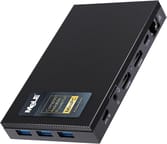
The Quieter3C measures about 5.2 x 3.2 x 0.7 inches and weighs about half a pound, with a plastic top textured like a heatsink over a metal base. The front carries only the power button. Three USB-A ports sit on the right side: two at 10Gbps and one at 5Gbps, which CNX Software confirmed by testing even though the spec sheet of the day listed them all as USB 3.0. The rear holds the full-function USB-C port, a combo audio jack, the microSD slot, two HDMI 2.0 outputs, a second USB-C port for the 12V/2A power adapter, and gigabit Ethernet. A VESA bracket comes in the box.
The full-function USB-C port is what separates this model from the Quieter3Q, whose only USB-C port takes power and nothing else. MeLE rates it for USB 3.2 Gen 1 data, DisplayPort 1.4 video, and USB PD 3.0 power input, and asks for a supply over 24W. CNX Software powered the Quieter3C from a Dell monitor with no separate adapter, and ETA Prime ran it from a 10,000 mAh phone battery pack while it fed a portable USB-C monitor. Together with the two HDMI ports, the USB-C port drives a third 4K display.
The earliest 2022 review units shipped with one HDMI port and a mini DisplayPort, plus an Intel AX201 Wi-Fi 6 card. MeLE’s current spec sheet lists two HDMI ports, Wi-Fi 5 on an Intel AC9560 module, and Bluetooth 5.1. Memory is LPDDR4x at 2933 MT/s in a single channel, soldered to the board, in 4GB, 8GB, or 16GB. Storage is soldered eMMC, and the M.2 2280 slot takes a PCIe 3.0 x2 NVMe drive up to 4TB (no SATA drives). Owners added NVMe drives, and one moved Windows onto a 512GB NVMe drive.
Performance: Celeron N5100 or N5105
MeLE sells the Quieter3C with either the Celeron N5100 or the N5105 at every memory size; both are four-core, four-thread Jasper Lake chips from 2021. The N5105 has the higher base clock and power limit, and PassMark puts it around 4,100 points against about 3,300 for the N5100. ETA Prime, Robtech, Retro Game Corps, and CNX Software all tested N5105 units. An Intel N150, the chip in MeLE’s newer Quieter 4C, scores around 5,300 on the same test.
The integrated Intel UHD Graphics shares that single memory channel, which costs frame rate. ETA Prime noted that The Art of Rally dips under 60 fps at 720p low, while the same chip with dual-channel RAM holds a steady 60. The chip handles office work, browsing, and 4K video, and reviewers found it capable of retro emulation through Dreamcast and most PSP titles. Modern 3D games are out of reach.
Reviewer Insights

ETA Prime
ETA Prime ran the Quieter3C over a single USB-C cable to a 4K monitor at 60Hz and played 4K60 HDR YouTube with about 10 dropped frames. “It’s a passively cooled PC, so it’s totally silent.” He measured 4W at idle, 12W in average gaming, and 14W at most from the wall, with temperatures of 48C at idle and 70C while gaming. Minecraft ran well, and Dead Cells passed 100 fps: “I was actually surprised to see that this is running at over 100 FPS.” Sustained full CPU and GPU load made it thermal throttle after about six minutes, and raising the TDP in the unlocked BIOS added heat without much performance gain. His summary: “This is far from a high performance mini PC,” but “I think it’s a great little performer if you need a supplemental PC.”
Robtech
Robtech compared the Quieter3C with the Quieter3Q on the same N5105 chip and found the 3C slower. Multi-core results were 7.5% lower, video encoding 8.5% lower, and 3DMark DX11 11.5% lower, because the 3C spent nearly all its time at the 8W PL1 limit. Maximum CPU temperature was lower, at 75C, while peak power draw rose to 19 watts. YouTube played without dropped frames only at 1080p30, though a 4K movie in VLC played cleanly. Ubuntu (with Wi-Fi and Bluetooth) and ChromeOS Flex both worked. He liked the ports, but “memory is still single channel which lowers graphics performance further so it’s a case of one step forward two steps back.”
Retro Game Corps
Retro Game Corps tested the Quieter3C as a small emulation and PC gaming box. He measured about 52C and two to three watts at idle, and about 75C under Prime95, and suspected heavy thermal throttling because the 10W chip rarely went above 8W. Lightweight 2D indie games ran at 60 fps: “I think this is the exact spot where this device is going to shine the most.” Skyrim Special Edition and GTA 5 were not playable even at the lowest settings. In Windows emulation, systems through PS1, N64, Saturn, Dreamcast, and most PSP games ran well, GameCube varied by title, and 3DS was marginal: “I wouldn’t buy this for 3DS emulation.”
CNX Software
CNX Software tested Windows 11 and Ubuntu 22.04 on an early unit and confirmed working audio, Wi-Fi, Bluetooth, Ethernet, video outputs, and the microSD slot. Under a Ubuntu stress test, the CPU peaked at 66C and settled near 2.3 GHz after the initial boost period. CNX Software also tested video output and power delivery over the new USB-C port, and summed up the benchmarks “with the Quieter3C performing very similarly to the Quieter3Q.” On surface heat: “During the stress test, the maximum temperature I recorded on the top of the device was around 54.6°C in an ambient room temperature of 12.7°C with the device not being too hot to touch.”
Customer Reviews
Owners use the Quieter3C for home servers, astrophotography rigs, and media setups. A. Diamond replaced two older ThinkCentre mini PCs with Quieter3C units and wrote that “the machine idles at 6-10 watts, and uses around 18 watts when running a substantial load” on Windows 11. Tantalum55 runs one on a telescope tripod and noted it “Can be powered by a USB C -PD battery port and can be configured as a wifi hotspot when local network is not available.” General Tso Tofu added a 4TB M.2 drive for a media and backup server and wrote, “It’s fanless, so it’s completely silent.”
Heat and reliability lead the complaints. Brandon Allen returned his unit because it “ran way too hot for comfort despite it’s light load.” Mike Gentry found that “it runs so hot the wifi signal wasn’t always good enough” on his telescope rig. Graves reported that “the wifi adapter died after about 6 months,” and Daniel Morante wrote that “it stopped powering on only after 9 months.”
Who should buy the Quieter3C
The Quieter3C fits a silent desk PC that runs off one USB-C cable from a monitor, a field computer for a telescope or a boat, or an always-on media server. The low idle draw makes it cheap to leave running, and the M.2 slot fixes the slow eMMC. Pick the 16GB model if you plan to keep many browser tabs open in Windows, because the memory cannot be upgraded later (see the soldered RAM trap).
Skip it if you want gaming beyond emulation, dual-channel memory, or a current chip. The MeLE Quieter 4C is MeLE’s newer fanless model with an N100 or N150 and a USB-C port with video out, and the fanless versus active cooling guide covers what a fan buys you. To compare against other fanless mini PCs, use Starry Hope’s Mini PC Comparison App.
Frequently Asked Questions
Does the MeLE Quieter3C use the N5100 or the N5105?
Both. MeLE sells every memory size with either the Celeron N5100 or the N5105. Both are four-core, four-thread Jasper Lake chips; the N5105 has a higher base clock and power limit and scores about 4,100 in PassMark against about 3,300 for the N5100.
Can the Quieter3C run from a monitor’s USB-C port?
Yes, if the monitor supplies USB PD power. The full-function USB-C port takes PD 3.0 power input and sends DisplayPort video, and MeLE asks for a supply over 24W. CNX Software powered it from a Dell monitor, and ETA Prime ran it from a 10,000 mAh battery pack driving a portable monitor.
How is the Quieter3C different from the Quieter3Q?
The 3C replaces one USB-A port with a full-function USB-C port that carries data, video, and PD power, so it has three USB-A ports instead of four. The Quieter3Q has a power-only USB-C port. Robtech measured the 3C 7.5% slower in multi-core and up to 11.5% slower in graphics tests, with lower peak CPU temperatures.
How many displays can the Quieter3C drive?
Three 4K displays: two over the HDMI 2.0 ports and one over DisplayPort on the full-function USB-C port. Early 2022 units had one HDMI port and a mini DisplayPort instead of two HDMI ports.
Can I upgrade the RAM or storage?
The RAM is soldered LPDDR4x in a single channel and cannot be upgraded. The eMMC is soldered too, but the M.2 2280 slot takes a PCIe 3.0 x2 NVMe SSD up to 4TB. SATA M.2 drives do not work.
Does the Quieter3C run Linux?
Yes. CNX Software ran Ubuntu 22.04 with working audio, Wi-Fi, Bluetooth, Ethernet, and video outputs, and Robtech booted Ubuntu and ChromeOS Flex without problems. Units ship with Windows 11 Pro.
Does the Quieter3C get hot?
The case is the heatsink, so it gets warm. MeLE states a surface temperature of 55C to 70C. ETA Prime saw 70C CPU temperatures while gaming and thermal throttling after about six minutes of full load, and several Amazon owners returned units because of heat.