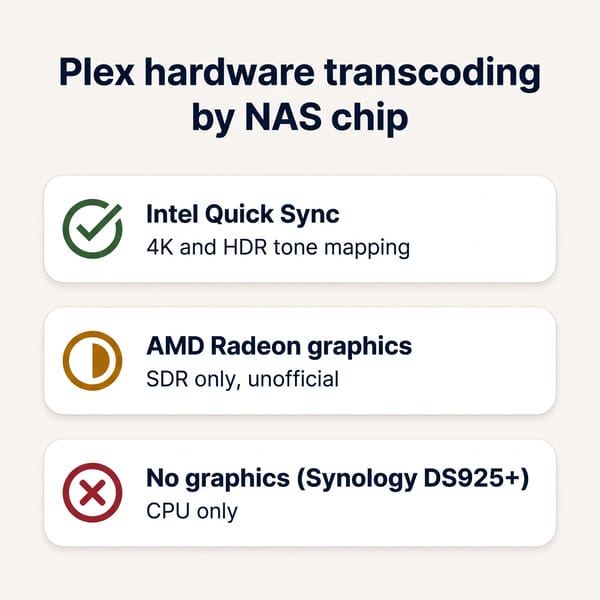
A NAS for Plex needs two things: enough drive bays for the library, and a processor that can convert video on the fly when a TV, phone, or remote viewer cannot play a file as it is stored. The second part decides the purchase, because Plex supports hardware transcoding on Intel’s Quick Sync video engine, including HDR to SDR tone mapping, with no artificial cap on simultaneous streams. Its AMD support is unofficial and covers SDR video only. A NAS with no integrated graphics, such as Synology’s DS925+, does every conversion on its CPU cores.
Six of the twelve NAS units below have Intel graphics that Plex fully supports, and all six come from UGREEN and TerraMaster. Prices below are list prices for the diskless box, the same figures as in our NAS comparison chart, so budget separately for hard drives.
Which NAS units transcode for Plex
| NAS | Bays | Processor | Plex hardware transcoding | List price |
|---|---|---|---|---|
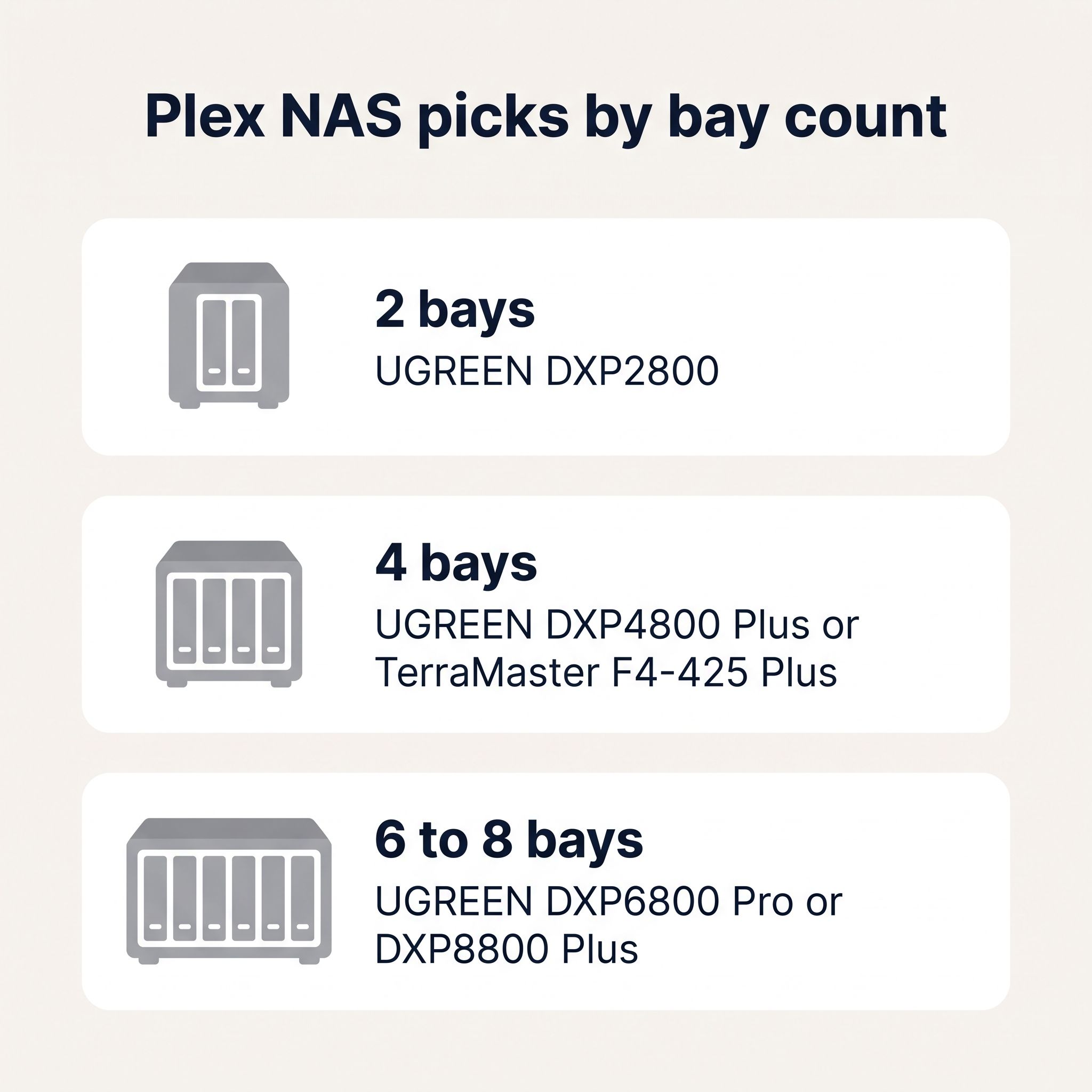
| UGREEN DXP2800 | 2 | Intel N100 | Yes, with HDR tone mapping | $389.99 |
| TerraMaster F4-425 Plus | 4 | Intel N150 or N95 | Yes, with HDR tone mapping | $509.99 to $649.99 |
| UGREEN DXP4800 Plus | 4 | Intel Pentium Gold 8505 | Yes, with HDR tone mapping | $656.99 |
| UGREEN DXP480T Plus | 4 M.2 SSD slots, no hard drive bays | Intel Core i5-1235U | Yes, with HDR tone mapping | $899.99 |
| UGREEN DXP6800 Pro | 6 | Intel Core i5-1235U | Yes, with HDR tone mapping | $1,099.99 |
| UGREEN DXP8800 Plus | 8 | Intel Core i5-1235U | Yes, with HDR tone mapping | $1,369.99 |
| UGREEN DXP4800 GT | 4 | AMD Ryzen Embedded R2514 | SDR only, unofficial | $559.99 |
| AOOSTAR WTR PRO 5825U | 4 | AMD Ryzen 7 5825U | SDR only, unofficial | $379.00 barebone |
| Minisforum N5 Air | 5 | AMD Ryzen 7 255 or Ryzen 5 7640HS | SDR only, unofficial | from $495.00 barebone |
| AOOSTAR WTR MAX | 6 | AMD Ryzen 7 PRO 8845HS | SDR only, unofficial | from $659.00 barebone |
| Minisforum N5 Pro | 5 | AMD Ryzen AI 9 HX PRO 370 | SDR only, unofficial | from $899.00 barebone |
| Synology DS925+ | 4 | AMD Ryzen Embedded V1500B | None | $700.00 |
The barebone AMD boxes ship without memory, and the AOOSTAR units also ship without a NAS operating system, so they cost more than the list price once you add memory and an operating system.
The picks
Our pick for most Plex libraries is the UGREEN DXP4800 Plus
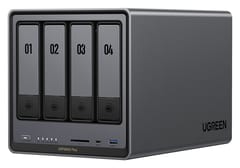
UGREEN NASync DXP4800 Plus
Editor's ChoiceThe DXP4800 Plus pairs four bays with an Intel chip that Plex fully supports, at a list price of $656.99. Four bays let you run RAID 5 with one drive’s worth of protection, which is the usual layout for a media library that will keep growing. The 12th-generation Pentium Gold 8505 scores about 70 percent higher than the N100 in budget boxes on PassMark’s CPU benchmark, so the CPU has room for Plex’s library scans, thumbnail generation, and a few Docker apps while Quick Sync handles the transcode. WunderTech’s July 2026 Plex roundup also names it the top pick. The rest of the box is 8GB of DDR5 that expands to 64GB, one 10GbE port and one 2.5GbE port, two M.2 slots, and a 128GB system SSD.
UGREEN’s UGOS Pro has no native Plex package, so Plex runs as a Docker container that you set up yourself, and you have to give that container access to the graphics device before Quick Sync will work. UGREEN’s own Plex vs Jellyfin guide lists Plex as “Runs through Docker.” The DXP4800 Plus also drew about 24 watts at idle with four hard drives spinning in KitGuru’s test, or about 210 kWh a year for a box that never sleeps.
The UGREEN DXP2800 brings Quick Sync to a two-bay budget
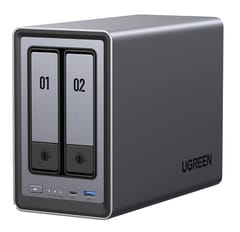
The DXP2800 carries the same Quick Sync engine in an Intel N100, with 8GB of DDR5, two M.2 slots, and one 2.5GbE port, for $389.99. Lon.TV tested an N100 mini PC as a Plex server and found that a 4K VP9 video and a Blu-ray MKV “were both transcoded without significant CPU load,” and that with five concurrent transcodes “the CPU usage only reached about 35%.” The DXP2800 uses the same chip, so it has room for several streams at once from one shared library.
Mirrored, two drives give you one drive’s worth of space, and a growing 4K library fills that quickly. Memory tops out at 16GB, and there is no path past 2.5GbE. It fits a library that sits comfortably on one large mirrored drive, or a NAS that is mainly a Plex server with backups on the side.
The TerraMaster F4-425 Plus costs less for four bays
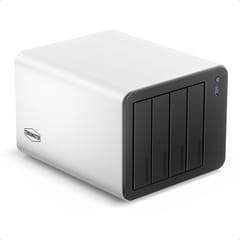
The F4-425 Plus in its Intel N95 version with 8GB of DDR4 lists at $509.99, about $147 less than the DXP4800 Plus, and the Intel N150 version with 16GB of DDR5 lists at $649.99. Both have Quick Sync, three M.2 slots, and two 5GbE ports, twice the speed of the DXP2800’s single 2.5GbE port.
The N150 version costs within about $7 of the DXP4800 Plus, which has the stronger CPU and a 10GbE port, so the N95 version is the one that saves money. Plex’s download page lists TerraMaster packages for TOS 4 through TOS 6, while new units ship with TOS 7, so you may end up running Plex in TerraMaster’s Docker app instead of as a native package.
The DXP6800 Pro and DXP8800 Plus add bays and a faster i5
UGREEN NASync DXP8800 Plus
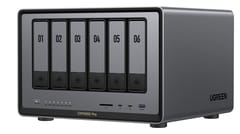
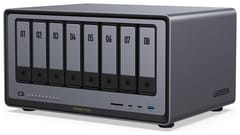
Most ExpandableFor a library that will outgrow four drives, or a household that wants RAID 6 with two-drive protection, the DXP6800 Pro has six bays for $1,099.99, and the DXP8800 Plus has eight bays for $1,369.99. Both use a 10-core Intel Core i5-1235U with Quick Sync and two 10GbE ports. The i5 scores about 40 percent higher than the DXP4800 Plus’s Pentium on PassMark, which helps when Plex shares the box with virtual machines or many Docker apps. Marius Hosting tested the DXP8800 Plus and confirmed that Plex installs with hardware transcoding.
Both cost more per bay than the DXP4800 Plus, and the six-bay draws more power: Notebookcheck measured the DXP6800 Pro at 37 to 42 watts idle with four hard drives installed. Their Quick Sync media engine is the same Intel generation as the Pentium’s, so the extra money mostly buys bays and CPU rather than transcoding speed.
The DXP480T Plus has the same i5 and transcodes as well, but it holds only four M.2 SSDs, which top out at 32TB before any RAID protection. Flash costs far more per terabyte than hard drives, so it suits a small server for a modest library rather than a large movie collection.
Direct play needs no transcoding, and mismatched files do
When a TV or phone asks Plex for a movie, Plex first tries direct play, which sends the file unchanged. Plex’s direct play guide says that works when the device supports the file’s container, codecs, resolution, and bitrate. A modern smart TV on your home network usually plays H.264 and HEVC files directly, and in that case the NAS does almost no work. Any NAS on this list, including the Synology, can serve a household that only watches that way.
A phone on cellular data needs a lower bitrate, an older streaming stick may not decode HEVC, and a subtitle format the device cannot draw gets burned into the picture, which Plex says “requires a full transcode of the video stream.” A 4K HDR movie sent to a non-HDR screen needs tone mapping as well, or the colors look washed out. Each of those jobs means decoding the video and re-encoding it in real time.
A graphics engine with a hardware video encoder does that job with little CPU load, which is also why an Intel mini PC makes a good Plex server. Plex’s hardware-accelerated streaming page says Intel hardware encoding on Linux and Windows has no “artificial limit to the number of simultaneous videos,” and Plex’s tone mapping page lists hardware tone mapping for Intel and NVIDIA. On Linux and NAS systems it needs an Intel chip from the Kaby Lake generation (7th-generation Core) or newer, which every Intel NAS on this list clears.
Plex charges for hardware transcoding
Plex Pass costs $6.99 a month or $69.99 a year after the April 2025 price increase, and a lifetime pass rose to $749.99 on July 1, 2026, according to Plex’s announcement. Hardware transcoding needs a pass, and without one Plex transcodes on the CPU even on a NAS with Quick Sync. Since 2025, streaming your own media outside the home also requires Plex Pass or Plex’s cheaper Remote Watch Pass.
Over three years, the yearly plan adds about $210 to the cost of a Plex server. Jellyfin, a free and open-source media server, does hardware transcoding without a subscription and supports AMD graphics, and it runs in Docker on any of these boxes, including the barebone AOOSTAR units once you install TrueNAS, Unraid, or Linux.
AMD-based NAS units are a weaker Plex choice
Plex added hardware transcoding for AMD graphics on Linux in 2023, but only for SDR video. Plex’s tone mapping documentation has no AMD entry, and its transcoder settings page marks HEVC encoding “(AMD is not supported).” A Plex forum moderator described the state in April 2025 as “only partial HW ( up to HEVC SDR) support for AMD gpus in the transcoder.” In a June 2026 Plex forum report, a Radeon 780M owner reported that hardware encoding failed in the Plex phone apps while it worked in Plex Web, and that rolling back to Plex Media Server 1.42.2 fixed it, which points to a regression in later releases.
That affects every AMD box with Radeon graphics in the table. The AOOSTAR WTR PRO 5825U and WTR MAX and the Minisforum N5 Air and N5 Pro all have far more CPU than the Intel N100 or Pentium, so their Ryzen cores have more headroom for CPU transcoding. The DXP4800 GT is the exception to that CPU point, with a Ryzen Embedded R2514 that sits between the N100 and the Pentium. The AOOSTAR and Minisforum boxes are better homelab machines for virtual machines and many containers. For Plex, they can transcode SDR video only when the client and driver cooperate, and they cannot tone map HDR on the GPU. If you want one of these boxes, run Jellyfin on it, or keep your library in formats your TVs direct play.
The Synology DS925+ cannot transcode in hardware
The DS925+ uses an AMD Ryzen Embedded V1500B, a 2018 chip with no integrated graphics. Plex still publishes a package for DSM 7.2.2 and later, so Plex installs and runs, but every transcode lands on four CPU cores that score below an Intel N100. WunderTech’s roundup notes that Synology “moved the DS925+ and DS1525+ to AMD processors with no integrated GPU,” so “hardware transcoding is gone from the current Plus lineup.”
The DS925+ is still a good backup and photo NAS, with ECC memory and the DSM apps that our UGREEN vs Synology comparison weighs against UGREEN’s, and it can serve Plex to clients that direct play. If you already own one, you can leave the library on it and run Plex on a small Intel mini PC that reads the files over the network.
A mini PC can do the Plex part instead
Splitting the work keeps storage on the system you trust for backups and puts transcoding on a cheap, low-power Intel N100 or N150 mini PC. That mini PC reads the library over the network from any NAS, including a Synology or an older box without graphics, and you can replace it later without touching the storage. The cost is two boxes to power and update, so for a new build with no hardware yet, one Intel NAS is simpler. A third option is a mini PC used in place of a NAS, which holds the drives and runs Plex in one box.